Students planning their first food shop
You’re looking for a pack of rusks that suits what you’ll actually eat for breakfast or as a snack, without building up a stock of unused food.


For your first food shop after moving into student accommodation, choose an amount of rusks you can eat and keep somewhere dry, rather than automatically opting for a large pack. If you’re looking for a particular recipe, check the ingredients, allergens and nutritional information per 100 g for the exact product.
You’re looking for a pack of rusks that suits what you’ll actually eat for breakfast or as a snack, without building up a stock of unused food.
You’d like to shop less often, but need to consider how much space you have and keep your rusks away from damp.
You’re looking for a particular recipe and need to check the label on the product you choose, especially its ingredients, allergens and nutritional information.
When stocking up for the first time, start with how much you’ll eat, then check how you can store the pack and what it contains.
| What to consider | What to check | Who is it for? |
|---|---|---|
| Amount for your first food shop | Compare the net weight and number of rusks with how much you expect to eat. | I want to stock up for the first time without buying a pack I’ll leave untouched; around 50% of consumers prioritise buying products that suit how they’ll use them. |
| Pack size and storage | Check that you’ll be able to finish the pack and store it away from heat and damp. | If I live alone or have a small cupboard, a large pack is only worthwhile if I can keep it dry; around 30% of consumers prioritise having a convenient supply without waste. |
| Ingredients | Read the ingredients and allergen information; compare the sugar, salt and fat content per 100 g to suit your needs. | A product described as wholegrain or as having a particular recipe may not meet my dietary requirements; around 20% of consumers prioritise the ingredients in the exact product. |
Auchan’s product listings for 750 g and 900 g packs of rusks say they should be kept away from heat and damp. If a pack goes soft, you may not finish it.
Choose a pack size that suits how much you eat, and keep it closed in a dry cupboard.
Ingredients and warnings about possible traces vary between products. The fact that a standard rusk contains wheat doesn’t tell you what’s in an entire range, either.
Check the ingredients, allergen information and any trace warnings on the packaging of the exact product you’re buying.
Terms such as ‘wholegrain’, ‘organic’ and ‘no added sugar’ describe different features and don’t sum up a product’s nutritional information.
Start by deciding which feature matters to you, then compare the ingredients and nutritional values per 100 g.
Carrefour’s Nature product contains 34 rusks in a 300 g pack.
E.Leclerc’s range includes wheat rusks, including a 900 g pack of 108 rusks, as well as other recipes.
Auchan offers, among other products, a 750 g pack of 100 Pouce rusks and a 900 g pack of 108 Auchan wheat rusks.
Auchan’s Heudebert range includes several rusk recipes and pack sizes, including a 290 g product made with 96% cereals.
ALDI offers a 300 g pack of BON&BIO® rusks made with wheat germ.
Lidl’s Point chaud range includes a ‘Sliced bread and rusks’ category.
These two 300 g packs of Heudebert rusks are a good fit if you’re looking for a moderate pack size for your first food shop. Compare their labels to find the recipe you want.
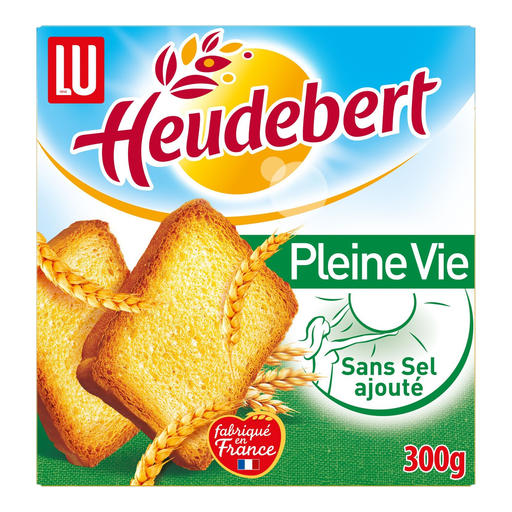 Image unavailable
This 300 g pack may suit moderate consumption. If you’re specifically looking for a recipe with no added salt, check this claim along with the ingredients and allergen information on the packaging.
 Image unavailable
This 300 g pack may suit you if you’d rather start with a moderate amount. If the ingredients matter to your choice, check the ingredients list and allergen information for this product.
Keep the pack closed in a dry place, away from heat and damp. Auchan’s listings for the 750 g and 900 g packs warn that the rusks are sensitive to these conditions, so choose an amount you can use while they’re stored properly.
Read the ingredients, allergen information and trace warnings on the packaging of the exact product. The DGCCRF notes that allergenic ingredients must be highlighted on the label; recipes and trace warnings can vary from one pack to another.
Compare the values given per 100 g, rather than serving sizes that differ. The DGCCRF says this format makes it easier to compare nutritional information between products. Focus on the details that matter to you, such as sugar, fat or salt.