A versatile first shop
You want rusks to spread at breakfast, but don’t want to start with a large pack. Carrefour and Auchan product listings include options with 32 to 36 slices, so you can compare the recipe and net weight.


For a versatile first shop, a wheat or cereal recipe in a pack of 32 to 36 slices is a practical starting point. Then compare the nutritional information per 100 g, ingredients and allergens for the exact product: the term “medium sliced” doesn’t tell you how thick the slices are or whether to choose a plain, cereal or brioche-style recipe.
For your first food shop, the right quantity depends as much on how you’ll use the rusks as on the recipe. A pack for a few breakfasts won’t suit the same needs as a supply you’ll use regularly.
You want rusks to spread at breakfast, but don’t want to start with a large pack. Carrefour and Auchan product listings include options with 32 to 36 slices, so you can compare the recipe and net weight.
You check the ingredients, allergens and nutritional values per 100 g first. This lets you compare sugars, fat, fibre and salt without relying on the recipe name alone to tell you what’s inside.
A larger pack could save you frequent trips to restock, provided you can keep it dry after opening. Check the number of slices, best-before date and storage instructions on the packaging.
Start with the quantity and recipe that suit your needs, then check the label for the variant you’ve chosen. According to the DGCCRF, nutritional values per 100 g make it easier to compare products.
| Criteria | What to check | Who it matters to |
|---|---|---|
| Pack size and recipe | Number of slices, net weight and ingredients in the wheat or cereal recipe. | If you want to top rusks for different breakfasts, you may first look for a pack that’s easy to add to your first food shop. Around 30% of consumers put this versatility first. |
| Nutritional composition | Sugars, salt, fibre and fat per 100 g for the exact variant. | If you’re considering both the plain recipe and the brioche-style flavour, their nutrition tables can help you choose based on what matters to you. Around 30% of consumers say composition is their top priority. |
| Allergens | Ingredients and allergens listed on the pack, including any ‘may contain’ warnings. | If you need to avoid an ingredient, the words “cereal” or “brioche-style” won’t tell you whether a particular product is suitable. For around 20% of consumers, checking allergens takes priority over pack size or flavour. |
| Quantity and storage | Number of slices, best-before date and storage instructions. | For a household that eats rusks regularly, reducing the need to restock only makes sense if the pack can be stored properly once opened. Around 20% of consumers prioritise quantity and storage. |
On its own, this expression doesn’t let you compare slice thickness or pack contents. Carrefour and Auchan listings, for example, give the net weight and number of slices.
For your first food shop, start by choosing a quantity that suits how much you’ll eat, then check the recipe. If slice thickness matters for your toppings, check this detail for the exact product.
“Brioche-style”, “cereal” and “fibre” refer to different recipes, but don’t sum up all their nutritional values or allergens. For example, Auchan lists 13 g of sugars per 100 g for its brioche-style version, compared with 6.9 g for its wheat version.
Compare the nutritional information per 100 g, then read the ingredients list and allergen information for the variant you’re thinking of buying.
A 60-slice pack, such as Carrefour’s Heudebert Braisor product, is mainly suited to regular consumption. Once opened, exposure to moisture can make the rusks lose their crunch.
Check the best-before date and instructions on the pack. Once opened, seal it carefully and store it somewhere dry.
These ranges offer recipes and pack sizes to consider. The details of one product don’t necessarily apply to other products from the same brand.
The range includes 96% cereal, Fibres +, Braisor and brioche-flavour rusks. It gives you several recipes from the same brand to compare.
Its wheat and brioche-flavour rusks let you compare a plain recipe with a flavoured one, both in a stated pack size of 36 slices.
Carrefour offers plain, six-cereal, wholemeal and no-added-salt rusks, so the first choice is the recipe you’re looking for.
Its six-cereal and seed product listed by Auchan contains 36 rusks and weighs 300 g.
ALDI France lists a wheatgerm rusk in a 300 g pack, distinct from crispbreads.
These two 300 g packs are options to consider for breakfast or toast-style toppings. One is described as a plain recipe, while the other is labelled “no added salt”. If the number of slices will determine your choice, check it on the pack.
 Image unavailable
A plain recipe to consider if you’re looking for rusks to top at breakfast. The listing states 96% wheat flour, 5.7 g of sugars and 1.13 g of salt per 100 g. Check the number of slices and allergen information on the exact pack before choosing this size.
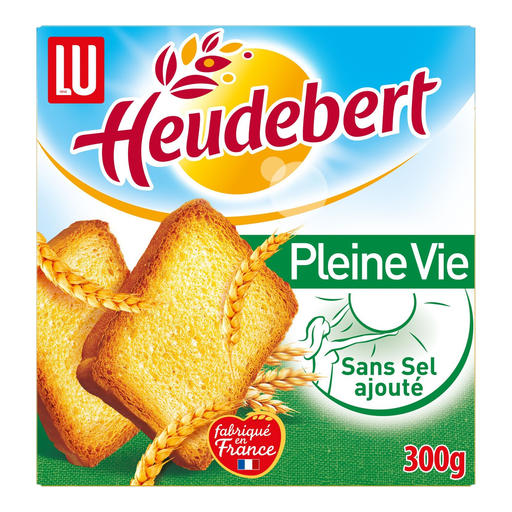 Image unavailable
Worth considering if “no added salt” is one of your criteria for rusks to top. The listing gives 0.01 g of salt per 100 g and identifies gluten, as well as possible traces of sesame. Check this information and the number of slices on the exact packaging.
On its own, this expression doesn’t tell you how thick the slices are, so it’s not a useful way to compare packs. For your first purchase, look instead at the number of slices, net weight and recipe. If thickness matters for how you’ll use them, check the exact product.
Start by comparing their nutritional values per 100 g: the DGCCRF says this makes products easier to compare. The number of slices and net weight will then help you choose a quantity that suits how much you’ll eat.
Read the ingredients list, highlighted allergens and any ‘may contain’ warnings on the exact pack. The recipes mentioned here may contain wheat or other gluten-containing cereals. Depending on the variant, sesame or dairy ingredients may also be relevant.
Follow the packaging instructions and seal the pack carefully after opening, keeping it away from moisture. Auchan specifically notes that its wheat product should be kept away from heat and moisture. Also check the best-before date before buying a pack you intend to use over a longer period.