Households that eat rusks regularly
If rusks are part of your breakfast almost every day, a large pack could suit your routine. Carrefour and Auchan, for example, offer pack sizes from 800 to 900 g. Make sure you can store them somewhere dry.


If you regularly enjoy rusks with your tea, a large pack of plain rusks could suit you, provided you finish it before they lose their crunch and can store them somewhere dry. If you only eat them occasionally, choose a quantity that suits your needs. And if the recipe matters most, compare the ingredients and nutritional information for the specific products before making your choice.
If rusks are part of your breakfast almost every day, a large pack could suit your routine. Carrefour and Auchan, for example, offer pack sizes from 800 to 900 g. Make sure you can store them somewhere dry.
Whether you’re enjoying them with a drink or adding a topping, you can choose from plain, wholemeal, multigrain or brioche-style recipes. The ranges from Carrefour and E.Leclerc illustrate these recipe differences, so check the details on the pack you’re interested in.
If you need to avoid an ingredient or want to compare nutritional values, the label on each product is key. The DGCCRF notes that allergens must be highlighted in the ingredients list on prepacked foods, while the nutrition declaration makes it possible to compare products per 100 g.
When choosing rusks to serve with tea, start by considering how often you eat them and how much you’ll be able to store. Then take a closer look at the recipe.
| Criteria | What to check | Who is it for? |
|---|---|---|
| Quantity for regular use | Net weight and number of rusks; how much your household gets through. | If rusks are a regular part of breakfast, I want a pack that keeps up with my routine without needing to shop too often. Around 36% of consumers would put quantity first for regular use. |
| Storage | Pack size and storage instructions after opening. | If I only have tea occasionally, I’d rather finish my rusks while they’re still crisp. Storage would be the top priority for around 29% of consumers. |
| Ingredients | Ingredients list, allergens and nutritional information per 100 g. | Before buying, I need to know exactly what the recipe contains, especially if there’s an ingredient I need to avoid. Around 21% of consumers would put this check first. |
| Flavour and recipe | Plain, wholemeal, multigrain or brioche-style, depending on the product. | When I’m having rusks with tea, I mainly want a recipe I enjoy. Around 14% of consumers would put flavour ahead of the other criteria. |
Auchan product listings note that some rusks are sensitive to heat and humidity. A 750 or 900 g pack may lose its crunch if you don’t eat rusks very often.
Choose a quantity you can finish, and follow the storage instructions on the packaging.
Some of the pack may no longer be enjoyable if the rusks go soft before you’ve eaten them.
Heudebert and Auchan product listings mention wheat in some products, as well as possible traces that vary by product. You can’t tell what a rusk contains just from its simple appearance.
If you need to avoid an allergen, read the ingredients list and any trace warnings on the pack you buy, rather than relying on a photo or range name.
These ranges offer a useful guide to pack sizes and recipes. Always check the specific product before buying.
Carrefour offers plain rusks, as well as wholemeal, multigrain, no added salt and brioche-style recipes.
The range featured by E.Leclerc includes wheat rusks, six-grain rusks and very low-salt rusks, as well as crispbreads.
Auchan offers 900 g packs of wheat rusks and 750 g packs of Pouce rusks.
Heudebert offers, among other products, a variety described as containing 96% cereals.
Aldi France offers wheatgerm rusks in a 300 g pack.
This selection features a 300 g pack of unsalted Heudebert rusks, worth considering if the recipe is important to you for breakfast or with tea.
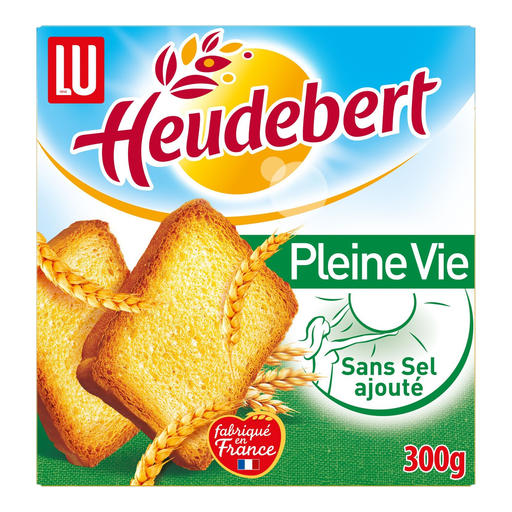 Image unavailable
This 300 g pack is a good option if you prefer a recipe described as unsalted to enjoy with your morning tea. If the ingredients or allergens are important to your choice, check the information on the pack.
Choose according to how often you eat rusks and whether you can keep them somewhere dry after opening. The net weight and number of rusks will help you judge whether you’ll finish the pack while they’re still crisp.
No. These names describe recipes that you should assess individually; they don’t tell you whether a product is right for your needs. Compare the ingredients and nutritional values per 100 g, particularly fibre, sugars, salt and fat. The DGCCRF notes that presenting this information per 100 g makes it easier to compare prepacked foods.
Read the label on the pack you buy, including the ingredients list and any trace warnings. The DGCCRF states that allergens in prepacked foods must be highlighted in the ingredients list. Product listings for some Heudebert and Auchan rusks show that information about wheat and possible traces varies by product.
Reseal the pack and store it away from heat and humidity, following the instructions on the packaging. Auchan’s listings for its wheat rusks note that they are sensitive to these conditions. If you only eat rusks occasionally, a smaller pack may suit you better.