
Livraison le jour même ou le lendemain

Qualité garantie

Débloquez vos offres de bienvenue: Livraison GRATUITE | Jusqu'à -80 % | 30 jours d'essai gratuits à JoyPlus
Téléchargez l'application
Condensation on windows, a musty smell in a cupboard or persistent damp in a car: a Rubson moisture absorber can be a practical solution when you're looking for a silent device that doesn't need electricity. But you still need to choose the right format and understand the limits of each product.
A moisture-absorbing sachet designed for a wardrobe or a shoebox cannot be compared to a dehumidifier intended for a 20 m² room. Always check the stated coverage area and the airflow around the product.
The price of the device is only part of the budget. A crystal model requires regular purchases of moisture absorber refills. So compare how many refills are included, their weight, and the replacement frequency stated for the area and humidity level.
An anti-odour moisture absorber can help reduce smells linked to a confined space. However, it does not replace ventilation, finding a leak, or repairing an infiltration problem. Similarly, an anti-mould moisture absorber acts on the conditions that favour damp, but does not substitute for cleaning mould that has already formed.
Start by identifying the use:
The stated area is a usage guideline. A very cold, poorly ventilated or particularly damp room can saturate a refill more quickly.
Models that don't need plugging in generally use crystals or hygroscopic beads. The moisture is turned into gel in some sachets, or into liquid water in a device with a tank. This difference affects maintenance:
In a bedroom or office, silent operation can be more comfortable than a motorised device. Regular ventilation is still useful to refresh the air.
Before ordering refills, check their format and weight. Rubson AERO 360° tablets of 450 g are stated as compatible with AERO 360° devices and with certain refillable absorbers that accept this weight.
Place the device on a stable surface, away from a heat source and direct light. Do not put it in an area intended for food storage. The crystals and collected liquid must not be ingested; keep products out of reach of children and pets. In case of contact with eyes or skin, follow the instructions on the packaging.
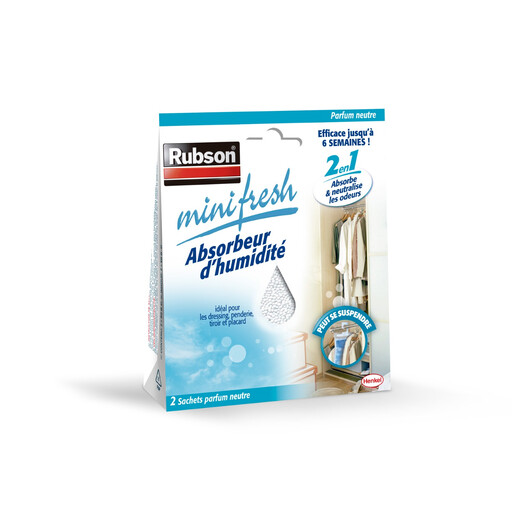
Why this choice suits this profile: This ready-to-use format is ideal for cupboards, drawers, wardrobes and shoe storage of 1 to 2 m², with no device to install.
The usage area is clearly limited to small spaces, which reduces the risk of choosing it for a room that is too large.
Two 50 g sachets, hygroscopic beads that turn into gel and a neutral scent. Replace when the gel has formed.
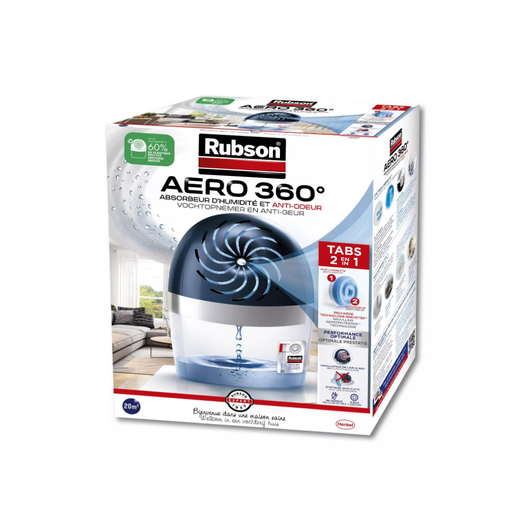
Why this choice suits this profile: Its change indicator, air circulation system and 450 g refill meet the expectations of regular household use.
The stated capacity of 20 m² prevents confusing a room-sized format with a sachet intended for a cupboard.
Electricity-free, silent operation, refill indicator and plastic stated as 60% recycled.
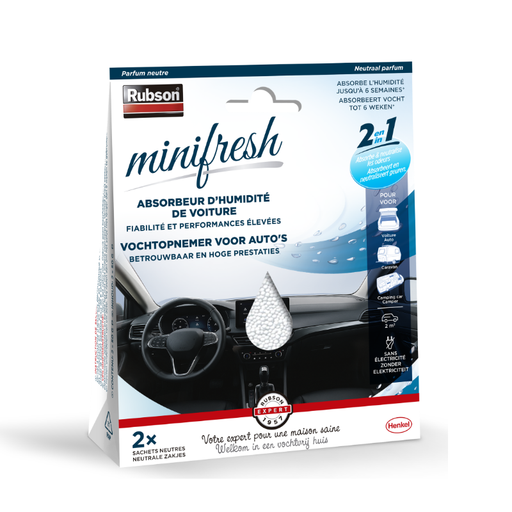
Why this choice suits this profile: This compact model is designed for the car, motorhome or caravan, as well as small boots and closed lockers.
Its use is targeted at spaces of 1 to 2 m², rather than being presented as a solution for the whole vehicle or home.
Hanging sachet, neutral scent, action against moisture and odours. Do not cover the white face when installing.
We have compiled a complete, real-time updated list of products that fully meet these strict selection criteria and European safety regulations.
The duration depends on the area, temperature and humidity level. The product sheets state around two months for certain 300 g refills in a 10 m² room, while a Minifresh sachet can be stated as lasting up to six weeks. Check the state of the gel or the saturation indicator rather than relying solely on a fixed duration.
Install a model designed for this use in a stable, clear space, without contact with controls, delicate fabrics or electrical equipment. In a car, Minifresh sachets are intended for small volumes. Remove the outer packaging and follow the positioning instructions.
It can help reduce humidity in an area suited to its capacity, without noise or electricity consumption. If condensation returns despite ventilation, look for a persistent cause — infiltration, poor ventilation or a very cold wall — and don't rely solely on the absorber.