
Livraison le jour même ou le lendemain

Qualité garantie

Débloquez vos offres de bienvenue: Livraison GRATUITE | Jusqu'à -80 % | 30 jours d'essai gratuits à JoyPlus
Téléchargez l'application
The round dining table is the promise of convivial meals. It encourages conversation, optimises space, and softens a room's sharp corners. But be warned: choosing the right model can be a real challenge. Between tempting marketing and hidden design flaws, it's easy to make a purchase you'll regret. As a product expert for Joybuy, my mission is to guide you. Let's break down the common pitfalls to avoid and the criteria that truly matter for making an informed choice.
Before you fall in love with a model from a photo, beware of these three recurring problems that can turn your dream table into a daily nightmare.
To avoid these pitfalls, focus on objective criteria. These are the true guarantors of a table's quality and suitability for your home.
The number of guests you can host depends directly on the diameter. Here are a few simple guidelines for your round kitchen table or dining room table:
Rule of thumb: Allow at least 70 cm of free space all around the table for chair clearance and foot traffic. The ideal? 90 cm for absolute comfort.
The design of the base isn't just a matter of style. It's crucial for the table's stability and the amount of legroom available.
Models of wood and metal round tables play on this contrast: they combine the warmth of a wooden top with the sturdiness of a metal base. It's a very on-trend combination, perfect for an industrial style or a modern dining room table.
The tabletop material has a direct impact on the look, maintenance, and lifespan of your table.
Here are a few models that meet specific needs, all evaluated against the quality and functionality criteria we've just discussed.
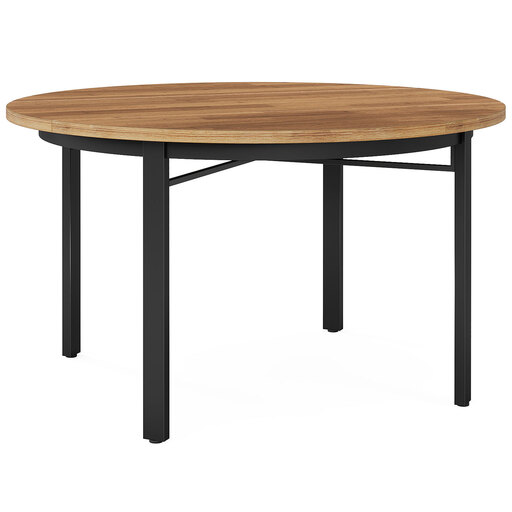
Why this model stands out: Perfect for families or couples in apartments. Its 118.5 cm diameter is an excellent compromise for comfortably seating 4 to 6 people without overcrowding the room. Its modern rustic style integrates easily into many interiors.
Its four slim metal legs ensure excellent stability (pitfall #1 avoided). Its diameter is perfectly calibrated for 4 to 6 people, which eliminates the risk of a sizing mistake. The MDF tabletop is advertised as waterproof, a good sign for handling everyday spills.
The combination of the wood-effect top and black metal legs gives it a light and versatile industrial style. Practical bonus: the adjustable feet allow you to compensate for minor floor irregularities.
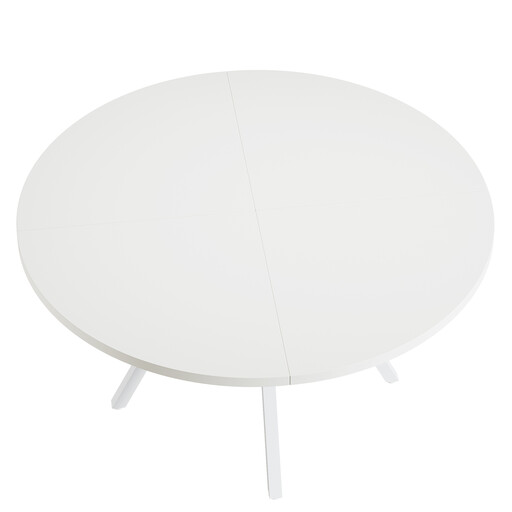
Why this model stands out: Ideal for those who love to entertain. Capable of seating up to 8 guests, it includes a storage shelf that makes it as convivial as it is ultra-functional. Perfect for keeping placemats and dishes within easy reach.
The X-shaped central base is designed for maximum stability, neutralising the main flaw of single-pedestal tables. The product description mentions heat, scratch, and water resistance, which is reassuring regarding the fragility of the finish.
The integrated table with storage is its strong suit. A two-in-one solution that maximises practicality without sacrificing style. The central pedestal ensures completely unobstructed legroom.
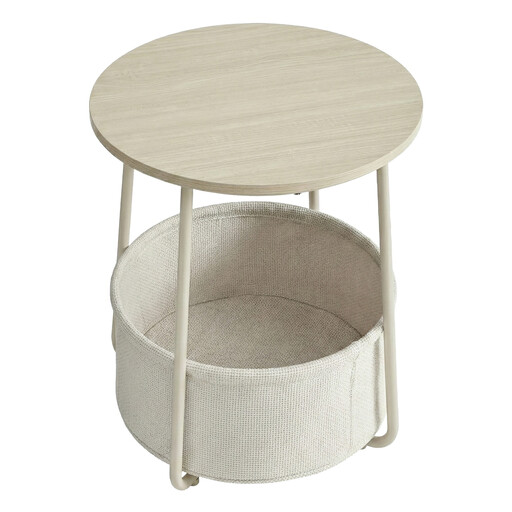
Why this model stands out: Note, this is not a dining table. It's the perfect solution for a reading nook, as an end table, or for a coffee corner. Its minimalist design and fabric basket make it an accent piece that is as stylish as it is practical for storing small everyday items.
Its use is clearly defined as an accent piece, which avoids the pitfall of incorrect sizing for a meal. Its steel frame is designed to be perfectly stable for its role (supporting a book, a cup, a plant), and its adjustable feet protect the floor.
The fabric storage basket is a smart and stylish addition. It offers discreet storage for remote controls, magazines, or a throw blanket, all while preserving the clean design.
We have selected a full range of products that meet these quality criteria and current safety standards.
The longevity of an MDF (medium-density fibreboard) table depends primarily on the quality of its finish. A model with a thick, well-sealed melamine finish, advertised as water and scratch-resistant, can last for many years with simple care. The best practice: always use placemats and trivets, and wipe up any spills immediately.
To be comfortable, allow a clearance of at least 70 cm between the edge of the table and the wall (or another piece of furniture). This is the minimum required to push back a chair without obstruction. For truly smooth traffic flow, even when someone is seated, aim for 90 to 100 cm.
Yes, provided it is well-designed. The stability of a pedestal table rests on two pillars: the weight and the width of its base. A heavy, wide base, or a cross-shaped structure like on some of our models, anchors the table to the floor and prevents it from tipping, even if you lean on the edges. It's a highly sought-after design for the legroom comfort it provides.