
Livraison le jour même ou le lendemain

Qualité garantie

Débloquez vos offres de bienvenue: Livraison GRATUITE | Jusqu'à -80 % | 30 jours d'essai gratuits à JoyPlus
Téléchargez l'application
Whether you're a passionate DIYer, a meticulous model maker, or a 3D printing enthusiast, the multifunction rotary tool has quickly become an essential part of the toolkit. Capable of sanding, engraving, cutting, polishing, and even drilling, its versatility is a game-changer. The problem? The market is flooded with models making tempting promises that can quickly lead to disappointment. To help you see clearly, we've broken down the most common pitfalls and the criteria that truly matter before you buy.
Navigating the jungle of options can quickly become a headache. Too many buyers regret their purchase due to recurring flaws, cleverly masked by slick marketing. Here are the two red flags you should never ignore.
Don't be swayed by an eye-catching wattage (W) on the box: it's an easy marketing ploy that in no way guarantees real-world performance. A poor-quality motor, even one rated at 180W, will quickly overheat, lack torque at low speeds, and wear out prematurely. A tool's true endurance comes down to its motor design. A model with copper winding, for example, will offer far better conductivity and durability than an aluminium equivalent.
A case packed with 150 accessories looks like a great deal. In reality, quality must always come before quantity. Too many entry-level kits are stuffed with sanding discs that disintegrate on first contact, bits that go dull in seconds, or imprecise drill bits. It's better to choose a rotary tool kit with fewer accessories that are well-made and genuinely designed for practical applications.
To make an informed choice, forget the marketing hype and focus on the features that truly define the tool's performance and versatility.
These two elements are inseparable. Power, measured in watts, determines the tool's ability to tackle tough materials without stalling. A 160W multi-tool represents an excellent balance for most DIY and finishing jobs.
As for rotational speed, measured in revolutions per minute (RPM), it absolutely must be variable. A speed selector isn't an option—it's essential for adapting the tool to the material:
A good precision DIY tool must be comfortable to use. Check the weight, the presence of non-slip coatings (like soft-grip), and the overall balance of the machine. Small extras, like an auxiliary handle for better control or an integrated LED light, can literally transform the user experience, especially for detailed work.
When it comes to accessories, make sure the basic kit contains the essentials for your projects: cutting discs, deburring grinding stones, cleaning brushes, polishing felts, and bits for engraving or carving. Finally, a quality chuck that securely grips the shanks is a guarantee of safety and precision that should not be underestimated.
Every project has its own requirements. To guide you, here is a selection of tools suited for specific needs.
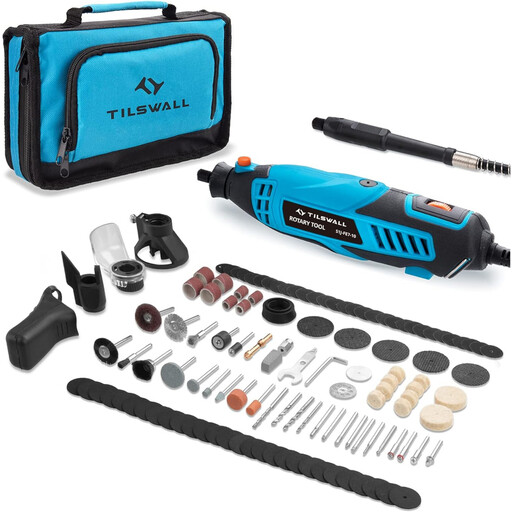
Why this model? It's an excellent, budget-friendly entry point to get fully equipped. Very comprehensive, it covers a wide range of tasks, from small repairs to creating decorative objects. A smart first purchase.
This model avoids the overstuffed kit pitfall by offering 145 genuinely useful accessories. Its 160W copper motor ensures reliable performance for this price range.
Its 160W power, 6 variable speeds (8,000-33,000 RPM), auxiliary handle, and LED light give it remarkable versatility at this price point.
Why this model?3D print finishing is precision work. This tool is perfect for removing supports, deburring edges, and smoothing PLA, ABS, or resin surfaces. Its light weight and auxiliary handle offer optimal control to avoid damaging parts.
Its low and intermediate speeds allow you to work on plastic without melting it—a classic pitfall with tools that are too powerful or lack a variable speed control. The kit includes well-suited detail sander and engraving accessories.
The LED light is a real bonus for spotting the slightest imperfection on prints. The precision handle, meanwhile, ensures a clean, professional finish.
We have compiled a complete list of products that meet our strict selection criteria and current safety standards.
1. What wattage is needed for a multifunction rotary tool? For home use and creative hobbies (engraving, model making, 3D finishing), a power rating between 130 and 160W is more than sufficient. It's the best compromise between performance and handling. Models over 170W should be reserved for more intensive jobs, like cutting thick metals.
2. Can a rotary tool be used for precision work like glass engraving? Yes, absolutely. It's one of the key applications for this type of engraving tool. To do this, you must use a suitable diamond-point bit and set the tool to a medium-to-high speed. Wearing safety glasses is non-negotiable for this kind of operation.
3. How do you maintain a rotary tool to make it last longer? Maintenance is simple but crucial. After each use, clean the air vents with a soft brush or a blast of compressed air to prevent dust from causing the motor to overheat. Remember to regularly check and clean the chuck. Finally, store the tool and its accessories in their case, away from moisture.