
Livraison le jour même ou le lendemain

Qualité garantie

Débloquez vos offres de bienvenue: Livraison GRATUITE | Jusqu'à -80 % | 30 jours d'essai gratuits à JoyPlus
Téléchargez l'application
Owning a pool is a dream. Maintaining it, not so much. Between tangled cords, robots that miss the waterline, and batteries that die mid-cycle, choosing an effective cleaner can be an uphill battle. The result: many owners end up regretting their purchase, frustrated by unfulfilled marketing promises.
This guide is here to shed light on the crucial points to check before investing in an automatic pool vacuum. We'll break down the most common pitfalls and give you the keys to choosing a model that will truly meet your expectations, with a focus on the features of the new robotic pool cleaner, the Beatbot M10.
The market for robotic cleaners is flooded with models. To make the right choice, watch out for these three often-misleading marketing claims.
Battery life is often the number one selling point. The problem: many manufacturers advertise a long-runtime pool robot measured under lab conditions, meaning in "floor-only cleaning" mode. As soon as the robot starts tackling walls and the waterline—a much more energy-intensive task—the runtime can drop by 30% to 50%. You're then left with a device that returns to its base before it has even finished its cycle.
The term "smart" is thrown around loosely. An entry-level robot often just uses a random path: it changes direction whenever it hits a wall. The result: some areas are scrubbed ten times over, while others are missed entirely. True smart navigation involves mapping the pool and following a systematic path for complete and efficient coverage.
A spec sheet might boast impressive suction power, but this number is meaningless if the filtration can't keep up. A filter with a mesh that's too coarse will let fine particles (sand, dust, dead algae) escape right back into the water. Likewise, a tiny filter basket forces you to constantly empty and clean it, defeating the whole purpose of an autonomous device.
To be sure of the performance of your future cordless robotic pool cleaner, focus on these three much more reliable technical indicators.
Rather than trusting the maximum advertised runtime, demand the runtime for a full cycle (floor, walls, and waterline). For a standard-sized pool (8x4 m), a runtime of 90 to 120 minutes for a full cycle is a good benchmark. The battery capacity, in milliampere-hours (mAh), is a much more tangible metric than the duration in minutes.
Favour models that detail their navigation technology. Terms like "smart mapping", "S-shaped path", or "systematic coverage" indicate an advanced algorithm. A good wall and waterline pool robot must be equipped with sensors (gyroscopes, accelerometers) that allow it to orient itself, adapt its path, and ensure a methodical cleaning of the entire surface, including corners and stairs.
Suction power, often indicated in litres per hour (L/h) or cubic metres per hour (m?/h), must be considered alongside two other elements:
Here are a few models that check all the boxes, catering to different needs and budgets.
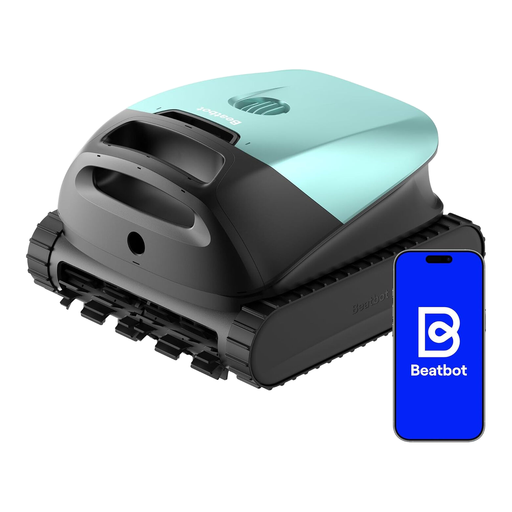
Why it stands out: Ideal for owners of large or complex-shaped pools who want a completely "hassle-free" solution. It's aimed at those who prioritise innovation, raw power, and automation taken to the extreme. The `Beatbot M10 reviews` confirm its effectiveness on all fronts.
It overcomes the battery life pitfall with a record-breaking runtime of 300 minutes and the navigation pitfall with its advanced mapping. Its 25,700 L/h power is backed by an XXL 5L filter, ensuring flawless suction and retention.
Its smart waterline parking feature is unique: the robot surfaces at the end of its cycle for effortless retrieval. Bonus: it even cleans submerged sun shelves.
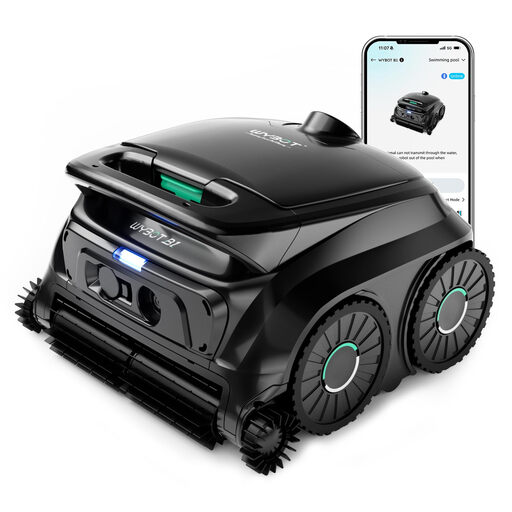
Why it stands out: Perfect for owners of standard-sized inground or above-ground pools looking for the best value for money. It focuses on the essentials (wall cleaning, smart navigation) without unnecessary frills.
It avoids the random navigation pitfall with its intelligent pathing that ensures methodical coverage. Its 120-minute runtime is realistic for a full cycle in most pools.
The ability to receive over-the-air (OTA) software updates allows it to improve its cleaning algorithms over time. It also features an automatic parking function at the end of the cycle for easy retrieval.
We have compiled a complete and up-to-date selection of products that meet our strict selection criteria and current standards.
The lifespan of a cordless pool robot primarily depends on its battery and the quality of its maintenance. Generally, a lithium-ion battery is designed to handle several hundred charge cycles (equivalent to 3 to 5 years of seasonal use) before its runtime noticeably decreases. To extend its life, it's advisable to store it in a cool, dry place and not to leave it completely discharged during the off-season.
No, and that's one of the major advantages of cordless models: their simplicity. Installation is as simple as fully charging the device before its first use, then immersing it in the water to start a cycle. No hoses to connect, no cables to untangle. Maintenance is limited to emptying and rinsing the filter basket after each use.
Absolutely. Cleaning the walls, and especially the waterline, is crucial for the hygiene and appearance of your pool. The waterline is where sunscreen, pollen, and microorganisms collect, creating a greasy film that encourages algae growth. A wall and waterline pool robot actively scrubs this strategic area, preventing stubborn stains and saving you from tedious manual cleaning.