
Livraison le jour même ou le lendemain

Qualité garantie

Débloquez vos offres de bienvenue: Livraison GRATUITE | Jusqu'à -80 % | 30 jours d'essai gratuits à JoyPlus
Téléchargez l'application
Cleaning windows, especially large bay windows or a conservatory, is a task we endlessly put off. Between the danger of ladders, the almost inevitable streaks, and the sheer amount of time it takes, the promise of a robot window cleaner is incredibly appealing. But be warned: the market is a jungle where the best products sit alongside the worst. To help you see things more clearly, we've broken down the pitfalls to avoid and the criteria that truly make a difference.
The appeal of a new gadget can sometimes mask deal-breaking design flaws that emerge over the long term. Here are the three red flags to check for before you buy.
To guarantee both efficiency and safety, three technical parameters must be examined closely. These are what separate a mere gadget from a true daily assistant.
A robot's ability to remain securely attached to the window is the number one safety criterion. This adhesion is provided by a motor that creates powerful suction. For large surfaces or windy environments, aim for a suction power of at least 5,500?Pa. But power isn't everything. A good safety system must be multi-layered: it should include a backup battery that takes over during a power outage and a sturdy safety cord to prepare for any eventuality.
A good automatic window cleaner does more than just move across the glass; it must apply the cleaning solution evenly. Multi-nozzle spray systems, such as a wide-angle triple-jet technology, tackle the most stubborn dirt even before the cleaning pad passes over. Paired with intelligent navigation (for example, WIN-SLAM 4.0), this technology ensures perfect coverage of the surface, including edges, for a completely streak-free bay window cleaning.
The concept of a robot window cleaner with a station is a complete game-changer. Far more than a simple charger, a multifunctional station serves as a control base, a carrying case, and an anchor point. It simplifies storage and ensures the robot is always ready to go. While a battery-powered cordless window cleaning robot is convenient for areas without an outlet, the combination of mains power and a battery via the station remains the most versatile and reliable solution.
Rather than an endless list, we've chosen to highlight one model that checks all the boxes for owners of large glass surfaces looking for a turnkey solution.
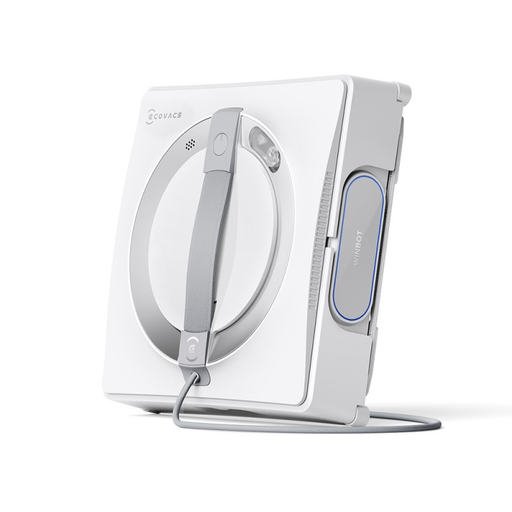
Why it stands out: Designed for large, often hard-to-reach glass surfaces (conservatories, bay windows, skylights), it offers an all-in-one solution that combines performance, safety, and sophisticated automation. It's sure to satisfy even the most demanding tech enthusiasts.
Its 12-stage protection system and 5,500 Pa suction drastically limit the risk of falling. Its 6-in-1 multifunctional station eliminates the logistical hassles of basic models. Finally, its WIN-SLAM 4.0 technology ensures a flawless clean, right to the very corners.
Its all-in-one station, which acts as a charger, carrying case, and safety base. Its wide-angle triple-jet spray technology is formidable for dissolving dirt even before the cleaning pad passes over.
Discover our full selection of products that meet our strict standards for quality and safety.
A robot window cleaner uses a motor to create strong suction that holds it against the glass, like an ultra-powerful suction cup. For foolproof security, quality models like the ECOVACS WINBOT W2 Pro Omni integrate double or even triple safety features: a backup battery to maintain suction during a power failure and a safety cord to catch the device in the unlikely event of a detachment.
Yes, advanced models are equipped with vacuum sensors, allowing them to work on frameless surfaces (like a shower screen or a glass balustrade). As it approaches an edge, the robot slows down, cleans right to the very limit, and then safely turns around.
The maintenance is minimal but essential. After each cycle, remember to remove and wash the microfibre pads. Don't forget to empty the dirty water tank (if applicable) and refill the clean water or cleaning solution tank. From time to time, a quick check of the spray nozzles is necessary to ensure they aren't clogged, especially if you have hard water. Here again, a multifunctional station will make storage and recharging much easier.