
Livraison le jour même ou le lendemain

Qualité garantie

Débloquez vos offres de bienvenue: Livraison GRATUITE | Jusqu'à -80 % | 30 jours d'essai gratuits à JoyPlus
Téléchargez l'application
A robot vacuum and mop can considerably reduce the amount of daily floor cleaning you need to do. However, you still need to choose a model that genuinely suits your home. Advertised suction power, artificial intelligence promises and all-in-one stations can make a real difference, while other features are mainly marketing claims or simply over-specified for a small home.
Before buying a robot vacuum and mop, take the time to avoid the following pitfalls.
The number of pascals, or Pa, refers to the suction pressure advertised by the manufacturer. However, this figure alone is not enough to predict performance across all floor types. The main brush, air duct design, filter, carpet handling and cleaning frequency also play a decisive role.
A model displaying 4 000 Pa can be perfectly suitable for a flat with hard floors and a typical amount of dust. For thick carpets, pet hair or larger areas, greater power provides more headroom — provided the battery and brush are up to the job.
An automatic emptying station means you do not have to empty the dustbin after every cleaning cycle, but it does not eliminate every chore. Depending on its design, you will still need to empty the dirty-water tank, refill the clean-water tank, replace the dust bag and clean the sensors.
Stations that can wash and dry the mops also require enough space near an electrical socket. Check their dimensions, the clearance required and the availability of consumables before placing your order.
Cables, toys, socks and small objects can block the robot or become wrapped around its brush. Wet areas and spilled liquids can also pose a risk to the motor. A robot vacuum for carpets and hard floors should be able to distinguish between different surfaces and, ideally, automatically lift the mop on carpets.
Before the first cleaning cycle, put away fragile items, loose cables and anything that could become tangled in the brush. This preparation remains essential, even with a connected robot vacuum equipped with advanced sensors.
A robot vacuum with LiDAR navigation uses a laser sensor to map rooms and plan its movements. This technology is particularly useful in homes with several rooms, hallways or closely spaced furniture. It generally allows you to create no-go zones, set priority rooms and manage multiple maps in a multi-storey home.
Models without advanced mapping can still be suitable for a studio flat or open-plan space. In all cases, check Wi-Fi compatibility: several devices work only on the 2.4 GHz band. The app should also offer the settings you need, such as scheduling, water flow, suction power, no-mop zones and robot status monitoring.
If you live with pets, look for a removable brush, an anti-tangle system and an easy-to-clean filter. High suction power is useful on carpets and in grooves, but it can also increase noise levels and reduce battery life.
Also remember to compare dustbin capacity. A bin of around 250 ml may be sufficient in a small home with little debris. For a family or a household with several pets, an automatic emptying station will be considerably more convenient.
Robot mopping is mainly suitable for light marks and everyday maintenance. It does not necessarily replace manual cleaning when it comes to removing ingrained stains. Check the water-flow adjustment, mop type and whether the mopping module can be removed when cleaning carpets.
The robot’s height is an important consideration if it needs to pass under a sofa or low furniture. Some ultra-slim models measure around 8 to 10 cm, while devices fitted with a LiDAR turret can be taller. For a large area, also check the stated battery life, automatic return to the station and whether cleaning resumes after recharging.
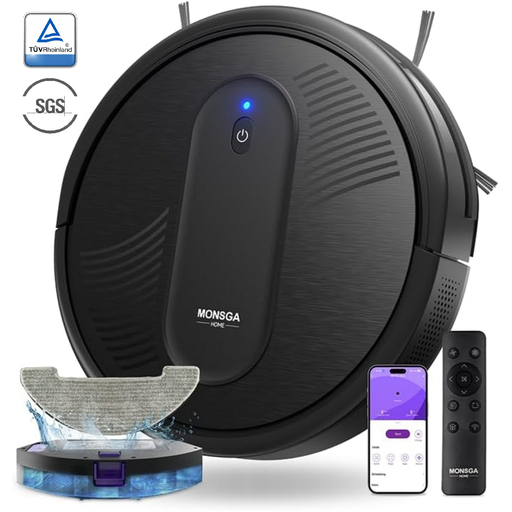
Why this choice suits this profile : With its 3.2-inch height, remote control, app and voice-assistant controls, plus automatic, spot and edge-cleaning modes, it offers an accessible introduction to robot vacuums.
The product details state 4 000 Pa suction, a 200 ml water tank and a 250 ml dustbin: concrete specifications to compare before buying.
Up to 140 minutes of stated battery life, a HEPA filter and carpet detection with automatic suction-power increase.
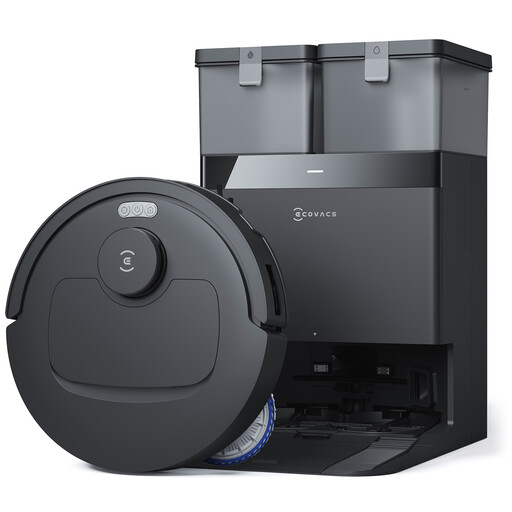
Why this choice suits this profile : This model is designed for people who want to automate vacuuming, mopping and mop maintenance across different floor types.
The station handles dust emptying, washing with hot water at 75 °C, hot-air drying and detergent dispensing.
Stated suction power of 25 000 Pa, two rotating mops, multi-floor mapping and automatic carpet detection.
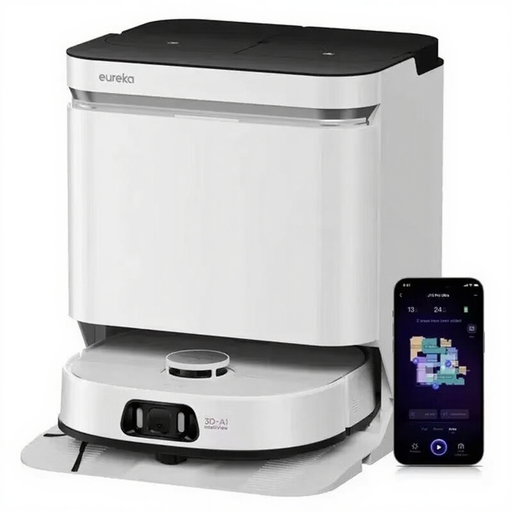
Why this choice suits this profile : Its design is well suited to homes with pets, carpets and hard floors that want regular mopping while minimising manual intervention.
The product details mention anti-tangle technology, a liftable brush and liquid detection: features that should be weighed against your actual needs.
Stated suction power of 16 200 Pa, LDS navigation, mop washing at 75 °C and drying directly in the station.
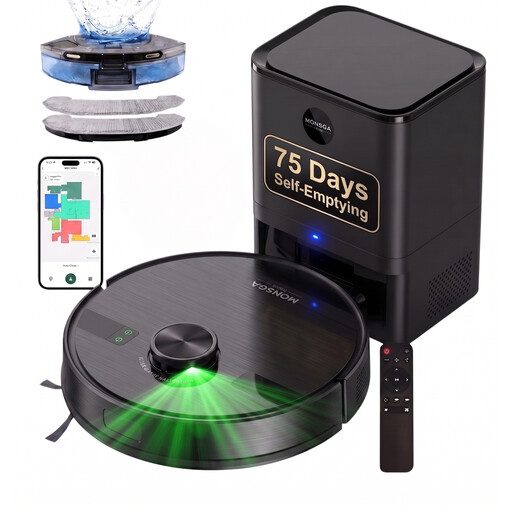
Why this choice suits this profile : Its emptying station and LiDAR mapping meet the needs of a spacious home or several areas requiring cleaning.
The product details recommend clearing away cables and fragile objects, then placing the station on a hard, stable and unobstructed floor: two precautions that are often overlooked.
Stated suction power of 9 000 Pa, a 4-litre emptying station, LiDAR navigation, up to 180 minutes of stated battery life and control via the app, remote control or voice.
We have compiled the products that fully meet these demanding selection criteria and European safety standards in a complete list updated in real time.
Yes, provided the manufacturer includes carpet detection and mop management. To prevent carpets from getting wet, remove the mopping module or set a no-mop zone. Thick carpets can also slow the robot down and reduce its battery life.
The cost is not limited to electricity consumption. You also need to allow for station bags, filters, brushes, mops and, where applicable, the recommended detergent. A highly automated station reduces the amount of handling required, but may use more consumables.
It depends on how often it is used, maintenance, the battery and the availability of spare parts. Cleaning the brushes and sensors regularly, using the robot on suitable floors and following the instructions helps preserve its performance over time.