
Same-day & Next-day Delivery

Quality Guaranteed

Unlock Your Welcome Offers: FREE Delivery | Up to 80% OFF | Free 30-day JoyPlus trial
Download the APP
Dull dishes, glasses covered in droplets, or endless drying cycles don't necessarily mean your dishwasher is faulty. The choice of rinse aid for your dishwasher, the detergent, and the dosage all directly affect the final result.
However, certain pitfalls can send your costs soaring. An "all-in-one" tablet isn't necessarily suitable for every water hardness level, a large container is only economical if you get the dosage right, and a professional formula has no place in a domestic dishwasher. Here are the points to check before you place your order.
The rinse aid product for your dishwasher mainly comes into play during the final rinse. It helps water slide off surfaces, which reduces droplets, marks, and drying time. It does not, therefore, replace a tablet, gel, or detergent powder.
If your plates come out greasy or covered in food residue, look instead at the detergent, the programme you've selected, how you've loaded the machine, or the condition of the filter.
All-in-one dishwasher tablets and some gels combine detergent, rinse aid, and regenerating salt function. This formula can simplify shopping when your water is moderately hard. However, in areas where the water is very hard, the dishwasher's salt reservoir may still be essential.
Check your appliance's manual and the setting that corresponds to the water hardness in your area before completely cutting out regenerating salt.
Adding more rinse aid doesn't automatically make your dishes shinier. Overdosing can leave a film, alter the appearance of glassware, and unnecessarily increase the cost of each cycle. The correct setting depends on your water hardness and the manufacturer's recommendations.
For domestic use, a bottle of 400 to 800 ml is often easier to store and handle. Containers of 5 or 10 litres are more suited to professional kitchens, hotels, canteens, and establishments that run an automatic dishwasher several times a day.
Compare the price per litre, but also the actual consumption per cycle. A large container is only worthwhile if you have enough space to store it and your appliance has a suitable dosing system.
A professional rinse aid should only be used with an appliance designed for this type of product, in the dedicated compartment. Professional dishwashers often use an automatic dispenser and short cycles. In all cases, the dosage recommended by the machine's manufacturer takes precedence over general advice.
Never pour a product intended for automatic rinsing into the detergent compartment. It should also not be used for hand-washing dishes.
An anti-limescale product for your dishwasher can help reduce marks caused by minerals, but it doesn't systematically replace regenerating salt. If the water in your area is very hard, check the threshold expressed in French degrees, usually indicated in °fH, then adjust the machine's setting.
Observe the result after several cycles: persistent droplets can signal a dosage that's too low, while a film or a slippery feel can indicate an excess of product.
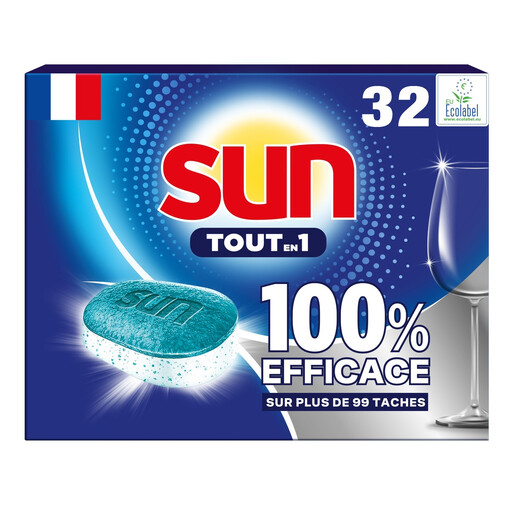
Why this choice suits this profile: With 32 washes, this format lets you try a combined solution without buying detergent, rinse aid, and anti-limescale product separately.
The formula combines the functions stated on the packaging, but you still need to check whether the water in your area requires the use of salt.
32 tablets, no pre-rinse indicated, with built-in rinse agents and anti-limescale.
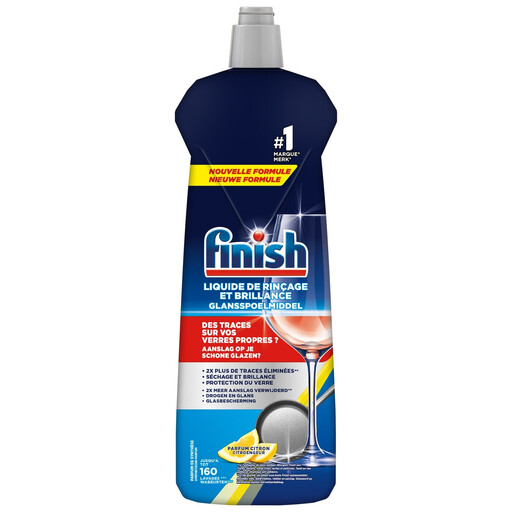
Why this choice suits this profile: This bottle is aimed at households that prefer a separate rinse aid, with a lemon fragrance and an adjustable dosage.
It doesn't claim to replace detergent: it's poured into the rinse aid reservoir, which clearly defines its role.
800 ml capacity, compatible with the programmes indicated by the brand, and dosage adjustable according to water hardness.
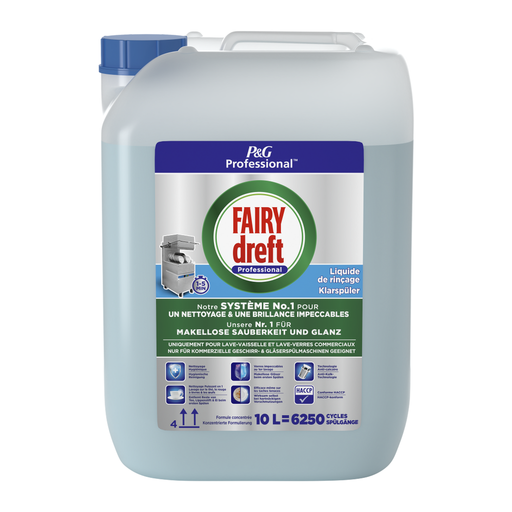
Why this choice suits this profile: With its 10 litres, this container is aimed at professional kitchens, catering establishments, and institutions equipped with an automatic dosing system.
The volume is suited to intensive use, but this product is reserved for professional dishwashers and must be adjusted according to the machine's parameters.
10 litres, use with automatic dispenser, and a formulation designed to reduce water marks and limescale deposits.
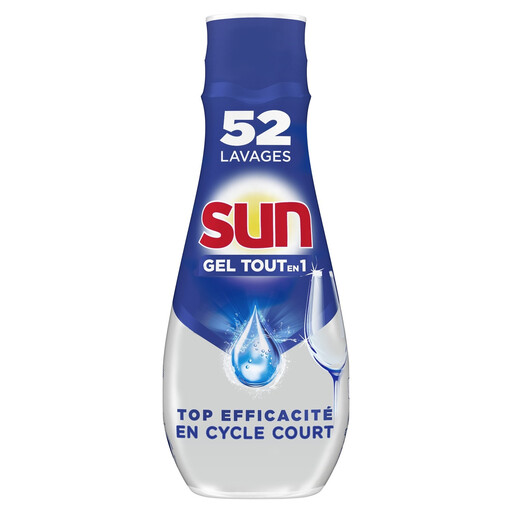
Why this choice suits this profile: The gel allows you to adapt the dose to the level of soiling, with a recommendation of 17 to 30 ml and up to approximately 52 washes claimed.
The adjustable dosage reduces the risk of waste. For very hard water, the manufacturer still recommends continuing to use salt.
900 ml gel, rinse and salt functions claimed, dosage from 17 to 30 ml depending on the level of soiling.
We've put together a comprehensive selection, updated in real time, of products that meet these demanding criteria and European safety standards.
Yes, but it's not always necessary. If the tablets already include a rinse function, start by observing the result. If you have persistent marks or insufficient drying, you can add a separate rinse aid if your dishwasher's manual allows it. However, avoid setting the dosage to maximum straight away: run several cycles first and adjust gradually.
It all depends on the capacity, the dispenser setting, your water hardness, and the number of cycles you run. A 400 ml bottle can be enough for regular use, while a professional 5 or 10 litre container is designed for much larger wash volumes. The cost per cycle is therefore more telling than the price of the container.
It can help reduce certain marks during the rinse cycle, but it doesn't necessarily replace regenerating salt or machine maintenance. In an area with very hard water, check the hardness setting, fill the salt reservoir if necessary, and regularly clean the filters and spray arms.