People who compare sugar content first
You check the ‘of which sugars’ line per 100 g and may prefer a plain cereal cake to a chocolate biscuit.


If the sugar content shown on the label is your priority, Bjorg rice and buckwheat cakes contain less than 0.5 g per 100 g. For a butter biscuit labelled ‘sugar-free’, look at Karéléa; for chocolate rice cakes in individual packets, Gerblé uses the distinct claim ‘no added sugars’. Before heading out, compare the pack size, ingredients and nutritional values too, rather than relying on the Nutri-Score alone.
You check the ‘of which sugars’ line per 100 g and may prefer a plain cereal cake to a chocolate biscuit.
For Music Day, you’re looking for a pack that’s easy to share out, such as rice cakes packed in individual sachets.
Allergens, possible traces and the presence of sweeteners matter just as much as the sugar claim.
When choosing rice cakes to take to Music Day, first decide what matters most to you: sugar content, packaging or ingredients.
| Criteria | What to check | Who is it for? |
|---|---|---|
| Sugar content | The exact claim on the pack and the ‘of which sugars’ line per 100 g. | If I’m mainly looking for the lowest sugar content shown, a plain rice cake may suit me better than a chocolate variety. Around 50% of consumers would prioritise sugar content. |
| Portable format | The number of sachets and rice cakes in each sachet. | For a day out, I’d rather take a portion with me without carrying an opened pack. Packaging would come first for around 30% of consumers. |
| Ingredients | Allergens, possible traces and sweeteners in the ingredients list. | If I need to avoid certain ingredients, the sugar claim alone isn’t enough to help me choose. Ingredients would be the priority for around 20% of consumers. |
Gerblé describes its dark chocolate rice cake as having ‘no added sugars’, yet it contains 1 g of sugars per 100 g. This claim isn’t the same as the ‘sugar-free’ claim on the Karéléa biscuit.
Read the exact wording, then compare the ‘of which sugars’ line per 100 g.
In France, the Directorate-General for Competition Policy, Consumer Affairs and Fraud Control (DGCCRF) states that displaying the Nutri-Score is voluntary. Its absence alone doesn’t tell you what a product is made of.
Use it when it appears on the pack, then check the nutritional information and ingredients.
According to the product information available, the Gerblé rice cake contains soya and lists 23 g of polyols per 100 g; the Karéléa biscuit contains wheat, milk and eggs.
Before choosing rice cakes to take with you or share, check the ingredients, any allergens listed and any ‘may contain’ warnings.
Carrefour’s product listing for the Karéléa biscuits shows 23 g of fat per 100 g. A claim about sugars doesn’t tell you about the other nutritional values.
Compare the values per 100 g and, where provided, per portion.
The rice and buckwheat variety is a plain cereal cake, rather than a sweet biscuit.
Carrefour’s product listing describes the butter biscuits as ‘sugar-free’.
The dark chocolate rice cake is labelled ‘no added sugars’, not ‘sugar-free’.
This sesame rice cake could be a handy cereal-based snack to take with you. Its name doesn’t confirm that it carries a ‘sugar-free’ claim, so check the packaging before buying if that wording matters to you.
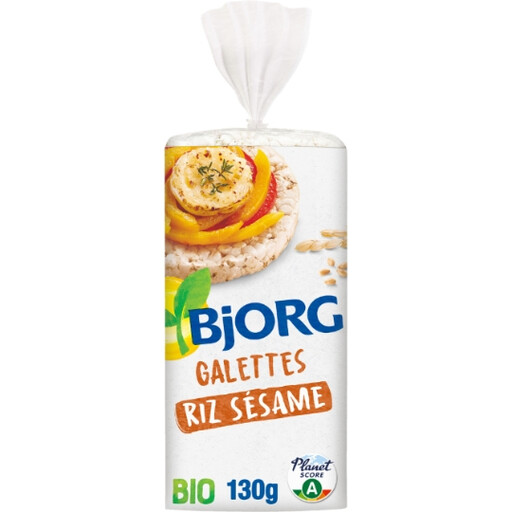 Image unavailable
This product combines rice and sesame in a 130 g pack, making it a handy choice if you fancy rice cakes while you’re out. If you’re looking for a specific sugar claim or need to consider allergens, check the label before choosing.
No. The DGCCRF states that the Nutri-Score is voluntary in France, while nutrition declarations are compulsory for most pre-packed foods. To compare rice cakes, check the sugars, fat and salt in the nutrition table, whether or not the Nutri-Score is shown.
No. Keep the distinction shown on each pack in mind. Gerblé’s dark chocolate rice cake is described as having ‘no added sugars’ and contains 1 g of sugars per 100 g, while Karéléa’s product listing describes its biscuits as ‘sugar-free’. Check the ‘of which sugars’ line too when comparing products.
No. Karéléa biscuits contain wheat, milk and eggs; Gerblé’s dark chocolate rice cake contains soya and polyols. If these ingredients affect your choice, read the ingredients list and allergen information for the specific product you’re buying.