People with coeliac disease preparing for a race
The priority is to check that the specific product is labelled ‘gluten-free’, rather than assuming it’s suitable just because the recipe contains rice or maize.


If you have coeliac disease, first check that the specific rice cake you plan to buy is labelled ‘gluten-free’. Then compare the carbohydrate content per serving and, as race day approaches, stick to a recipe you’ve already tried during training. Nutri-Score doesn’t replace these checks: according to the European Commission, front-of-pack nutrition labelling isn’t mandatory under current EU rules.
The priority is to check that the specific product is labelled ‘gluten-free’, rather than assuming it’s suitable just because the recipe contains rice or maize.
A familiar snack, tried during training in the portion you plan to eat, means you won’t be trying a new recipe just before you run. Sports Dietitians Australia recommends choosing familiar foods that you know you tolerate well before exercise.
When planning what to take with you, the carbohydrate content of the rice cakes you’ll actually eat is more useful than the figure given for 100 g alone.
If you’re considering rice cakes as part of your marathon training, first check the exact product, then the portion and the conditions in which you’ll eat it.
| What matters | What to check | Who this is for |
|---|---|---|
| Gluten-free labelling | Look for the words ‘gluten-free’ on the packaging of the exact product; an ingredients list with no wheat isn’t enough. | If I have coeliac disease, seeing that a rice cake is made with maize isn’t enough for me to choose it as a snack. Around 42% of consumers prioritise checking for gluten. |
| Tolerance before exercise | Try the recipe and portion during training. Compare the fibre and fat content if these affect what you can comfortably eat. | As race day approaches, I prefer to have a snack I’ve already eaten in similar conditions. This is the main concern for around 33% of consumers. |
| Portion and carbohydrates | Use the carbohydrate information per 100 g to work out how much you’ll actually take with you and eat. | When planning a long run, I want to know how the carbohydrates in my rice cakes fit into my plan, rather than relying on the weight of the whole pack. Around 25% of consumers prioritise portion size and practicality. |
A recipe that doesn’t mention wheat doesn’t, by itself, confirm the gluten content of the finished product. Regulation (EU) No 828/2014 sets a limit of 20 mg/kg for a food to be labelled ‘gluten-free’ when sold to the final consumer.
If you’re buying for someone with coeliac disease, check for this wording on the packaging of the product you’ve chosen, along with any other information relevant to their needs.
According to the European Commission, front-of-pack nutrition labelling is still voluntary under current EU rules. So the absence of a Nutri-Score doesn’t mean a rice cake is unsuitable.
If a score is shown, read it alongside the nutrition information and the portion you plan to eat. Don’t use it instead of checking for the words ‘gluten-free’.
A multigrain rice cake, a recipe with seeds or a new topping may be different from your usual snack. Sports Dietitians Australia recommends choosing familiar foods that you know you tolerate well before exercise.
During your training runs, try the recipe, amount and timing you’re considering for race day.
Carrefour France lists a BJORG maize, amaranth and linseed rice cake labelled ‘gluten-free’ and certified by AFDIAG. Auchan France also lists a BJORG four-grain product.
Carrefour France’s listing for CARREFOUR BIO corn cakes gives a pack size of 120 g and a recipe made with 99.8% organic maize and sea salt.
Carrefour France lists GERBLÉ Happy Digest biscuits and crispbreads among its products labelled ‘gluten-free’.
This BJORG four-grain rice cake is worth considering as a training snack. If you’re buying it for someone with coeliac disease, check that this specific product is labelled ‘gluten-free’ before including it in your trials.
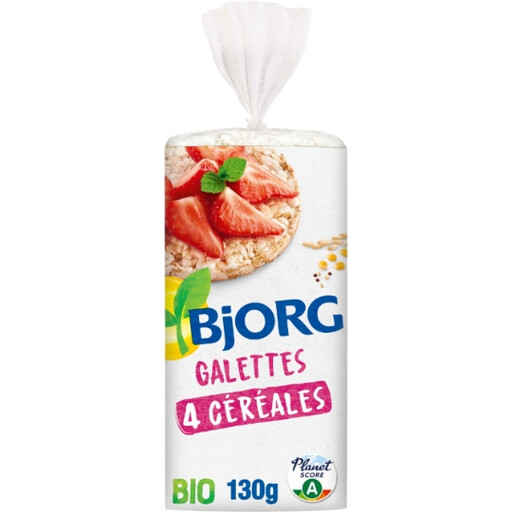 Image unavailable
Worth considering if you want to try a four-grain snack on a training run. The pack is listed as 130 g; check the nutrition information and work out the portion you’ll actually eat. Before using it as part of a gluten-free diet for coeliac disease, also check the ‘gluten-free’ label and allergen information on the pack you buy.
No. The European Commission says that front-of-pack nutrition labelling isn’t mandatory under current EU rules. To compare rice cakes, check the available nutrition information and the portion you plan to eat.
No. The ingredients list doesn’t replace the ‘gluten-free’ label on the specific product. Regulation (EU) No 828/2014 reserves this claim for foods containing no more than 20 mg/kg of gluten in the product sold to the final consumer.
It’s better to try the same recipe and planned portion during training first. Sports Dietitians Australia recommends choosing familiar foods that you know you tolerate well before exercise.
A rice cake can be part of your fuelling plan, but its nutrition information alone won’t tell you everything you’ll eat during the race. Match its carbohydrate content to the portion you actually plan to have, and take into account any other foods and drinks you’ve tried during training.