People with coeliac disease
Whether the specific product is suitable for a strict gluten-free diet matters more than its brand or Nutri-Score. French Health Insurance reminds people that this diet must be followed for life.


If you have coeliac disease, first choose a rice cake whose packaging carries a verifiable ‘gluten-free’ claim. Then compare the fat per 100 g across products that meet your requirements. Nutri-Score can help you read the label when it’s displayed, but it’s optional in France and doesn’t replace either of these checks, as the DGCCRF reminds us.
Whether the specific product is suitable for a strict gluten-free diet matters more than its brand or Nutri-Score. French Health Insurance reminds people that this diet must be followed for life.
Once you’ve checked that the product is gluten-free, compare the ‘fat’ figures per 100 g for rice cakes intended for the same use.
The logo can make it easier to narrow down your options at a glance, but you can still check the nutritional information if it’s not there. The DGCCRF says that displaying Nutri-Score is voluntary in France.
For someone with coeliac disease who also wants to reduce their fat intake, checking that a product is gluten-free comes first. You can then compare the fat content and recipe of products that meet this requirement.
| What matters | What to check | Who is it for? |
|---|---|---|
| Gluten-free suitability | The ‘gluten-free’ claim on the specific product’s packaging, followed by the ingredients and allergen list. | If I have coeliac disease, I need to be able to identify a suitable rice cake before comparing its taste or ingredients; around 46% of consumers put this check at the top of their list. |
| Fat | The amount of fat per 100 g in products intended for the same use; portion size and toppings also matter. | Once I’ve checked that it’s gluten-free, I look for a recipe that suits my goal of reducing fat; for around 36% of consumers, this is the main point of comparison. |
| Recipe and practical choice | The ingredients and nutritional information, even if there’s no Nutri-Score; and whether the product is available if I need to buy it regularly. | If I want to vary the grains I eat and easily find the same rice cake again, I need a clear label and a product that suits my shopping needs; around 18% of consumers prioritise this convenience. |
The word ‘galette’ doesn’t refer to one specific type of product. According to St Michel, its organic Galette au bon beurre contains wheat flour and declares gluten.
Check the product description, ingredients and gluten-free claim rather than relying on the product name alone.
In France, the DGCCRF distinguishes between Nutri-Score, which is voluntary, and the nutrition declaration, which is required for most prepacked foods. The absence of the logo doesn’t mean a rice cake is non-compliant.
Compare the ‘fat’ figure per 100 g and check the gluten-free information separately.
A rice-based recipe isn’t enough on its own to confirm that the finished product is suitable for the strict gluten-free diet described by French Health Insurance.
Check the gluten-free claim, ingredients and allergens on the pack you’re buying.
Lidl says its gluten-free products may be available as occasional offers rather than as part of its permanent range.
If you buy regularly, check that your chosen product is available and look for an alternative rice cake whose labelling meets your requirements.
The details below apply to specific rice cakes, not to every recipe from each brand.
Carrefour France lists an organic five-grain rice cake labelled ‘gluten-free’.
Products listed include four-grain rice cakes and rice-and-buckwheat rice cakes.
Carrefour France lists a wholegrain rice cake under this brand, among other products.
Its organic Galette au bon beurre shows why a biscuit-style cake shouldn’t be mistaken for a gluten-free rice cake.
This Bjorg product lets you consider a multigrain rice cake when choosing a gluten-free option and comparing fat content. Check the information on the pack before buying.
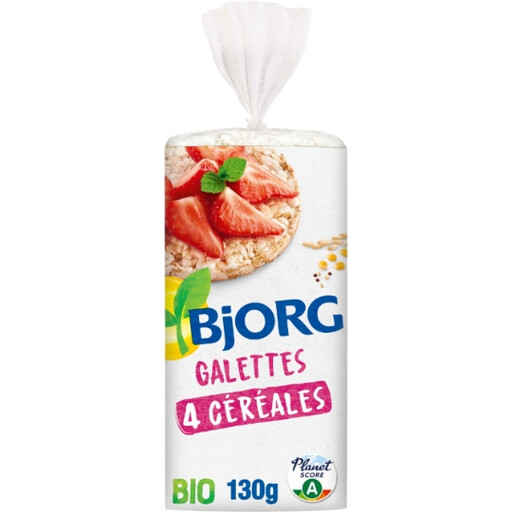 Image unavailable
If you’re comparing a multigrain rice cake with other products suitable for your gluten-free diet, first check the claim on the pack. Auchan France’s product information for Bjorg four-grain rice cakes gives their fat content as 2.2 g per 100 g. The recipe is made with rice, maize, buckwheat and quinoa, and may also contain traces of soya.
No. The DGCCRF says Nutri-Score is voluntary, while a nutrition declaration is compulsory for most prepacked foods. You can compare fat per 100 g using this information even if there’s no logo.
No. Check for a ‘gluten-free’ claim and read the label on the specific pack. This claim is governed by EU regulations: it means the finished product contains no more than 20 mg/kg of gluten.
Compare the fat per 100 g in rice cakes intended for the same use, then take portion size and toppings into account. For reference, product information from Carrefour France and Auchan France gives the fat content per 100 g as 1.8 g for Aglina five-grain, 2.2 g for Bjorg four-grain and 2.9 g for Bjorg rice and buckwheat.