
Livraison le jour même ou le lendemain

Qualité garantie

Débloquez vos offres de bienvenue: Livraison GRATUITE | Jusqu'à -80 % | 30 jours d'essai gratuits à JoyPlus
Téléchargez l'application
A RGB LED ambient lighting system for a car interior is all it takes to transform the cabin, highlight the lines of the dashboard or create a personalised atmosphere in an SUV or van. The key is choosing a kit that suits your needs. A poorly designed installation can leave cables exposed, produce uneven lighting or rely on a Bluetooth control system that is inconvenient for everyday use.
Before buying a car LED strip, it is therefore worth focusing on the features that really matter, rather than being won over by a simple avalanche of colours and lighting effects.
A total length of 175 or 236 inches does not guarantee that every area of the cabin will be lit evenly. Some kits consist of several segments, floor lights or optical fibres that you need to distribute yourself. Check the number of strips, the length of each one and the accessories supplied.
Even when described as ‘universal’, a kit must be compatible with a 12 V power supply. Depending on the model, it may connect to the 12 V socket, a dedicated circuit or directly to the fuse box. An unsuitable voltage could reduce light intensity or even damage the components. Short-circuit protection is a genuine advantage, but it does not replace proper installation.
A Bluetooth app will generally let you change the colour, brightness and animations within seconds. Its reliability can, however, vary depending on the smartphone and app used. A touch button or remote control is therefore a useful backup if there are connection problems.
Music synchronisation usually relies on a built-in microphone. The system responds to sounds picked up inside the cabin, rather than connecting directly to the car radio or audio system.
For 12 V car interior lighting, start by checking the operating voltage shown on the product listing. The kits featured here are advertised as compatible with cars and lorries, but the word ‘universal’ does not remove the need to check the available space or the cable routing.
Avoid installing anything near the pedals, steering wheel, seat rails or a heat source. Control boxes must remain accessible, properly ventilated and protected from crushing. Even an LED strip that produces little heat must never interfere with driving.
An acrylic LED strip for cars spreads light along the full length of a slim, flexible profile. It fits easily into the gaps in the dashboard and door panels. Optical fibres, meanwhile, can create a more discreet RGB neon light for cars, provided they are not bent sharply. An excessively tight curve can interrupt the transmission of light.
For more direct lighting, floor lamps and modules designed for door handles can complement the main strip. The right choice therefore depends on the effect you want: a continuous line of light, targeted illumination or more generous decorative lighting throughout the cabin.
The IP rating deserves careful attention. It indicates the level of protection against dust and water under specific conditions, but it does not mean that the controller can be submerged. For a lorry or vehicle that is regularly exposed to moisture, install the electronic components in a protected area and check the IP rating stated on the product listing.
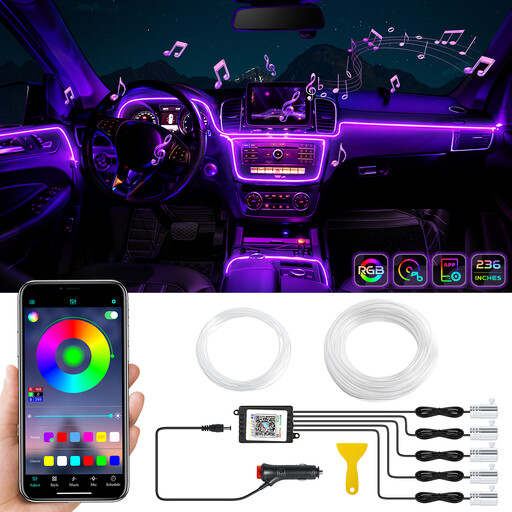
Why this choice suits this profile: This kit combines a 6 m optical fibre, five LED sources and app control. Its installation is advertised as compatible with cars and lorries.
The length and contents of the package are clearly detailed. The listing also specifies a 10 to 16 V power supply and short-circuit protection.
Lotus Lantern app, 29 advertised preset modes, sound detection and an optical-fibre cable that can be cut into several sections.
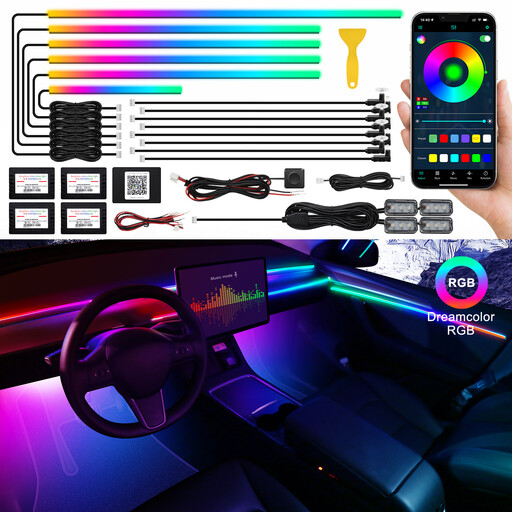
Why this choice suits this profile: Its configuration lets you customise the dashboard, footwell, handles and door storage compartments in detail.
The different modules connect to a main controller and four sub-controllers, making it easier to divide the lighting into zones.
Six strips, four floor lamps and four lights for handles and storage compartments, with a Bluetooth app, touch button and dynamic modes.
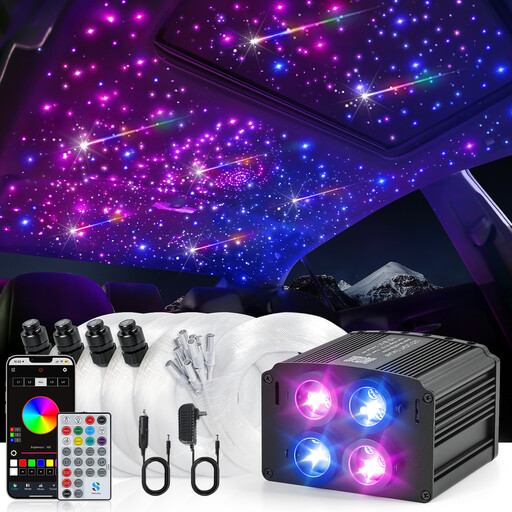
Why this choice suits this profile: This kit is designed for car starry-sky projects and vehicles whose cabins need particularly spectacular decorative lighting.
The listing details the light engine, four outputs, fibres and mounting accessories. However, the project requires considerably more preparation than a simple LED strip.
Advertised 32 W light source, 1 000 fibres, 240 meteor-effect fibres, app control and RF remote control.
Test the kit before securing it in place. Clean and dry the surfaces, then plan the cable routing before removing the adhesive backing. Acrylic strips should be inserted without sharp angles or tight bends. For fibres, leave a little extra length when cutting and use only the designated cutting marks.
Adjust the brightness so that it does not affect visibility. In France, decorative lighting must not distract the driver or produce light that could disturb other road users. Also avoid installations visible from outside that could be mistaken for a regulated light or signal.
We have put together a complete, real-time updated selection of products that meet these demanding criteria, as well as European safety requirements.
Connect the controller to a compatible 12 V power source, test the different modules, then install the strips in the gaps around the dashboard, doors or seats. Cables must be kept away from the pedals, steering wheel and all moving parts.
Power consumption depends on the number of modules and their wattage. Refer to the electrical specifications shown on the product listing and avoid overloading an existing circuit. Sound synchronisation does not necessarily result in higher power consumption, but very bright modes may place greater demands on the system.
Its service life depends on the quality of the components, the voltage actually supplied, heat and how the kit is handled during installation. Using the specified voltage, protecting the controllers and avoiding bends in the fibres or acrylic strips can help prevent premature faults.