
Livraison le jour même ou le lendemain

Qualité garantie

Débloquez vos offres de bienvenue: Livraison GRATUITE | Jusqu'à -80 % | 30 jours d'essai gratuits à JoyPlus
Téléchargez l'application
Want to personalise the cabin of your car, SUV or van without embarking on an electrical project? An RGB LED interior car light with app control lets you adjust colours, brightness and certain effects from your smartphone. But behind the marketing promises, there can be significant differences between a simple light strip and a genuine ambient car lighting kit.
Before you place an order, three pitfalls deserve your attention: Bluetooth compatibility advertised without a clearly identified app, a strip length that's insufficient for door panels and footwells, or a poorly thought-out installation with cables running too close to the pedals. Here are the criteria to consider, followed by a selection suited to different needs.
A product listing may state several metres of cable or fibre without specifying the number of light segments or their placement. For even lighting, check for dedicated dashboard strips, footwell lamps and, depending on the kit, modules for door handles or storage compartments.
A very long interior car LED strip powered by a single light point can also produce uneven illumination. Acrylic strips with evenly spaced LEDs distribute light along their entire length, whereas fibre optic solutions rely more on the emitters at their ends.
Mentions of "Bluetooth car LED" or "app control" don't always cover the same features. In particular, check:
Music synchronisation usually uses the phone's microphone or the control box's built-in mic. It therefore reacts to sounds picked up inside the cabin, not necessarily to the vehicle's direct audio signal.
Most kits featured here run on 12 V, via the cigarette lighter socket or a suitable power adapter. Connecting to an incorrect voltage can damage the components. Before installation, test the whole system, then keep wires away from the pedals, steering wheel, seat rails and hot areas.
For connection to the fuse box, it's best to consult the vehicle's wiring diagram and call in a professional if you're not comfortable with this type of work. The term "universal" refers to general placement; it doesn't remove the need to check the available space in your cabin.
Look for a clearly stated voltage, for example 12 V DC, as well as short-circuit protection when mentioned in the product listing. Low heat output is desirable for installation in tight gaps, but it doesn't replace a well-ventilated and properly secured setup.
Also check the operating temperature range. Some models claim use from -20°C to 60°C, a particularly useful detail for a vehicle parked outside in winter or exposed to direct sunlight.
An RGB car LED strip intended for DIY installation must have clearly marked cutting points. On several acrylic kits, it's recommended to keep some extra length and avoid cutting through a resistor. A poorly cut end may display a different colour or fail to synchronise properly.
Fibre optic cables and tubes should not be bent at right angles. To follow the dashboard contour, opt for a gradual curve and clean the surfaces before fixing. A plastic trim removal tool can help insert the strip into gaps without marking the upholstery.
A basic kit may light up the dashboard and footwells. The 14-in-1, 18-in-1 or 22-in-1 versions add lighting for handles, storage compartments and sometimes door panels. The number of controllers also matters: one main box accompanied by several sub-controllers makes it easier to synchronise distant zones.
The "dual zone" control allows, depending on the model, two colours or two modes to be displayed simultaneously. This should not be confused with a simple colour change applied to the entire cabin.
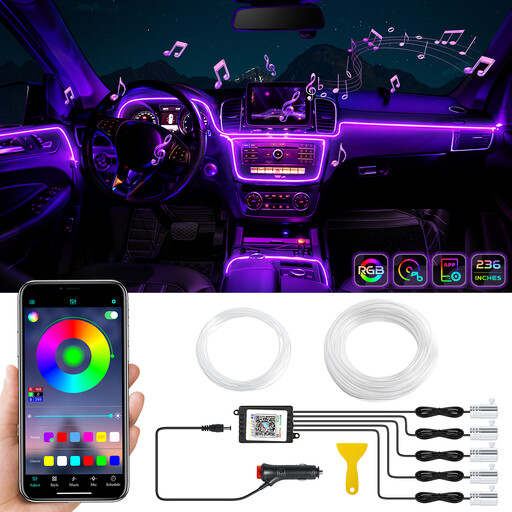
Why this suits this profile: With its 6-metre fibre, five RGB lights and car power supply, this format works well for a first custom installation without adding too many modules.
The fibre length and accessories are clearly detailed, reducing the risk of discovering too late that a component is missing for installation.
Lotus Lantern app, 16 million claimed colours, sound sensor and stated operating range of 10 to 16 V.
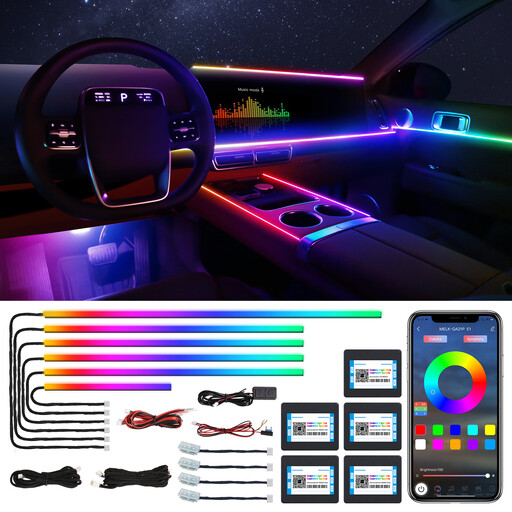
Why this suits this profile: Drivers looking for a more structured ambience get six strips, four footwell lamps, five controllers and app control.
The dual control lets you differentiate the main strips from the footwell lighting, rather than forcing a single colour across the whole cabin.
600 claimed LEDs, chasing effects, voice control, timer and concealed touch button.
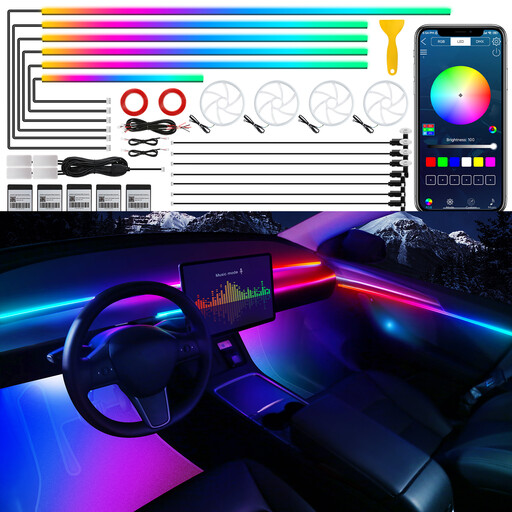
Why this suits this profile: With dedicated zones for footwells, handles, storage compartments and door warning lights, this kit is aimed at SUVs, vans and ambitious customisation projects.
The locations and lengths are listed separately, making it easier to plan the wiring before removing any trim panels.
600 claimed LEDs, five controllers, dynamic effects and app control compatible with iOS and Android.
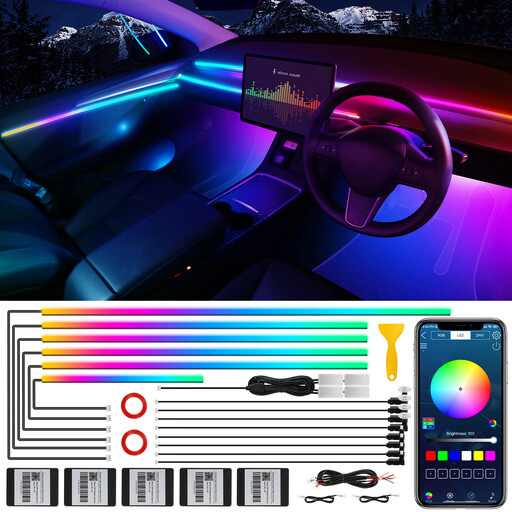
Why this suits this profile: This format adds lighting for door handles and storage pockets to the main strips and footwell lights, giving you more visible customisation during night-time drives.
Sub-controllers are included for distant zones, helping to limit improvised extensions and exposed cables.
Claimed total length of 4.45 metres, chasing effects, sound detection and cuttable at marked resistor points.
We've put together a comprehensive, real-time updated selection of products that meet these strict criteria, as well as European safety requirements.
On the open road, avoid settings that could impair visibility or distract the driver. Also consult the manual, check any applicable regulatory markings and familiarise yourself with the warranty conditions before final installation.
Scan the supplied QR code, install the indicated app, enable Bluetooth from within the app, then search for the corresponding controller. Its name may vary depending on the kit version: "LED LAMP", "Lotus Lantern" or "LotusLamp X". Test the pairing before fixing the strips in place.
The cost depends on the kit's actual power consumption, how long you use it and the power source. An installation plugged into the 12 V socket draws energy from the vehicle while it's running. To avoid draining the battery, switch the system off when the engine is off, unless the manual specifies a different setup.
The number of LEDs alone doesn't determine a universal lifespan. It depends on component quality, heat, humidity, bending and the voltage applied. An installation free from mechanical stress, respecting the stated temperature and voltage limits, reduces the risk of premature failure.