
Livraison le jour même ou le lendemain

Qualité garantie

Débloquez vos offres de bienvenue: Livraison GRATUITE | Jusqu'à -80 % | 30 jours d'essai gratuits à JoyPlus
Téléchargez l'application
Looking to modernise your vehicle’s cabin with an RGB Bluetooth car interior LED strip? Between the promises of endless colours, music synchronisation and ‘no wiring’ installation, a few details can turn a tempting purchase into a fiddly accessory that’s a pain to fit — or even disappointing day to day.
This guide helps you compare the different LED kits for car interiors, spot the grey areas in product descriptions and choose a setup that suits your vehicle, without simply taking the marketing claims at face value.
A product listing might quote 175 or 236 inches of fibre — roughly 4.45 to 6 metres. This figure doesn’t necessarily refer to a single continuous strip: the length may be split across several segments intended for the dashboard, doors and footwell.
Before ordering, check:
Bluetooth is typically used to control the lighting via an app, not to power it. An ambient car light always needs to be connected to a suitable power source, most often a 12 V socket or a dedicated circuit.
Kits that cover multiple zones sometimes use a main controller alongside several secondary modules. This setup makes it easier to spread the lighting around the cabin, but it does mean you’ll need to hide the cables neatly and install the control boxes in a dry, cool spot away from any moving parts.
An acrylic optical fibre for cars or a rigid light strip can give a smooth, even look in the gaps of your dashboard. However, it must not be bent at a sharp angle or heavily compressed. Too tight a curve can interrupt the light transmission.
Always test the kit before fixing the components in place. Once the adhesive is on, corrections take much longer and can leave marks on the plastic.
Most of the models featured here run on 12 V DC, a standard voltage in passenger cars. That doesn’t automatically mean every setup is compatible with every vehicle. Check the voltage specified by the manufacturer and avoid overloading an existing circuit.
If a listing mentions short-circuit protection, treat it as a safety feature of the product, not a free pass to ignore proper wiring rules. Cables must never interfere with the pedals, steering wheel, seats or doors.
An app-controlled LED lighting system can offer:
Check the exact app name given in the instructions. Depending on the product, it could be ‘Lotus Lantern’, ‘LotusLamp X’, ‘LED LAMP’ or ‘Magic Lantern’. The claimed compatibility with iOS and Android should be confirmed with your phone and the version of the app available.
A so-called cuttable RGB LED strip for cars should only be cut at the marked points. On some models, the last section may show a different colour or stop syncing if a resistor is cut. Measure each location before you get the scissors out.
Configurations labelled 10-in-1, 14-in-1, 18-in-1 or 22-in-1 mainly refer to a combination of strips and lamps for the footwells, handles or storage compartments. They don’t necessarily mean 10, 14, 18 or 22 separate light strips.
The options below are based on the information stated in the product listings: number of components, voltage, control method, accessories and areas covered. They don’t guarantee identical results in every vehicle.
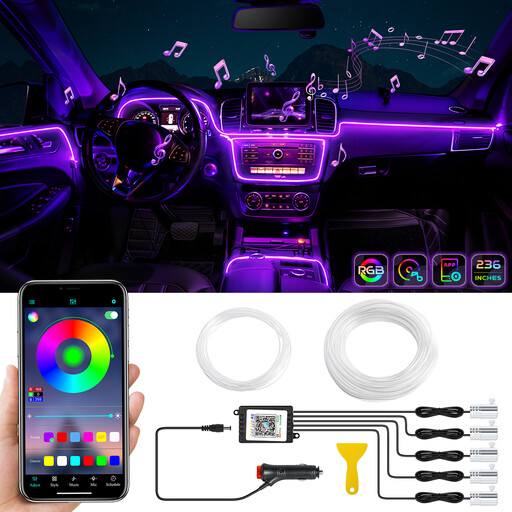
Why this suits this profile: This setup is controlled via an app, runs on 12 V and includes several components for the dashboard and footwell. It’s a good choice for a first, gradual customisation of your cabin.
The listing details the controllers, extension cables and installation areas. It also recommends testing the lighting before fitting and not bending the fibre excessively.
iOS and Android app, sound-reactive mode, memory function and claimed short-circuit protection. The fibre length is stated as 236 inches.
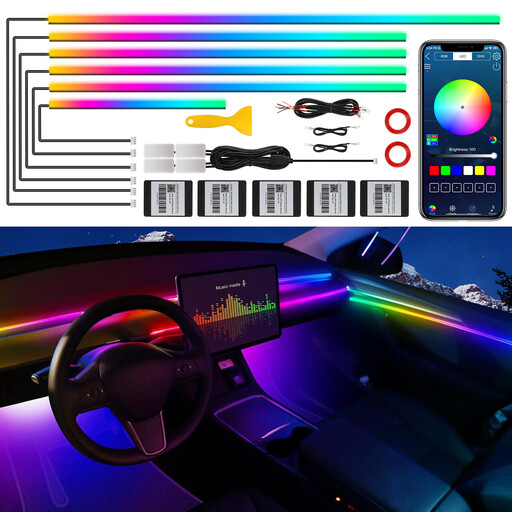
Why this suits this profile: This kit is aimed at drivers who want to manage several zones at once and enjoy dynamic effects via a Bluetooth app.
Separate controllers make it easier to distribute the components. The listing specifies the cutting points and precautions to take with the resistors.
Six acrylic strips, four footwell lamps, touch control and claimed Dreamcolor effects. The system runs on 12 V and is adjustable via an app.

Why this suits this profile: With extra zones for the handles and storage compartments, this kit is designed for in-depth customisation, particularly as part of a car tuning project.
The contents are clearly listed: main strips, footwell lamps, handle lights and storage lights. This makes it easier to plan the installation and the number of connections.
18-in-1 configuration, dual zone, sound synchronisation and claimed Bluetooth app. The kit includes one main controller and four secondary controllers.
We’ve put together a full, real-time updated selection of products that meet these strict criteria and European safety requirements.
To avoid any nasty surprises, follow this order:
Music synchronisation can be fun when the car is parked or for showing off. When you’re driving, it’s better to choose a subtle lighting setup that won’t distract you or reduce visibility.
Product listings claim compatibility with cars and vans. However, you still need to check the available space, your vehicle’s voltage and whether you can hide the controllers. A general claim of compatibility doesn’t mean you can skip checking whether the installation is actually feasible.
It’s best to follow the instructions and switch off the power when the vehicle is parked. A permanent connection can drain the battery, depending on the circuit used. Also avoid running the lighting while driving if its effects catch your attention or bother you.
Power consumption depends on the number of modules, the brightness and the mode selected. Models covering several zones have more light sources. To keep consumption down, choose a reasonable intensity, switch off any zones you’re not using and check the 12 V connection before installation.