
Livraison le jour même ou le lendemain

Qualité garantie

Débloquez vos offres de bienvenue: Livraison GRATUITE | Jusqu'à -80 % | 30 jours d'essai gratuits à JoyPlus
Téléchargez l'application
Between increasingly intense summer heatwaves and unpredictable winter temperatures, maintaining a comfortable indoor climate has become a top priority. The reversible portable air conditioner stands out as the ultimate all-in-one solution for year-round thermal comfort. The problem?: the market is flooded with devices making tempting promises, but their performance is often disappointing. To help you see more clearly, our editorial team has broken down the pitfalls to avoid and the essential criteria to check before you buy.
Navigating the air conditioner jungle is no easy task. Here are three common mistakes that can cost you dearly, both in comfort and on your utility bill.
To make an informed choice, you need to stick to the facts. Here are the three fundamental technical specifications to scrutinize.
An air conditioner's capacity is measured in BTU (British Thermal Unit) or kilowatts (kW). This is the number one criterion for ensuring performance that matches your room's volume.
The energy label is your best friend for preventing your budget from melting away. For a hot and cold portable air conditioner, there are two acronyms to remember?:
The higher these ratings, the more efficient and economical your appliance is. Opting for a Class A+ portable air conditioner is a smart investment that ensures controlled energy consumption all year round, whether for cooling or for use as a portable space heater.
A good reversible unit does more than just blow hot and cold air. The most comprehensive models, often labelled as a 4-in-1 air conditioner, add some very useful features to their arsenal?:
This versatility transforms your appliance into a true comfort partner for every season.
Because every home is unique, here are some units that meet specific user profiles, selected based on our performance and practicality criteria.
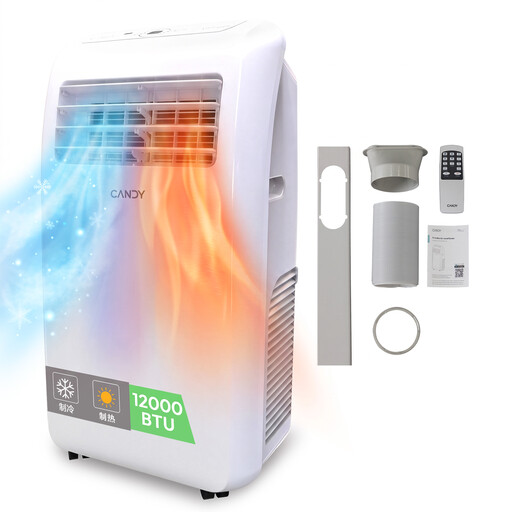
Why it stands out : Perfect for those who want a single, effective solution for their main living area (up to 35 m?). This Candy air conditioner ensures comfort in summer and winter, without the hassle of juggling multiple devices.
Its 12,000 BTU (3.5 kW) power is perfectly calibrated for rooms up to 35 m?, which eliminates the risk of being undersized. Its A+ energy class for both heating and cooling protects you from nasty surprises on your bill.
Its true 4-in-1 versatility (cool, heat, dehumidify, fan) and powerful airflow (400 m?/h) ensure consistent comfort in any season.
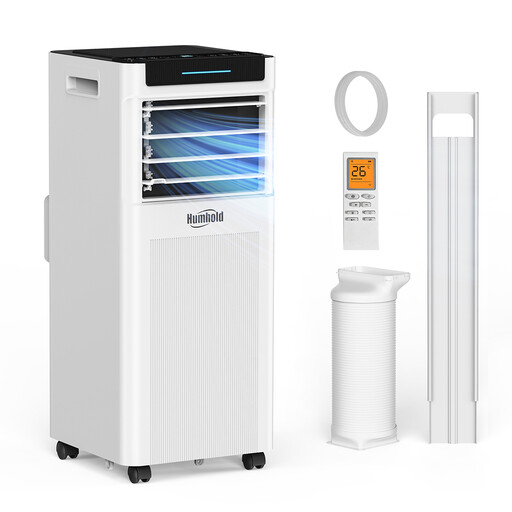
Why it stands out : The perfect solution for those primarily looking to survive summer heatwaves. It is perfectly sized for a bedroom or office (up to 30 m?) where the heating function is a secondary concern.
With 9,000 BTU, its power is well-suited for medium-sized rooms, avoiding the waste of an oversized model. Its dedicated night mode (under 51 dB) directly tackles the noise problem for a peaceful sleep.
Its compact design and self-evaporation system reduce the chore of manual draining, a detail that makes all the difference in the middle of summer.
We have compiled a complete and up-to-date selection of products that meet our demanding selection criteria and local standards.
Consumption depends on several factors?: the appliance's energy class, its power, the outside temperature, and, most importantly, the quality of your home's insulation. A Class A+ model will always be much more economical than a lower-rated appliance. To give you an idea, a 3.5?kW (12,000 BTU) unit can consume up to 3.5 kWh at full power. Fortunately, its compressor shuts off once the target temperature is reached, which moderates consumption over time.
Yes, and that's one of its biggest advantages. Installation requires no major work. Simply plug it into a power outlet and place the hot air exhaust hose through a partially opened window. Most models even come with a window sealing kit, which is essential for optimising insulation and preventing cool air from escaping. It's the ideal solution for renters who cannot undertake major renovations.
It should be seen more as an excellent portable space heater. It proves incredibly effective for quickly raising the temperature in a room or for providing comfort during the shoulder seasons (autumn, early spring). However, in regions with harsh winters or in a poorly insulated home, it will be a welcome supplement to your main heating system, but it can in no way replace it entirely.