
Livraison le jour même ou le lendemain

Qualité garantie

Débloquez vos offres de bienvenue: Livraison GRATUITE | Jusqu'à -80 % | 30 jours d'essai gratuits à JoyPlus
Téléchargez l'application
With scorching summers and increasingly unpredictable shoulder seasons, the reversible mobile air conditioner has become an essential ally for home comfort. Able to cool a room when the temperature soars and provide supplemental mobile heating and cooling at the first sign of a chill, it wins users over with its versatility and simple, major-work-free installation. But be warned: the market is saturated with sometimes misleading marketing claims. To help you make an informed choice and avoid the common traps, follow our guide.
The mobile air conditioner aisle can feel like a jungle. To navigate it successfully and avoid disappointment, here are two classic mistakes you must not make.
Noise is public enemy number one, especially in a bedroom or office. Many manufacturers feature the "silent mobile air conditioner" label, but this term is purely a marketing gimmick and guarantees nothing. Since noise perception is subjective, a unit that one person finds discreet can be unbearable for another.
The only reliable indicator is the sound level in decibels (dB). For true acoustic comfort, aim for a model with a minimum sound level that does not exceed 50-55?dB. This is equivalent to the hum of a modern refrigerator or a quiet conversation. A product sheet that omits this crucial information? That's a red flag.
It's an inescapable law of physics: to produce cold air, an air conditioner must expel hot air. A portable air conditioner without an outdoor unit (known as a monobloc) therefore absolutely requires an exhaust hose to vent this hot air outside, most often through a window or a dedicated opening.
Devices sold as "ventless" are actually evaporative air coolers. They work by evaporating water and provide a localized cooling sensation, but they are incapable of lowering the overall temperature of a room. Make no mistake: for true air conditioning, the hose isn't an option—it's essential.
Beyond the marketing traps, three technical criteria help separate the wheat from the chaff.
Cooling power, expressed in BTUs (British Thermal Units), is the most critical factor. It determines the unit's ability to cool a given area. Don't rely on the square footage advertised by brands, which is often overly optimistic. Instead, use these benchmarks:
mobile air conditioner for 30m? (approx. 320 sq ft): a 9,000 BTU model is a common and effective benchmark.Choosing the right power is key to ensuring maximum efficiency without sending your electricity bill skyrocketing.
The reversible function is obviously the main advantage of these units, turning them into economical supplemental heaters for the shoulder seasons. But recent models go even further to make your life easier:
Wi-Fi connected mobile air conditioner: This allows you to control the unit remotely from a smartphone. It's perfect for starting a cooling cycle on your way home to arrive to a comfortable interior.To illustrate how these criteria apply in practice, here is our selection of models for different user profiles.
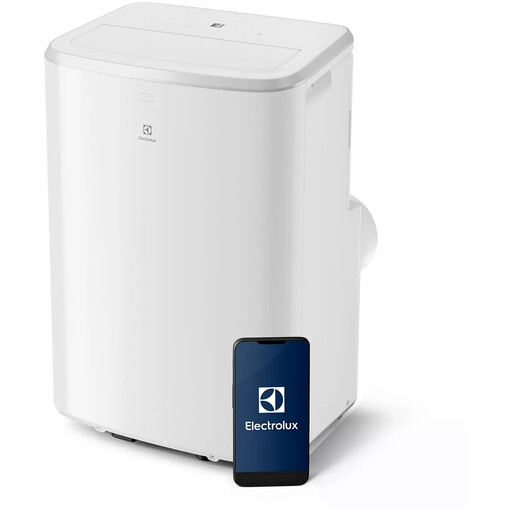
Who is it for? For those who want an all-in-one, high-performance, and reliable solution capable of managing the comfort of a living space (up to 30 m?) all year round.
This model is upfront about what it does. It's a true 4-in-1 (cool, heat, fan, dehumidify), and its versatility fully justifies the need for an exhaust hose.
A genuine heating function (2.6 kW) and 9000 BTU power for effective cooling, all controllable via Wi-Fi for tailor-made comfort year-round.
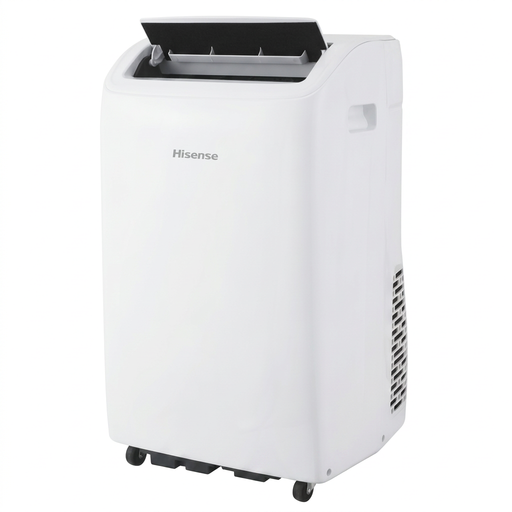
Who is it for? For the tech-savvy user who wants absolute control over their comfort. A high-performance, intelligent device that integrates seamlessly into a connected lifestyle.
No more vague promises of "silence." This model tackles the noise problem head-on with a dedicated Night mode and a clear figure: a minimum of 50 dB. This is reliable data, not a marketing claim.
Its Wi-Fi connectivity, compatibility with voice assistants, and smart modes (SMART, Super Cooling) for optimized, effortless management.
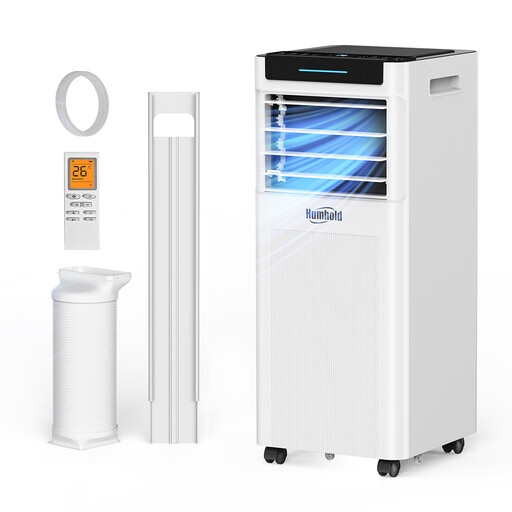
Who is it for? For those seeking a targeted summer solution, primarily for a bedroom or small office (up to 28 m?). The absolute priority: nighttime silence.
This air conditioner doesn't pretend to be reversible, and that's its strength. It focuses on a single mission—cooling—and accomplishes it brilliantly. Its sleep mode, rated at under 49 dB, makes it a champion for nighttime use.
Its compact size and low noise level in sleep mode. It's the sensible choice for rest spaces where noise is non-negotiable.
Discover our full selection of products, all rigorously chosen for their performance and compliance with French standards.
The lifespan of a mobile air conditioner generally ranges from 5 to 10 years. To maximize it, regular maintenance is crucial. This includes cleaning the filters every two weeks during periods of heavy use and dusting the air vents. Careful storage in winter, away from dust and moisture, will also extend its longevity.
Yes, but the frequency depends on the unit and the ambient humidity. Most recent models include an auto-evaporation function: some of the condensed water is reused to cool the system before being expelled with the hot air. However, in dehumidifier mode or in a very humid environment, the internal tank can fill up. An indicator light will then signal that it's time to drain it manually.
The cost depends on several factors: the unit's energy efficiency class (aim for Class A or better), its power, your frequency of use, and your electricity rate. Logically, a 9,000 BTU model (approx. 2600 W) will consume more than a 7,000 BTU one. To manage your budget, use the programming function to run the unit only when necessary and opt for a reasonable set temperature.