
Livraison le jour même ou le lendemain

Qualité garantie

Débloquez vos offres de bienvenue: Livraison GRATUITE | Jusqu'à -80 % | 30 jours d'essai gratuits à JoyPlus
Téléchargez l'application
A reversible baby play mat can quickly become the main play space in your home. It supports tummy time, those first rolls, floor play and the breaks in between activities. But some models rely heavily on their colours or marketing claims, without really meeting the everyday needs of families.
Before you place an order, there are three pitfalls to avoid: foam that is too thin and doesn’t insulate well from the floor, dimensions that sound generous but don’t account for the space you actually have, and a material that’s tricky to clean. Storage is also often underestimated: a bulky mat without a practical folding system could end up at the back of a cupboard after just a few uses.
A baby foam mat needs to offer a surface that is soft enough to cushion the little bumps that come with floor play. The product description should state the material, care instructions and any usage precautions. A comfortable foam improves the experience, but it is no substitute for adult supervision and should never be presented as medical protection.
Be sure to check:
To choose a safe baby play mat, consult the regulatory information that applies to toys and children’s products, as well as the manufacturer’s warnings. Where required, the CE mark represents the manufacturer’s declaration of conformity. It does not guarantee that the product is suitable for every situation, and it does not replace the need to regularly check its condition.
A 200 x 150 cm baby mat offers a generous surface for placing a few toys around your child. This size can work well in a living room, bedroom or family space, but it’s best to measure the area before you order. Also leave a margin around the mat so you can move around without tripping.
In a smaller flat, a foldable baby mat can be much more practical than a rigid model. It’s easier to store behind a piece of furniture or in a chest, and it’s simple to take along to grandparents’ house. However, do check its dimensions when folded: a mat that doesn’t take up much floor space may still be bulky in a cupboard.
Mealtimes, spit-ups and hands-on floor play mean regular cleaning is a must. An easy-clean children’s mat should be wipeable with a damp cloth, if the instructions allow. Don’t assume that a mat can be washed with lots of water or submerged.
For the model shown below, the product page states that a damp cloth is sufficient and advises against immersion and the use of strong chemical products. It also notes that the soft foam must not be ingested, as it could present a choking hazard. These instructions should be kept and followed.
Not all products are designed for the same purpose. A reversible play mat is ideal for creating a comfortable zone, whereas a decorative accessory or a creative activity should remain a complement. The cards below help you distinguish between uses without mixing up the functions.
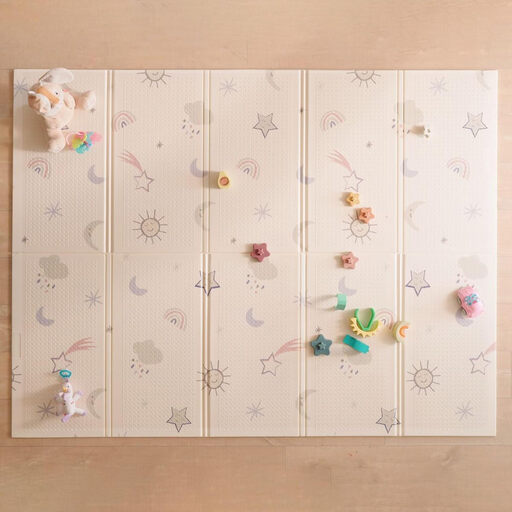
Why this choice suits this profile: This mat combines soft foam, a 200 x 150 cm size and a practical folding design to create a play area without cluttering your home with extra accessories.
The product page specifies cleaning with a damp cloth and outlines the care limits. The folding design means you don’t have to leave a large surface on the floor permanently.
A reversible surface, soft foam, generous dimensions and easy transport thanks to the folding design.
Why this choice suits this profile: Its two sides let you quickly change the visual feel of the play area without buying multiple mats.
Its reversible design refreshes the look without taking the mat away from its main purpose: providing a dedicated floor-play zone.
Two patterns, a large surface and a foldable design as stated by the manufacturer.
Why this choice suits this profile: For families who often set up and put away the mat, the folding design and 200 x 150 cm size make it easy to use in the living room, bedroom or on the go.
Transport and storage keep bulk to a minimum. Cleaning with a damp cloth handles everyday surface dirt.
A foldable design, reversible surface, soft foam and dimensions suited to a family play area.
We’ve put together a comprehensive, real-time selection of products that meet these demanding criteria and comply with European safety regulations.
Place the baby play mat on a clean, dry floor with plenty of clear space around it. Keep it away from radiators, flames, stairs and unstable furniture. A mat should not be used as a barrier or for extended sleeping.
Check the foam and fold areas regularly:
It depends on the room and your child’s age. A 200 x 150 cm surface offers a comfortable space for playing and placing a few toys, but it does need enough clear space around the mat. Measure the intended spot before you buy, taking furniture and walkways into account.
Not necessarily. Some models can be wiped clean with a damp cloth, whereas immersion could damage the foam or the covering. Always check the instructions. For the Nuby model shown here, the product page advises against immersion and the use of strong chemical products.
How long you use it depends on the mat’s condition and your child’s development. Regularly inspect the edges, surface and folds. Replace it as soon as you notice a tear, distortion or any detachable piece, even if the mat still seems usable.