
Livraison le jour même ou le lendemain

Qualité garantie

Débloquez vos offres de bienvenue: Livraison GRATUITE | Jusqu'à -80 % | 30 jours d'essai gratuits à JoyPlus
Téléchargez l'application
That tangled mess of cables at the bottom of your bag or cluttering your desk? It's a frustration we all know. The retractable cable charger emerges as the perfect solution: a single unit to charge all your devices, without the usual chaos. However, not all models are created equal. Before you buy, it's best to know the three classic pitfalls that can turn a promise of convenience into a real headache.
To make the right choice, you need to read between the marketing lines and focus on a few essential technical specifications.
The total wattage (W) is one thing, but how it's distributed is even more crucial. A good 67W fast charger must be able to deliver that full power to a single port (for a laptop, for example), but also distribute it intelligently when multiple devices are connected. Favour models that detail the maximum power per port, as well as for simultaneous use. The Power Delivery (PD) standard is an essential prerequisite for fast charging modern devices, from laptops to smartphones. A charger capable of powering a laptop and a phone must guarantee sufficient power for each, for example, 45W for the former and 20W for the latter, at the same time.
The acronym GaN stands for Gallium Nitride. A GaN charger uses this semiconductor material instead of traditional silicon. In practical terms, this translates into three major advantages for the user:
This technology is therefore an excellent indicator of quality and modernity. It transforms a simple power "brick" into a true compact charging station.
The Achilles' heel of many models is the integrated cable itself. A quality cable must be thick enough to handle a fast charge without overheating and sheathed in a durable, wear-resistant material (like braided fabric). The retraction mechanism, meanwhile, must be smooth and robust. Premium models are often tested for thousands of retraction/extension cycles, a guarantee of durability that entry-level products obviously cannot provide.
To help you see things more clearly, here are a few models that tick all the boxes, suited for different user profiles.
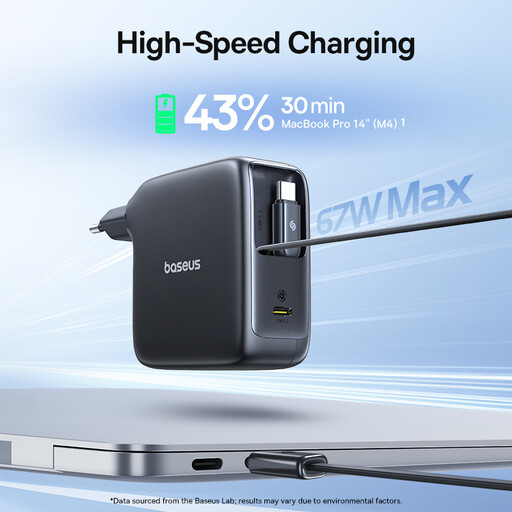
Why it stands out: Designed for those who travel light, this charger integrates not one, but two retractable USB-C cables. This allows you to charge a laptop and a smartphone simultaneously, without any extra cables to carry. It's the very definition of the ultimate USB-C travel charger.
Its dual retraction mechanism is designed for heavy use, reducing the risk of premature jamming. By eliminating the need for external cables, it tackles the clutter problem at its source.
67 W of power, enough for a MacBook Air and an iPhone. Ultra-compact design and perfect organisation thanks to the two integrated cables.
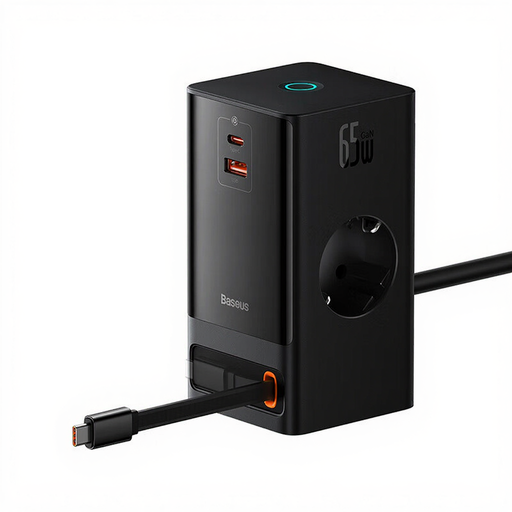
Why it stands out: Much more than a simple charger, this is a smart power strip. Perfect for a desk or bedside table, it combines AC outlets, USB ports, and a retractable USB-C cable. It's the ultimate solution for centralising all your connections in one place.
It replaces both a traditional power strip and an army of wall chargers, avoiding the "deceptively bulky" trap. Its GaN technology ensures efficient thermal management, even with multiple devices plugged in.
Extreme versatility: 2 AC outlets and 3 USB ports (including one retractable) to connect everything. GaN technology for compactness and safety.
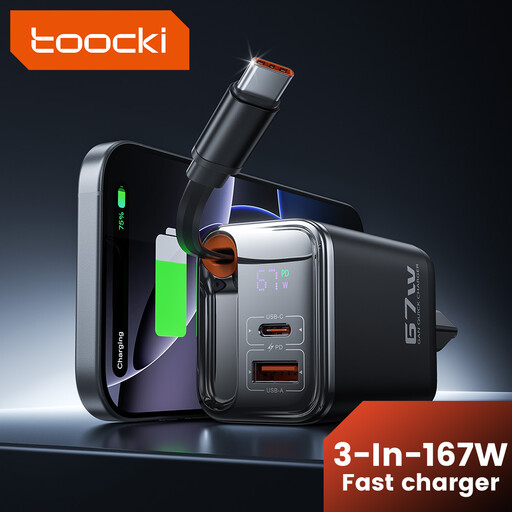
Why it stands out: This charger is the perfect solution for those juggling devices from different generations. It offers a retractable USB-C cable for modern devices, an additional USB-C port, and even two USB-A ports for older smartphones, e-readers, and other accessories.
It avoids the poorly distributed power pitfall by offering ports suited for every need. Its 67 W of power is intelligently distributed to ensure efficient charging, even with four devices plugged in simultaneously.
Maximum compatibility with both new and older devices. A true multi-port wall charger that remains compact enough for travel.
We have curated a complete and up-to-date selection of products that meet our selection criteria and European safety standards.
It all depends on the build quality. Entry-level models can fail after just a few months of daily use. Conversely, chargers from reputable brands, designed with robust materials and proven mechanisms, can last for several years without any issues. A word of advice: to preserve the mechanism, handle the cable gently without pulling on it abruptly.
No, there is absolutely no risk. Modern chargers, especially those certified with Power Delivery (PD), "communicate" with the connected device to provide only the maximum power it can safely accept. Plugging a 20W smartphone into a 67W port will therefore only send the 20W it needs. The charge is both fast and safe.
Yes, and in a very tangible way. For a frequent traveller, the difference in size and weight of a GaN charger is immediately noticeable in their bag. For stationary use, its lower heat output is a real plus for safety and product longevity. It's a technology that provides a tangible benefit, making powerful chargers both more convenient and safer.