
Livraison le jour même ou le lendemain

Qualité garantie

Débloquez vos offres de bienvenue: Livraison GRATUITE | Jusqu'à -80 % | 30 jours d'essai gratuits à JoyPlus
Téléchargez l'application
Resin 3D printing is no longer exclusive to industrial labs. It's making its way into the hands of miniature creators, designers, engineers, and discerning hobbyists, offering a level of detail and speed that were once unattainable. But with a jungle of technical specs, how do you navigate the options? This guide is here to break down the essential criteria and present our 2026 selection. The goal: to help you find the perfect resin 3D printer for your projects.
Before diving into our top picks, let's review the key factors that should guide your decision.
The LCD screen's resolution is the number one criterion for print quality. A high resolution, like that of a 14K 3D printer, means smaller pixels (measured in micrometres, or ?m). The result: finer details, smoother surfaces, and razor-sharp edges. This is a non-negotiable feature if you plan to print complex objects like ultra-detailed miniatures, jewellery, or dental models.
The build volume (length × width × height) defines the maximum size of your creations in a single run. A large-format 3D printer is essential for prototyping large parts or running batch productions of multiple small objects at once. For more modest projects, a standard volume will be more than sufficient and come at a more accessible price point.
Expressed in millimetres per hour (mm/h), speed is crucial for rapid resin prototyping and small-scale production. Fast resin 3D printing doesn't just depend on the machine. It's influenced by the light source's power, the type of resin (some, known as "high-speed" resins, cure faster), and release technologies like ACF films.
Here are three models that tick all the boxes, each catering to specific needs for precision, volume, or speed.
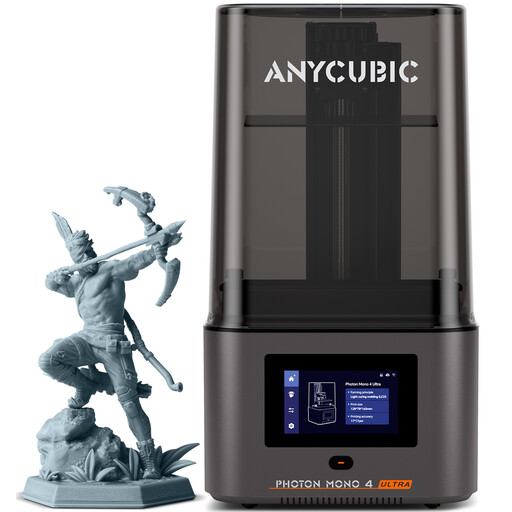
Why It Stands Out: The Anycubic Photon Mono 4 Ultra 10K delivers exceptional detail in a compact form factor. Its 7-inch 10K screen ensures microscopic pixel resolution, making it the perfect tool for high-precision projects.
Key Features:
Who Is It For? The ideal choice for creators using a 3D printer for miniatures, jewellers, and model makers who demand maximum precision on small parts.
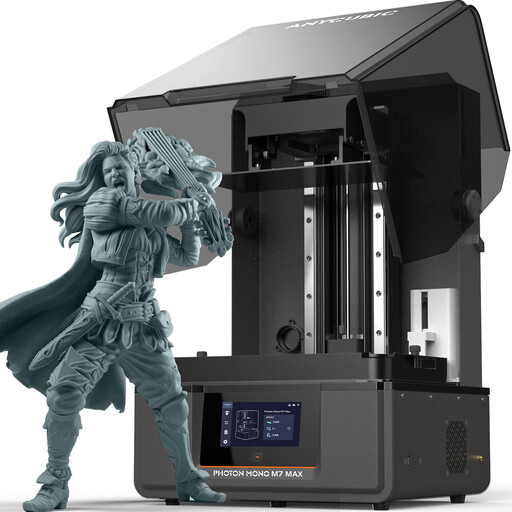
Why It Stands Out: This version of the Anycubic resin 3D printer is built for production. With its XXL build volume and smart features like resin temperature control, it targets professionals for whom reliability and capacity are paramount.
Key Features:
Who Is It For? A solution designed for professionals, production workshops, dental labs, and industrial applications that require a reliable and durable large-format 3D printer.
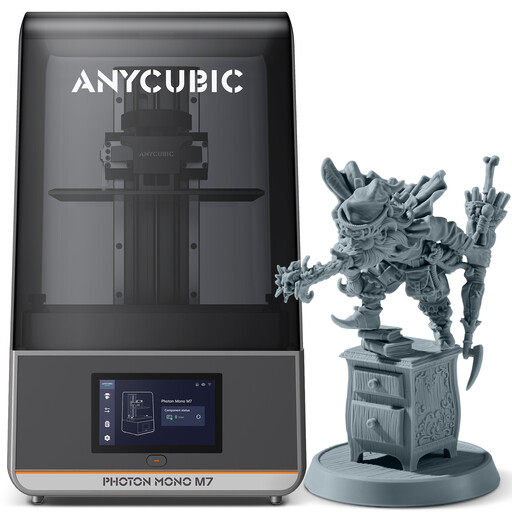
Why It Stands Out: The Anycubic Photon Mono M7 14K embodies the perfect balance between extreme resolution, top-tier speed, and a generous build volume. Its 10.1-inch 14K screen allows for producing parts that are both large and incredibly fine.
Key Features:
Who Is It For? Perfect for demanding users, from designers to engineers, who want a versatile machine capable of producing both large functional prototypes and ultra-detailed display models.
Our selection highlights flagship models, but the market is full of alternatives. If your projects have different requirements, feel free to explore our full catalogue.
Discover a wider range of models on our Desktop 3D Printer page.
Resin 3D printers (SLA, DLP, LCD) cure liquid resin layer by layer using UV light. They are renowned for their very high precision and perfectly smooth surfaces, making them ideal for detailed objects (miniatures, jewellery, etc.). FDM (Fused Deposition Modeling) printers, on the other hand, work by extruding a plastic filament. Generally more affordable, they offer a wider choice of robust materials, perfect for functional parts where the level of detail is less critical.
It all depends on your use case. For creating miniature figurines, jewellery, or dental models where every micron counts, a 14K resolution provides a tangible improvement in fineness and sharpness. For larger parts or functional prototypes, an 8K or 10K resolution is often more than sufficient and represents an excellent compromise between cost and performance.
In addition to the printer itself, you will need liquid resin, of course, but also a cleaning agent like isopropyl alcohol (IPA) to wash the parts. Also, consider the release film (often called FEP or ACF) at the bottom of the vat: it's a consumable part that needs to be replaced periodically. Finally, never skip on safety equipment: nitrile gloves and goggles are mandatory for handling resin safely.