
Livraison le jour même ou le lendemain

Qualité garantie

Débloquez vos offres de bienvenue: Livraison GRATUITE | Jusqu'à -80 % | 30 jours d'essai gratuits à JoyPlus
Téléchargez l'application
A repositionable Post-it note may seem easy to choose: pick a colour, a square format and a few adhesive note pads. Yet the wrong purchase can quickly become frustrating. A note that peels away from a door, a small square that is too narrow for a list, or a bulk pack that is barely used can soon turn into wasted spending.
This selection is intended for individuals, students, teachers, professionals and office teams in France. The goal is to compare self-adhesive notes, adhesive memo notes and different Post-it formats according to practical criteria, rather than being guided solely by the colour or appearance of the pack.
Classic repositionable notes are generally suitable for clean, relatively smooth surfaces such as notebooks, binders, desks or documents. However, a note attached to a vertical surface, door, painted wall or screen may require reinforced adhesion.
The Post-it Super Sticky range is advertised as offering twice the adhesion of standard Post-it notes. This figure reflects the information provided for the relevant products. It does not mean that the note will be suitable for every surface: dust, moisture, texture and temperature can all affect how well it holds.
Multicoloured Post-it notes are eye-catching and can make visual organisation easier. However, several colours chosen at random are not enough to create a genuine organisational system. For a planner, it is better to assign a function to each shade: tasks, appointments, ideas, urgent items or information to pass on.
If you use colours solely for leaving messages, a classic assortment will work perfectly well. For project tracking or brainstorming, pay closer attention to the number of pads and sheets per pad.
A 47.6 × 47.6 mm square is suitable for a keyword, date or quick reminder. It is far less practical for a detailed list. Conversely, a large-format Post-it takes up more space on a desk or board and may seem excessive for writing down a simple telephone number.
The number of sheets should therefore not be your only criterion: always compare the dimensions, number of pads and total quantity of paper.
Here are some useful guidelines for office stationery and school use:
Lined formats make writing easier and help keep lists or professional messages neat and legible. For freer note-taking, a blank surface provides greater flexibility.
Before applying a note, make sure the surface is dry, dust-free and sufficiently smooth. Repositionable adhesive is designed to be removed and reapplied, but repeated handling can eventually reduce its grip.
For walls, doors, vertical surfaces or more challenging materials, look for the Super Sticky designation. Always remove the note gradually rather than pulling it off abruptly, particularly from painted or delicate surfaces. The term “repositionable” is not a guarantee that the note will work on every type of finish.
A multipack of several pads makes sense for a team, classroom or household that regularly uses office adhesive notes. For occasional use, three pads or a 450-sheet cube may be more appropriate than an XXL assortment.
Several Post-it products featured here mention 100% PEFC paper, with the chain-of-custody reference SGSCH-PEFC-COC-110078. This information relates to the certification stated on the product page; it does not replace the need to check local recycling guidelines. Store your pads in a dry place at a moderate temperature, away from moisture and heat.
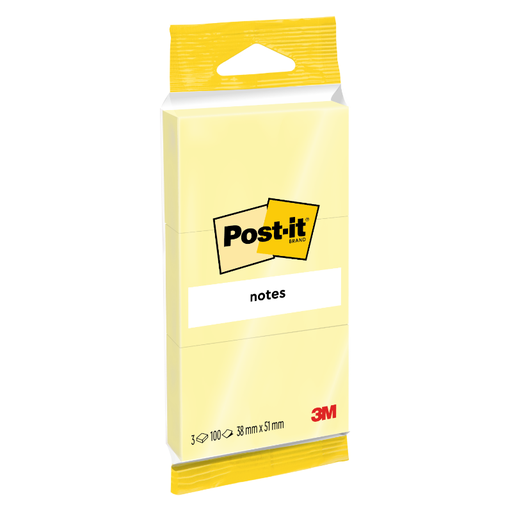
Why this choice suits this profile: its compact size and three pads are ideal for everyday reminders at home, in class or at the office.
The size is clearly specified and the pack remains limited, helping you avoid buying too many pads for occasional use.
100 sheets per pad, three pads per pack, yellow colour and repositionable adhesive, as stated on the product page.
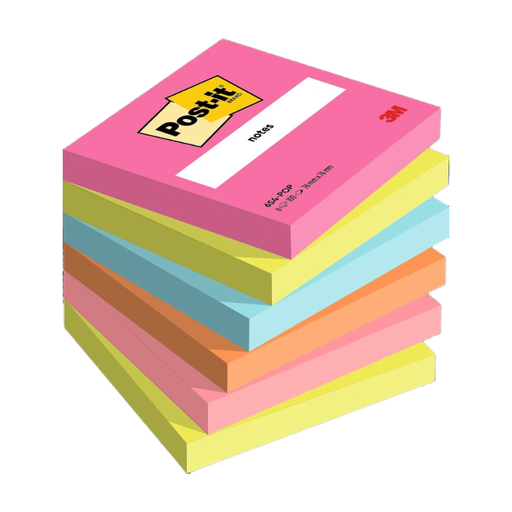
Why this choice suits this profile: the coordinated colours make it easier to organise tasks, ideas and messages visually.
The 76 mm square provides more room than a mini memo note, while the six pads allow you to separate different categories.
Six 100-sheet pads, multiple colours and paper specified as 100% PEFC.
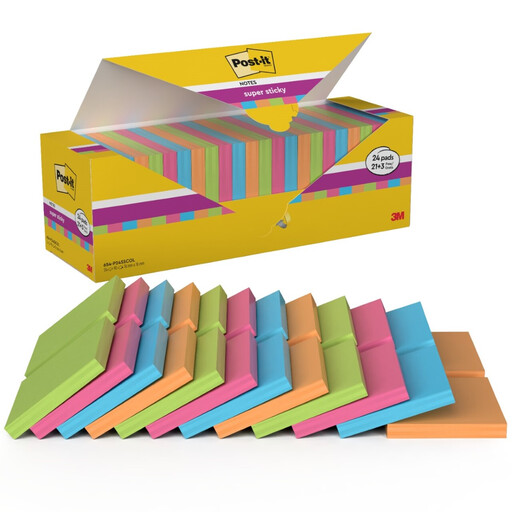
Why this choice suits this profile: the 24-pad pack meets the needs of a department, classroom or intensive user.
The Super Sticky adhesive is advertised for vertical and challenging surfaces, with removal and repositioning possible according to the product page.
21 pads purchased and 3 pads free, 90 sheets per pad, assorted colours and PEFC-certified paper according to the product page.
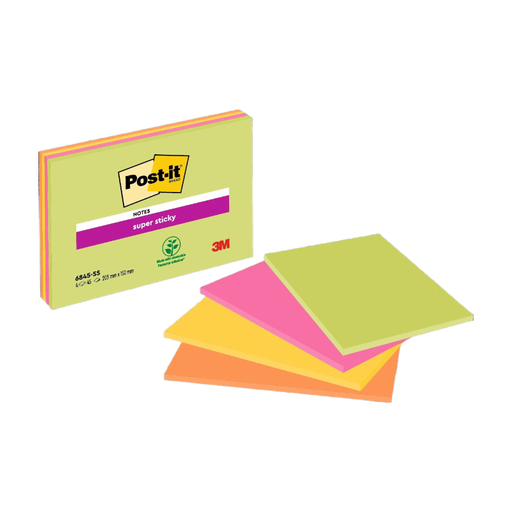
Why this choice suits this profile: its large lined surface makes it easy to write lists, minutes or diagrams during a meeting.
Its format is designed for longer content, so you can avoid using multiple small pads whenever several lines are needed.
45 sheets per pad, four pads per pack, lined format and Super Sticky adhesive, as stated on the product page.
Browse our complete selection of available products, with different formats, colours, pack sizes and levels of adhesion.
Its longevity depends on the surface, dust, moisture, temperature and handling. A note applied to a clean, dry surface will generally hold better than one placed on a textured or damp surface. For prolonged display, check regularly that it is still securely attached.
This is possible depending on the type of paint and the condition of the wall, but every surface reacts differently. Test the note in an inconspicuous area, remove it slowly and avoid crumbly, freshly painted or damp surfaces. The term “repositionable” does not guarantee that no marks will be left on every type of finish.
The price per sheet varies according to the format, number of sheets and pack size. A larger format can reduce the number of notes needed for a list, while a smaller format limits waste for a simple reminder. To compare them, divide the pack price by the total number of sheets, then check that the size genuinely suits your needs.