Households replacing an electric or ceramic hob
First check the dedicated circuit, the fitting dimensions and whether your cookware is compatible before switching to induction.


Choose induction if your cookware has a ferromagnetic base and your installation can accommodate the hob you have in mind. A ceramic hob lets you use non-ferromagnetic cookware, while a combination induction-gas hob also requires you to confirm the ventilation and gas connection requirements.
First check the dedicated circuit, the fitting dimensions and whether your cookware is compatible before switching to induction.
Compare the number of cooking zones that can genuinely be used at the same time, the zone diameters and whether there is a flexible or extendable zone, rather than looking only at the hob’s width.
A combination hob may meet this need, provided you also check the ventilation, gas supply and installation requirements for your home.
Worth considering: if your cookware is induction-compatible and the dedicated circuit is suitable for the model you choose.
Bear in mind: non-ferromagnetic cookware will not work; also check the zones and functions of the exact model.
Worth considering: if you want to continue using non-ferromagnetic cookware.
Compare: the size and layout of the cooking zones, any extendable zones and the fitting dimensions.
Worth considering: if cooking with gas remains useful in your everyday routine while also adding induction zones.
Bear in mind: the checks relating to induction cookware, gas, positioning and ventilation.
| Priority | What to check | Your needs |
|---|---|---|
| Cookware compatibility | Test the base of your saucepans and frying pans with a magnet; induction requires a ferromagnetic base. Check the items you use most often before choosing the technology. | I want to keep my current cookware without having to replace incompatible items straight away. |
| Cooking zones and dish sizes | Compare the number and diameter of the cooking zones, as well as the independent timers. For a griddle or rectangular dish, look for a flexible or extendable zone specified for the model. | I sometimes prepare several dishes at once or use large frying pans and non-round dishes. |
| Existing installation | Measure the cut-out dimensions, the space beneath the hob and the type of connection required. For a combination hob, also check the gas supply and the home’s ventilation. | I want to replace my hob without discovering too late that the worktop or connections are unsuitable. |
| Practical features | Compare the controls, timer, child lock, residual heat indicator and features such as the booster, but only where they are specified for the model you have chosen. | I am looking for a practical hob when several dishes have different cooking times. |
A saucepan without a ferromagnetic base cannot activate an induction zone, as Que Choisir points out.
Test the base of every item you use regularly before choosing induction; if several important pieces are incompatible, also compare the ceramic option.
In France, Bosch offers 60 cm induction and ceramic hobs, including models with four cooking zones and flexible zones.
In its French range, Siemens offers 60 cm induction hobs with four cooking zones and a flexible zone.
In France, Electrolux offers ceramic hobs and combination induction-gas hobs for households deciding between keeping gas and switching to induction.
These Joybuy options cover induction and ceramic hobs for replacing a domestic hob.
 Image unavailable
An option for cooking several dishes at once with induction-compatible cookware.
Four zones, nine power levels, Boost function, timer, pan detection, child lock and residual heat indicator are specified. Stated cut-out: 565 × 495 mm; stated power: 7 200 W.
It requires cookware with a ferromagnetic base. No flexible or extendable zone is specified for large rectangular dishes; also check the circuit, cut-out and ventilation beneath the hob.
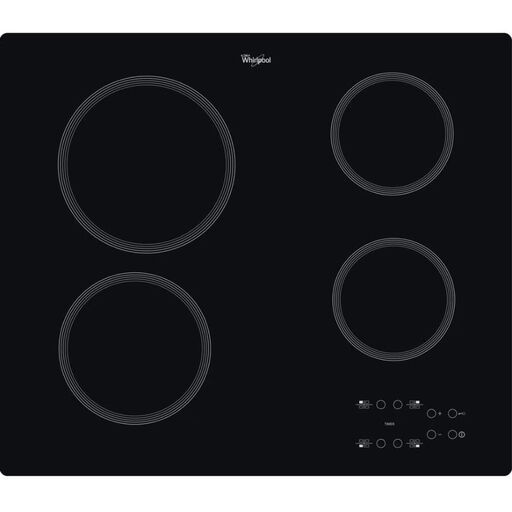 Image unavailable
This ceramic hob is suitable for households wanting to keep using non-ferromagnetic cookware.
Four radiant zones, including two 145 mm zones and two 180 mm zones, nine power levels per zone, a timer for each zone, touch controls, child lock and residual heat indicator are specified. Stated cut-out: 560 × 490 mm.
The radiant surface remains hot after cooking. No flexible or extendable zone is specified; check that the cut-out is compatible with your worktop.
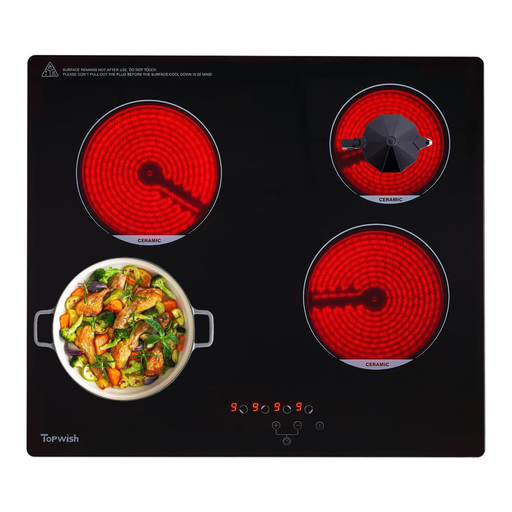 Image unavailable
A ceramic option for cooking with different types of cookware across four zones.
The description specifies four zones, touch controls, a timer, child lock, automatic switch-off and a residual heat indicator. Stated cut-out: 560 × 490 mm.
The total power and information about dual-circuit zones must be confirmed in the manual. Also check the fixed connection and fitting compatibility.
The base must be ferromagnetic. According to Que Choisir, a saucepan without a ferromagnetic base will not allow the induction hob to switch on. Check every item before choosing induction, or plan to replace any incompatible cookware.
No. Promotelec states that a cooking hob requires a dedicated circuit, with a 32 A connection box for single-phase or 20 A for three-phase installations. Before buying, check the existing installation, the connection specified in the manual and the model’s power rating.
No. External width alone is not enough: compare the fitting height, width and depth specified in the manual. For example, an Electrolux EHF6547FOK ceramic hob measuring 590 × 520 mm specifies a fitting size of 38 × 560 × 490 mm.
Yes. GRDF states that gas hobs are open-flue appliances requiring suitable ventilation. Have the gas supply, air vents, positioning and connection assessed for the installation in question.