To replace an integrated fridge, first check the housing dimensions, how the cabinet door is attached and the ventilation requirements in the manual for the model you’re considering. Then choose a single-door fridge if you don’t need a freezer, or a fridge-freezer if you store frozen food. If the appliance won’t fit your kitchen unit, you could install a freestanding model elsewhere, but you won’t automatically be able to reuse the existing cabinet door.
Who is this option for?
Households keeping their fitted kitchen
If you’re keeping the unit and its door, start by measuring the housing and identifying how the cabinet door connects to the appliance door. Also check that the ventilation openings specified in the manual will remain unobstructed.
Households that store frozen food
An integrated fridge-freezer gives you a separate freezer compartment. Compare the capacity of both compartments and check that your cabinet doors are compatible with the fitting method for the model you choose.
Households whose housing is no longer suitable
If the unit won’t allow an integrated model to be installed correctly, consider placing a freestanding appliance elsewhere, in a suitable spot. It won’t, however, fit behind the existing cabinet door.
What should you check before choosing?
Integrated single-door fridge
Consider this if: you only need a fridge and the housing and cabinet door match the model’s installation instructions.
Bear in mind: a single-door fridge isn’t necessarily equipped with a freezer compartment.
Integrated fridge-freezer
Consider this if: you need a freezer and your kitchen unit can accommodate the model’s compartments and cabinet-door fitting.
Bear in mind: the freezer takes up some of the total capacity, so compare the litre capacity of each compartment separately.
Freestanding elsewhere
Consider this if: the appliance isn’t compatible with your kitchen unit and you have another location that meets the installation requirements.
Bear in mind: the appliance will no longer be concealed behind your fitted kitchen’s cabinet door.
Once you’ve chosen the type of appliance, check each model against your existing kitchen unit before comparing capacity and energy consumption.
| Priority | What to check | My needs |
|---|
| Housing and ventilation |
Compare the internal dimensions H × W × D with the model’s housing dimensions, not just the appliance dimensions. Check the air inlets and outlets specified in its manual: Liebherr says not to obstruct those on the unit or the appliance. |
I want to keep my kitchen unit without blocking ventilation to the new fridge. |
| Cabinet door and opening |
Identify whether the appliance uses a sliding-door or fixed-door fitting, then check the parts, dimensions and opening direction specified for the model. A reversible door doesn’t necessarily mean your existing cabinet door will fit. |
The cabinet door needs to open properly with the new appliance door. |
| Fridge and freezer capacity |
Check whether there’s a freezer compartment and note the litre capacity of each section. For a fridge-freezer, check how the stated power-cut storage time is defined rather than assuming it guarantees a particular storage period. |
If I keep frozen food, I need a freezer compartment with enough capacity for how I use it. |
| Energy consumption and temperature |
Compare kWh/year figures for appliances intended for the same use, then compare temperature-retention tests carried out using the same method. Anses recommends keeping the coldest part of the fridge between 0 and +4 °C. |
I want to compare the stated energy consumption and check the temperature once the appliance is installed. |
What mistakes should you avoid?
-
Relying on the appliance dimensions alone
The external dimensions may differ from the required housing dimensions. A unit that’s a similar size may also have ventilation that doesn’t meet the requirements in the manual.
Measure the inside of the unit and compare it with the installation diagram for the exact model, including the ventilation openings.
-
Assuming a reversible door means you can reuse the cabinet door
With a sliding-door fitting, rails connect the cabinet door to the appliance door. A fixed-door fitting works differently.
Identify the existing fitting and check the system, required parts and opening direction in the manual for the model you’re considering.
-
Comparing only total capacity or energy rating
A fridge without a freezer, a fridge-freezer and a freestanding appliance won’t divide their capacity in the same way. Stated energy consumption and temperature stability are also measured using different criteria.
First decide whether you need a freezer and an integrated appliance. Then compare capacity by compartment, kWh/year and tests carried out using the same method.
A few brand examples
These models illustrate different formats and fitting methods; their inclusion here doesn’t confirm that they’ll fit your kitchen unit.
Bosch
Bosch product pages feature both integrated single-door fridges and fridge-freezers.
- According to Bosch, the KIR18NSF0 is a single-door model with a sliding-door fitting and no integrated freezer compartment.
- The KIN86SFE0 fridge-freezer uses fixed-door hinges, so check that its cabinet-door fitting matches your existing unit.
Liebherr
Liebherr product pages give the housing dimensions and door-fitting details for each model.
- For the ICNSe 5103 fridge-freezer, Liebherr specifies a housing size of 177,2–178,8 × 56–57 × 55,0 cm and a sliding-door fitting.
- These dimensions and fitting details apply to this specific model. Check the manual for any other model you’re considering.
Electrolux
The KRF6DD18S1 is an integrated single-door fridge for refrigeration, with no freezer compartment listed on its product page.
- For this model, Electrolux specifies a sliding-door fitting, 307 L of fridge capacity and 91 kWh/year.
- These specifications alone don’t tell you whether it will fit your housing or how well it will maintain a stable temperature in practice.
Whirlpool
Whirlpool’s integrated range includes both single-door fridges and fridge-freezers.
- According to Whirlpool, the WHSS 2131B4 is a single-door model with a sliding-door fitting for an 88 cm housing, with a total capacity of 110 L.
- The WHC18T323P fridge-freezer is designed for different freezer needs. Check its own dimensions and fitting rather than assuming they’re the same as those of the single-door model.
Integrated fridges on Joybuy
This selection includes three integrated fridge-freezers and one integrated single-door fridge. Before replacing your appliance, check the housing, cabinet door and ventilation against the manual for the model you choose.
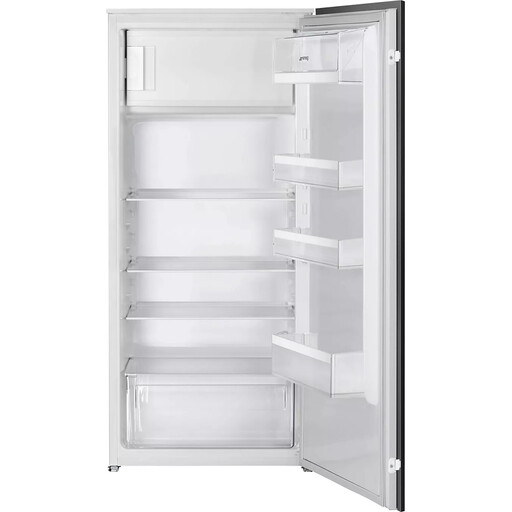 Image unavailable
SMEG S4C122E, integrated single-door fridge-freezer, 188 L
If you’re considering a single-door integrated appliance with a freezer, check that the top compartment suits your needs. The model name gives a total capacity of 188 L and an E energy rating. Also check the housing dimensions and cabinet-door fitting in the manual.
View on Joybuy
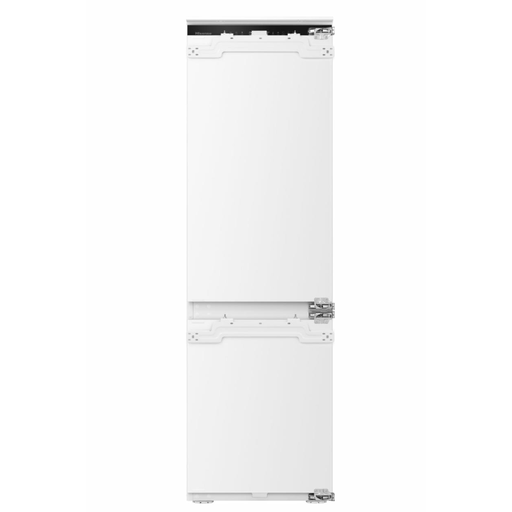 Image unavailable
Hisense RB3B250SAWC, integrated fridge-freezer, 252 L
This fridge-freezer is worth considering if you want a freezer compartment in your fitted kitchen. Its product name lists a capacity of 252 L, No Frost, an Inverter compressor and a C energy rating. Before choosing it, check the housing dimensions and cabinet-door fitting in the manual.
View on Joybuy
 Image unavailable
AEG NSC6M18FES, integrated fridge-freezer, 249 L
If you need both fridge and freezer space in a kitchen unit, compare the capacity of each compartment with how you’ll use it. This model’s product name lists a capacity of 249 L, TwinTech No Frost and an E energy rating. Check the housing dimensions, door fitting and kWh/year separately.
View on Joybuy
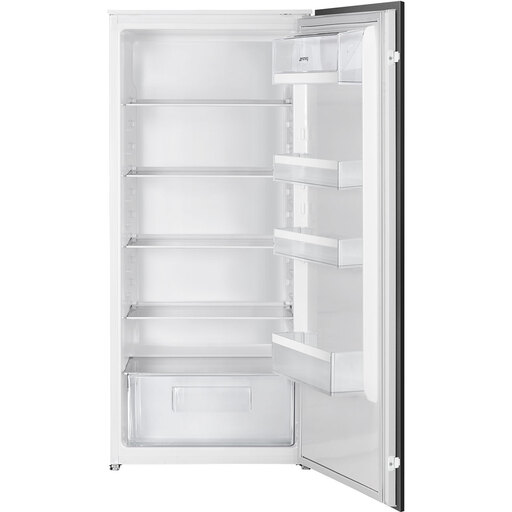 Image unavailable
SMEG S4L120E, integrated single-door fridge, 188 L
This single-door option is for those who need fridge space rather than a fridge-freezer. Its product name lists a capacity of 188 L and an E energy rating. Check whether it has a freezer compartment, along with the model’s housing dimensions and cabinet-door fitting.
View on Joybuy
Frequently asked questions
What should I measure before ordering an integrated fridge?
Measure the available height, width and depth of the housing, then check the cabinet-door dimensions, hinge positions and ventilation openings. Compare these with the housing dimensions and ventilation diagram in the manual for the exact model, rather than relying on its external dimensions alone.
Can I keep my cabinet door if I switch from a sliding-door to a fixed-door fitting?
Don’t assume you can just because the dimensions are similar. According to Bosch, a sliding-door fitting uses rails to connect the cabinet door to the appliance door; a fixed-door fitting works differently. Check the dimensions, maximum load and specified parts in the manual for the new model.
How can I check that food is being stored safely after installation?
Check the temperature at the coldest point: Anses recommends storing food there between 0 and +4 °C. A thermometer can help you check the temperature setting in everyday use. To compare models before buying, look for temperature-retention tests carried out using the same method.
Does the energy rating also tell me how long food will stay frozen during a power cut?
No. Compare kWh/year figures for stated energy consumption, and check separately how the power-cut storage time is measured for models with a freezer. In its test, Que Choisir measures how long it takes for the freezer to warm from −17 to −9 °C without power. This result alone doesn’t guarantee how long all food will stay safe to eat.


