What should you compare?
First choose the freezer set-up you really need, then compare the usable capacity, dimensions and kWh/year figures of models that suit the way you’ll use them.
| What matters |
What to check |
Who is it for? |
| Electricity consumption |
Compare the kWh/year figures and energy ratings of specific models, making sure their capacity and features suit the same needs. |
If I want to limit the consumption of an appliance that runs continuously, I compare models that can store the food my household needs. Around 36% of consumers put electricity consumption first. |
| Freezer capacity |
Check the freezer compartment’s capacity and star rating, without confusing it with the appliance’s total capacity. |
If I regularly store frozen food, I check whether a small compartment will be enough or whether I need a separate freezer section. Around 29% of consumers prioritise frozen-food storage. |
| Fresh-food capacity |
Compare the usable fridge capacity with the amount of food you usually store and how often you shop. |
If my old appliance is too small or too large, I look for a capacity that suits the food I buy and my shopping habits. Fresh-food capacity is the priority for around 21% of consumers. |
| Dimensions and installation type |
Measure the space and access route, then check the model’s dimensions and installation type. |
If I’m replacing an appliance in a fitted kitchen, I check that its dimensions and installation suit the existing space. A good fit in the kitchen is a priority for around 14% of consumers. |
Fridge-freezers available
The models featured are fridge-freezers with separate fridge and freezer compartments. Some are designed for integrated installation.
 Image unavailable
Samsung RB33B612EBN, 344 L fridge-freezer, E energy rating
Worth considering if you’re looking for separate spaces for fresh and frozen food in a freestanding model.
Fridge capacity: 230 L; freezer capacity: 114 L; stated energy consumption: 254 kWh/year; E energy rating.
The product information also lists No Frost, a reversible door and an open-door alarm.
Joybuy
 Image unavailable
AEG NSC6M18FES, 249 L integrated fridge-freezer, E energy rating
Worth considering for a fitted kitchen if you’re looking for separate capacity for fresh and frozen food.
Fridge capacity: 186 L; freezer capacity: 62 L; E energy rating.
This model is listed as integrated. Check that it’s compatible with your existing space and cabinet.
Joybuy
 Image unavailable
Hisense RB3B250SAWC, 252 L integrated fridge-freezer, C energy rating
Worth considering if you need separate fridge and freezer compartments in an integrated appliance.
Fridge capacity: 176 L; freezer capacity: 76 L; stated energy consumption: 150 kWh/year; C energy rating.
Check the dimensions and installation requirements for your kitchen.
Joybuy
 Image unavailable
Haier HTW5618ENMG, 360 L three-door fridge-freezer, E energy rating
Worth considering if you’re looking for separate capacity for fresh and frozen food in a freestanding appliance.
Fridge capacity: 235 L; freezer capacity: 125 L; stated energy consumption: 271 kWh/year; E energy rating.
The product information lists Total No Frost, a four-star freezer and Holiday mode.
Joybuy
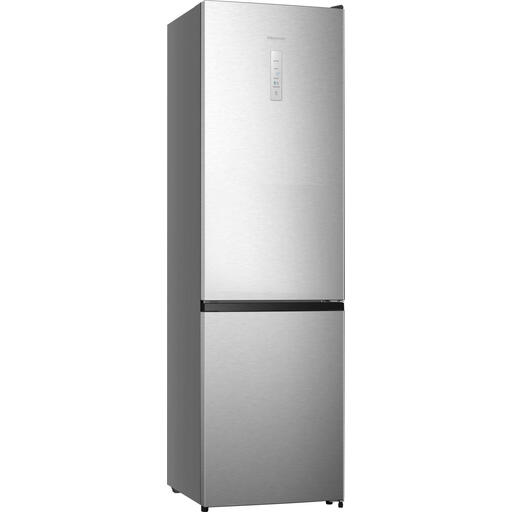 Image unavailable
Hisense RB440N4CCB, 336 L fridge-freezer, B energy rating
Worth considering if you’re looking for a freestanding model with separate capacity for fresh and frozen food.
Fridge capacity: 238 L; freezer capacity: 98 L; stated energy consumption: 135 kWh/year; B energy rating.
The product information lists Total No Frost, a reversible door and a fast-freeze function.
Joybuy
Frequently asked questions
Is the energy rating enough to tell you how much electricity an appliance uses each year?
No. Also compare the kWh/year figures and capacities listed for models that meet your needs. To estimate the annual cost, multiply the kWh/year figure on the label by the price per kWh under your tariff. This calculation, based on declared consumption, doesn’t guarantee the amount of your bill. You can also look up the models in the European Commission’s EPREL database.
How do you check the fridge temperature once it’s installed?
Anses recommends a temperature of 0 to +4 °C at the coldest point and regular checks, for example with a thermometer. Don’t overfill the appliance and clean it regularly. These usage tips aren’t enough to establish the performance of a specific model.
What happens to your old fridge when you replace it?
When replacing an appliance, ADEME says you can hand the old one to the retailer or delivery driver, or take it to the appropriate area at a household waste recycling centre. The DGCCRF describes the ‘one-for-one’ take-back of electrical appliances when you buy a new one. Ask the retailer how collection and removal will be arranged for your delivery.
Do you need a paid extension to benefit from a warranty?
No. If you buy from a professional retailer, you can make a claim under the legal guarantee of conformity for two years for a new or second-hand item. An optional commercial warranty is in addition to your legal guarantees; it doesn’t replace them.
Are energy labels for domestic fridges regulated in France?
Yes. The DGCCRF includes domestic refrigeration appliances among the products covered and specifies that energy labels and product information sheets must be written in French. There are conditional exceptions for some refurbished appliances, so check the information that applies to the product in question.


