What to compare
If you’re planning to replace an appliance in France, compare your current appliance and how you use it before deciding whether to maintain, repair or replace it.
Keep and maintain
Worth considering: the appliance still does its job, and there’s no clear improvement in how you use it to justify replacing it.
Bear in mind: you won’t necessarily get the energy consumption of a newer model.
Repair
Worth considering: a repair could extend the appliance’s useful life.
Bear in mind: the outcome depends on the repair and how much longer you’ll use the appliance; a repair won’t change its energy consumption.
Replace with a suitable appliance
Worth considering: the appliance no longer meets your needs, or a credible reduction in electricity use justifies replacing it.
Bear in mind: excess capacity or features you don’t need can reduce the savings you expect.
When planning a replacement in France, consumers may prioritise different trade-offs. The percentages show the share of consumers who put each concern first in the situations described.
| Concern |
What to check before buying |
Consumers concerned |
| Avoid replacing an appliance too soon |
Energy use of the current appliance over a known period; maintenance options or a repair quote. |
If my appliance still works, I want to avoid buying a new one when the electricity savings wouldn’t justify it. Around 27% of consumers put avoiding premature replacement first. |
| Use fewer kWh |
kWh/year for refrigeration or kWh/100 cycles for washing, taking your usual usage and programmes into account. |
When I want to reduce my energy use, I compare figures that reflect how I use the appliance rather than relying on its rating alone. Around 27% of consumers prioritise using fewer kWh. |
| Choose the right capacity and programmes |
Compartment volume or capacity in kg or place settings; programmes you’ll actually use. |
If load sizes or storage needs vary, I want a suitable capacity without choosing a size I don’t need. Around 20% of consumers prioritise matching capacity to their needs. |
| Keep noise to a minimum |
Noise level shown for the relevant product category and operating stage, such as the spin cycle or dishwasher cycle. |
If the appliance is near a living area, I pay attention to noise during stages that could disturb the household. Around 13% of consumers make quiet operation their priority. |
| Choose an appliance with a longer useful life |
The rating that applies to the product category and available repairability or durability information. |
If I want to keep my next appliance for a long time, I check the repair information relevant to its category without treating it as a promise of longevity. Around 13% of consumers prioritise useful life. |
ADEME explains that the energy label for washing appliances shows consumption for reference cycles. In France, dishwashers are among the appliances covered by the repairability index. For washing machines, the durability index replaced the repairability index from 8 April 2025, according to the ministry responsible for the ecological transition.
Joybuy products for these needs
This selection includes dishwashers and fridge freezers. Compare them based on capacity, their stated energy rating and installation requirements.
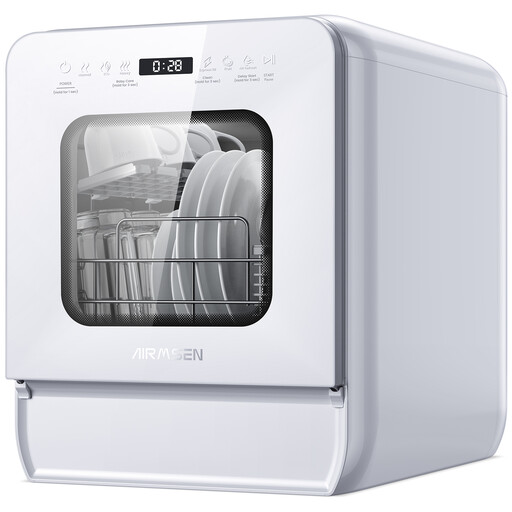 Image unavailable
AIRMSEN tabletop dishwasher with 5 L tank, energy rating D
Its tabletop design may suit a smaller space, provided its stated capacity of up to 4 place settings meets your household’s needs.
Energy rating D; stated consumption of 0.58 kWh per cycle; supplied by a 5 L tank or connected to a tap.
View on Joybuy
 Image unavailable
Heinrichs HTG 8840 Schwarz tabletop dishwasher
This tabletop model may suit your needs if its capacity of 6 place settings and water connection are compatible with your planned installation.
Energy rating D; 49 kWh per 100 uses; 6.5 L of water per cycle; stated noise level of 47 dB; 7 programmes.
View on Joybuy
 Image unavailable
AEG NSC6M18FES built-in fridge freezer, 249 L
Consider this model if you’re looking for a built-in appliance and the available cabinet space is suitable for installation.
Stated total capacity of 249 L; energy rating E; noise level of 37 dB(A); freezing capacity of 5 kg/24 h.
View on Joybuy
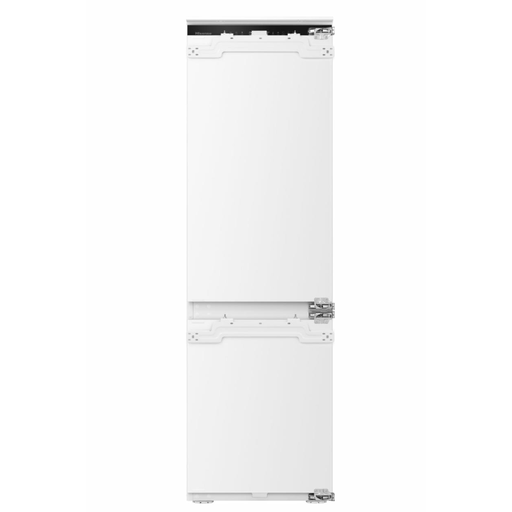 Image unavailable
Hisense RB3B250SAWC built-in fridge freezer, 252 L
This built-in model may suit your needs if its dimensions and ventilation requirements match the space available.
Stated total capacity of 252 L; energy rating C; annual consumption of 150 kWh; noise level of 34 dB(A).
View on Joybuy
 Image unavailable
Samsung DW70H72WCB0U1 built-in dishwasher, 13 place settings
Consider this model if you need a fully integrated dishwasher with 13 place settings and the cabinet space is suitable for installation.
Energy rating C; capacity of 13 place settings; stated noise level of 44 dB(A).
View on Joybuy
Frequently asked questions
How can I estimate the annual energy use of a washing appliance?
Divide the figure in kWh per 100 cycles by 100, then multiply it by the number of cycles you run each year to get an estimate. The energy label is based on reference conditions, so different programmes, loads or usage frequencies can change actual consumption. For a fridge, start with the kWh per year figure shown and compare models with capacities that suit your needs.
What maintenance should I consider before replacing an appliance?
Check the maintenance instructions for your model and see whether a simple task could extend its useful life. If you need a professional repair, ask for a quote and check the terms of the Repair Bonus: according to ADEME, both the appliance and the professional must be eligible.
Does the Repair Bonus replace the legal guarantee of conformity?
No. For goods bought from a professional seller, the legal guarantee of conformity applies under its own terms, while a commercial guarantee is separate. Subject to certain conditions, the Repair Bonus contributes towards repairing an eligible appliance with an accredited professional; it doesn’t replace your rights relating to the purchase.
What labels should I check in France, and what happens to my old appliance?
For a new appliance covered by the scheme, check the energy label and product details: the scale depends on the category. The repairability index applies to dishwashers, among other products. For washing machines, the durability index replaced the repairability index from 8 April 2025. When buying a new appliance, ask the retailer about free like-for-like take-back of equivalent used equipment and how it works in practice.


