What should you check before replacing your fridge?
When deciding whether to replace your fridge, first compare what your old and new appliances can do, then look at their annual energy use. The energy label, as explained by ADEME, helps you compare models, but the rating letter is no substitute for checking annual kWh and the capacity of each compartment.
| Criteria |
What to check |
Relevant to |
| Difference in energy use |
The annual kWh of your old appliance and the model you are considering, comparing similar types and capacities; your actual electricity tariff per kWh to calculate the difference in running costs. |
If my current fridge is still working, I want to know how replacing it would affect my bill. Around 36% of consumers would put this calculation first when making their decision. |
| Fresh and frozen food capacity |
The capacity in litres of each compartment, not just the total, as well as the appliance type. |
I regularly freeze food, but I don’t want to reduce the space available for fresh food unnecessarily. Around 29% of consumers would prioritise how the capacity is divided. |
| Features and maintenance |
The defrosting system, alarms and food-preservation features of the specific model; check its annual kWh separately. |
If defrosting or alerts matter in my day-to-day life, I look for features I’ll genuinely use. Around 21% of consumers would put this convenience first. |
| Installation and noise |
The dimensions, available space and fixing system if it’s a built-in appliance, the door-opening direction and the noise level. |
In a kitchen with existing cabinetry or one that opens onto the living area, the fridge needs to fit and its noise level needs to suit me. Around 14% of consumers would consider compatibility and noise decisive. |
Brands to consider
These ranges offer models and specifications to compare. Choose based on the features of the model you’re considering, not the brand alone.
Bosch
The French range includes freestanding fridge freezers, with product information that lets you compare compartments and features.
- For the KGE39AWCA and KGN39AIAU, Bosch lists the fridge and freezer capacities, energy rating, noise level and whether or not they have No Frost.
- These features vary between the two models, so check the product information for the model and configuration you’re considering.
Liebherr
The brand offers single-door fridges and fridge freezers, making it easier to work out how much freezer space you need first.
- Its ranges distinguish between appliances designed mainly for fresh food and fridge freezers with a separate freezer compartment.
- Liebherr’s claims about the low energy use of certain models don’t apply to the entire range. Compare the annual kWh and capacity of the specific model.
Whirlpool
The French range includes freestanding and built-in fridge freezers, with features that vary by model.
- Whirlpool’s product information for the built-in WHC18T132FR fridge freezer lists a total capacity of 250 L and energy use of 224 kWh per year.
- These figures apply to the WHC18T132FR, not all Whirlpool fridge freezers. Check the built-in installation requirements too.
Electrolux
The brand’s built-in fridge freezers are worth considering when the available space and the split between compartments are key to your choice.
- Electrolux’s product information for the ENS3LE18S lists 219 kWh per year, with 198 L of fridge space and 73 L of freezer space.
- These figures apply to the ENS3LE18S. The stated benefits of its food-preservation technologies don’t replace the need to compare energy use, capacity and installation requirements.
Fridges to consider on Joybuy
These appliances with freezer compartments illustrate a range of capacities and formats to consider when replacing your fridge. Before choosing, check that their capacity and installation type suit your needs, then verify the energy figures on the exact model’s label.
 Image unavailable
Hisense RB3B250SAWC, 252 L built-in fridge freezer
Worth considering if you’re looking for a built-in appliance with fridge and freezer compartments in one unit.
The product title lists No Frost, a C rating and an Inverter compressor. Check the available space and fixing system, then look up the capacity of each compartment and the annual kWh on the energy label for the exact model.
View on Joybuy
 Image unavailable
Haier HTW5618ENMG, 360 L three-door fridge freezer
This format is worth considering if you regularly use both the fridge and freezer compartments.
The product title mentions Total No Frost, an E rating, Wi-Fi and My Zone. Check that the capacity of each compartment suits your needs, and look up the annual kWh on the energy label.
View on Joybuy
 Image unavailable
Candy CFQQ5T817EPS, 467 L four-door fridge freezer
Consider this capacity if your fresh and frozen food needs justify having plenty of space for both.
The product title lists Total No Frost, an E rating and Smart Inverter. Compare the capacity of each compartment with your usual needs before checking the annual kWh for the exact model.
View on Joybuy
 Image unavailable
Samsung RF50C530EB1, 495 L multi-door fridge
This larger format is worth considering if you need plenty of space for fresh and frozen food.
The product title lists an E rating. Before comparing it with your current appliance, check the capacity of each compartment, the annual kWh and the space required for installation.
View on Joybuy
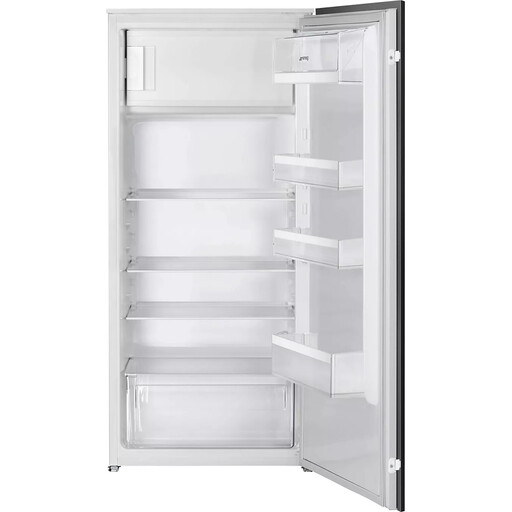 Image unavailable
SMEG S4C122E, 188 L built-in single-door fridge with freezer
This format is worth considering if you mainly need fridge space, with a small integrated freezer compartment.
The product title lists an E rating and a top-mounted freezer. Check the capacity of each compartment, the defrosting requirements, the annual kWh and whether it fits your available space.
View on Joybuy
Frequently asked questions
Which figures should you compare between two new fridges?
Compare annual kWh and the separate fridge and freezer capacities of appliances that meet the same needs. Then check the installation type, noise level and features. The European EPREL database lists these details for registered models.
Is a better energy rating enough to justify replacing your fridge?
No. The rating doesn’t show the difference compared with your current fridge. If you know or can measure its annual energy use, compare it with the annual kWh of a new appliance of a similar type and capacity. Then apply your actual tariff per kWh to the difference to estimate the electricity cost of running it.
Does a fridge freezer always use more energy than a single-door fridge?
The appliance type alone isn’t enough to tell. A fridge freezer has a separate freezer compartment. If you need one, compare the annual kWh of models with storage capacities suited to your needs, rather than comparing a large fridge freezer with a smaller single-door appliance.
What should you check before replacing a built-in fridge?
Check the dimensions of the available space and the new appliance, the fixing system, the door-opening direction and the installation instructions. Also check the capacity of each compartment and the noise level: the model must fit your cabinet and meet your storage needs.


