Which criteria should you prioritise?
Start with the appliance you’re replacing, then compare models that can do the same job. The European Commission lists refrigeration energy use in kWh per year, while washing machines and dishwashers are rated in kWh per 100 cycles, so these figures are not directly comparable.
| What matters to you |
What to check |
Who this is relevant to |
| Refrigeration and usable capacity |
Compare annual kWh for fridges and freezers of a suitable type and size; check how the space is divided between fridge and freezer compartments. |
If my appliance runs continuously, I want to look at its energy use without losing the space I need for food. Around 36% of consumers prioritise refrigeration and storage. |
| Laundry cycles |
Check the kWh per 100 cycles, water use per cycle and a capacity that suits your usual loads. |
If I do laundry frequently, I’m looking for a washing machine that suits the amount of washing I do and my water use. This is the top priority for around 29% of consumers. |
| Dishwashing and daily routines |
Check the number of place settings you need, the Eco programme duration and noise level, as well as the energy and water figures on the label. |
When dishes need washing every day, I want the capacity and cycle duration to fit my routine, especially if the kitchen is near a living area. Around 21% of consumers make this a priority. |
| Repair before replacement |
Identify your current model and find out whether it can be repaired. For a new appliance, check the applicable index and service information for the exact model. |
Before buying, I’d rather know whether my appliance can be repaired and whether the next one comes with useful maintenance information. Durability is the top priority for around 14% of consumers. |
Appliances to explore on Joybuy
These fridge-freezers, washing machines and dishwashers cover the three types of appliance to consider before replacing one. Compare their format and capacity with your needs, then check the energy figures for the exact model in its product information sheet before comparing appliances in the same category.
 Image unavailable
Haier HTW5618ENMG, 3-door fridge-freezer, 360 L
Worth considering if you need a three-door refrigeration appliance with a stated capacity of 360 L. The model name lists an E energy class and Total No Frost. Check the usable capacity of each compartment, the annual kWh on the energy label and the space needed for installation.
View on Joybuy
 Image unavailable
Haier T Series 7 THASN276TM6-S, 7 kg top-loading washing machine
A top-loading model is worth considering if this format suits your utility room and 7 kg is right for your loads. The model name lists 1,200 rpm and an A energy class. Check the label for consumption per cycle, the reference programme duration and spin noise.
View on Joybuy
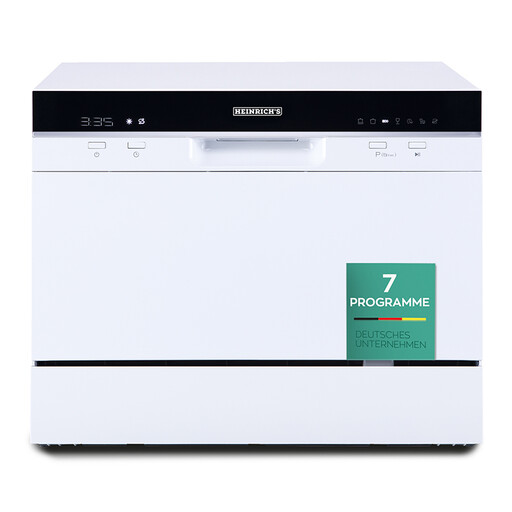 Image unavailable
Heinrich's HTG 8840 Weiss, 6-place-setting tabletop dishwasher
This tabletop format could suit a kitchen where a 6-place-setting appliance meets your needs, provided the space and connections are suitable. The product name lists a D energy class, 7 programmes and 47 dB. Check the energy information sheet for consumption and Eco programme duration before comparing it with other models.
View on Joybuy
 Image unavailable
Candy CFQQ5T817EPS, 4-door fridge-freezer, 467 L
Consider this model if you need 467 L of storage and have room for a four-door appliance in your kitchen. The model name lists an E energy class and Total No Frost. Check the annual kWh and compartment capacities on the model information sheet. Also make sure there is enough clearance to open the doors.
View on Joybuy
 Image unavailable
Candy TCA464TM4-S ProWash 500, 6 kg top-loading washing machine
This top-loading model is worth considering if a 6 kg capacity suits your laundry loads. Its name lists 1,400 rpm, a B energy class and 17 programmes. Compare the reference cycle consumption and check the spin noise level and required connections.
View on Joybuy
Frequently asked questions
Can you compare a fridge’s kWh directly with a washing machine’s?
No. According to the energy labelling information provided by the European Commission, a fridge shows kWh per year, while a washing machine shows kWh per 100 cycles. Start by comparing models in the same category that suit similar needs.
Will a new energy label show how much I’ll save on electricity?
No. It provides a standardised basis for comparing models, not the savings you’ll make by replacing your appliance. To estimate your costs, consider how often you use the appliance, the programmes or settings you choose and the price you pay for electricity.
Why check the Eco programme duration on a dishwasher?
The energy and water figures on its label relate to this reference programme. Check that the duration fits your routine; don’t assume other programmes will deliver the same figures.
Which index should you check before buying a washing machine or dishwasher in France?
According to the French ministries responsible for the ecological transition, the durability index applies to washing machines covered by this labelling, while the repairability index applies to covered dishwashers. Alongside the energy label, dimensions and your needs, check the index that applies to the exact model.
Where can you check the energy specifications for a particular model?
Check its product information sheet and, if its energy label has a QR code, the data in the European EPREL register. Before comparing figures, make sure the reference and variant match the appliance you’re considering.


