Before replacing a faulty appliance, consider whether it makes sense to have it repaired. If you decide to buy a new one, compare its energy consumption with that of models in the same category, using the same reference basis. Capacity, noise and installation requirements should also suit the way you use it. For the categories covered in France, the repairability or durability index provides an additional point of comparison, but does not predict the lifespan of any individual appliance.
Who are these criteria useful for?
Households mindful of energy and water use
If you’re replacing an appliance, compare the energy figures and, where shown on the label, water use for models in the same category. ADEME recommends taking account of the indicators specific to each appliance; your own usage habits remain a key factor.
Households looking for an appliance that suits their needs
If load size, noise or cycle length matters in your day-to-day life, check these factors as well as the energy class. A capacity that doesn’t suit your usual loads can make a model impractical.
Shoppers deciding whether to repair or replace
If your current appliance has broken down, ask what repair is possible before choosing a replacement. For a new model in a category covered in France, also check the details behind its repairability or durability index.
Which criteria should you check first?
First, find out whether your current appliance can be repaired. If you’re replacing it, shortlist models that suit your needs, then compare their label figures within the same category, as recommended by ADEME and the European Commission.
| Criterion |
What to check |
Who is it for? |
| Reference consumption |
Compare the unit and reference basis shown on the labels of models in the same category. For a dishwasher, ADEME lists energy use in kWh per 100 cycles and water use in litres per cycle, among other figures. |
If I’m replacing an appliance I use a lot, I want to compare like-for-like figures without mistaking them for my actual consumption; around 42% of consumers make this a priority. |
| Capacity and ease of use |
Check the capacity you need and the dimensions. Depending on the appliance, also look at its noise level or the displayed programme duration. |
When my usual loads or available space present a challenge, I first look for an appliance that works for everyday use; around 33% of consumers prioritise this suitability. |
| Repairability and durability |
For your current appliance, ask for a diagnosis and check its warranty. For a new model covered by an index, look at the details behind the applicable index, not just its overall score. |
If my appliance breaks down, I want to know whether I can keep it; if I replace it, I check the repairability or durability information. Around 25% of consumers make this a priority. |
What mistakes should you avoid?
-
Comparing appliances from different categories directly
An energy class or consumption figure can’t be understood without considering the category and the unit shown. Other parameters also vary from one appliance to another.
Compare each category separately, using the same reference basis.
-
Treating the displayed consumption as your future consumption
The label gives a reference figure. Your actual use may differ depending on how often you use the appliance and which programmes you choose.
Use this figure to compare similar models, then consider how it relates to your own habits.
-
Choosing a capacity without thinking about your usual loads
A capacity that’s too small may mean running more cycles; a larger capacity than you need may go unused. Noise and cycle length can also affect everyday use.
Work out the load size you need to handle and the space available before comparing labels.
-
Assuming an index guarantees that a repair is possible
The score for a new model doesn’t tell you whether a specific fault with your current appliance can be repaired. You’ll need a diagnosis to find out.
For a faulty appliance, ask what repairs are possible; when buying new, check the criteria behind the applicable index.
Brands to consider
There are no brand profiles to display in this section.
New appliances available on Joybuy
These products include new wine coolers, fridge-freezers and washing machines. Compare models within their category, then check the energy label for your chosen model and make sure it suits your needs.
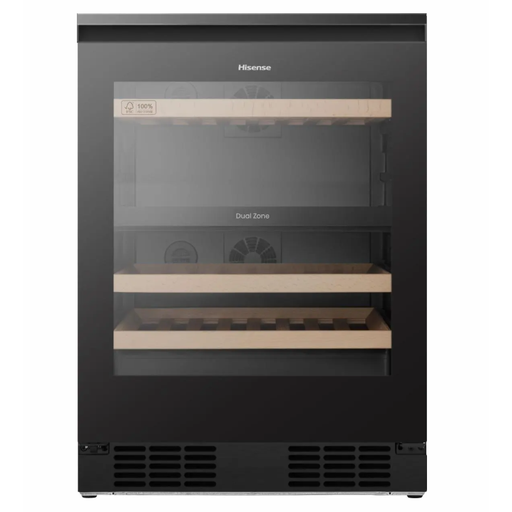 Image unavailable
Hisense RW3N122GALF, 128 L dual-zone wine cooler
Worth considering if you’re looking for a wine cooler with two temperature zones. The product listing states that it has a 128 L capacity, an LED display and an F energy class. Check the label for this model and compare its figures with those of other wine coolers on the same basis.
View on Joybuy
 Image unavailable
Candy CFQQ5T817EPS, 467 L four-door fridge-freezer
Consider this model if you’re looking for a four-door design and have enough space for it. The product listing states that it has a 467 L capacity, Total No Frost and an E energy class. Check the dimensions, installation clearances and energy label before comparing its consumption with that of models in the same category.
View on Joybuy
 Image unavailable
Candy TCA464TM4-S ProWash 500, 6 kg top-loading washing machine
Worth considering if you want a top-loading machine and 6 kg suits your usual loads. The product listing states that it has a spin speed of 1 400 tr/min, 17 programmes and a B energy class. Check the label for its consumption and reference programme before comparing it with another washing machine.
View on Joybuy
 Image unavailable
Electrolux EWF1410N2, 10 kg front-loading washing machine
Worth considering if your usual loads call for a 10 kg capacity. Check that you have enough installation space, too. To compare it with the top-loading machine shown here or with other models, check their respective labels and bear the difference in capacity in mind.
View on Joybuy
 Image unavailable
Sonlu CC-520WE, 444 L fridge-freezer
Consider this model if its capacity suits your storage needs. The product listing states that it has a 444 L capacity, frost-free design, 40 dB noise level and an E energy class. Check the dimensions and energy label; when comparing it with another fridge-freezer, consider its capacity and consumption together.
View on Joybuy
Frequently asked questions
Can you compare a fridge’s energy consumption with that of a dishwasher?
No. Their labels don’t necessarily use the same units or reference basis. ADEME and the European Commission list indicators that vary by category, so compare models of the same type and check the unit shown.
Is the energy class enough to choose a new appliance?
No. Also compare the consumption figure on the same basis, then check the capacity and the details that matter to you, such as noise or cycle length when these are shown. The energy class alone doesn’t tell you what your future consumption will be.
Which index should you check for a washing machine or dishwasher in France?
According to the French Ministry of the Economy, the durability index replaced the repairability index for front-loading and top-loading washing machines on 8 April 2025. Dishwashers are covered by the repairability index. When comparing models covered by an index, look at the criteria behind the score out of 10.
Should you consider a repair before replacing an appliance?
Yes, if the fault can be diagnosed and a repair is possible. Check the warranty first. In France, the Ministry of the Economy states that some products outside their warranty may qualify for repair support when a certified repairer carries out the work. Eligibility depends, among other things, on the product, how it has been maintained and the cause of the fault.


