What should you compare before deciding?
Start with the appliance you own, how you use it and the capacity you need. Then compare models with the same function, or get a repair assessment.
| Priority |
What to check |
Based on my needs |
| Always-on refrigeration |
Compare fridges or freezers of the same type. The European Commission’s appliance label includes details such as kWh/year, compartment capacities and noise levels. Also check which features you’ll actually use. |
My current appliance runs all the time; I want to know its usable capacity before choosing a larger or smaller model. |
| Washing cycles |
For dishwashers with a similar capacity, compare kWh per 100 Eco cycles, litres of water per cycle, place settings and programme duration. ADEME and the European Commission describe these figures on the label; they don’t apply to every programme. |
I’m looking for a capacity I can load to suit how often I do the washing up, without treating the 100-cycle reference as my annual consumption. |
| Cooking |
For an oven, consider its capacity in relation to what you cook and check the consumption figures for the modes you use. For a hob, check how you plan to use it and whether your cookware is compatible. The European Commission distinguishes ovens, which must carry an energy label, from hobs. |
I mainly use certain oven modes or cook on a hob. I want to compare options that match my habits, without assuming that switching technology will necessarily reduce my energy use. |
| Repair |
Ask for a diagnosis and check the appliance’s warranty and repairability. In France, the ministries responsible for the environment and ecosystem say that eligibility for the Repair Bonus depends, among other things, on the fault being covered, the appliance no longer being under warranty and using an approved repairer. |
If my appliance still has the right capacity, I’d rather find out whether it can be repaired before deciding to replace it. |
A guide to brands
There are no brand details to display.
Refrigeration appliances available on Joybuy
These fridges and freezers are options to consider if you’re looking to replace a refrigeration appliance. Before choosing one, compare its type and capacity with your needs, then check the model’s energy label to assess its annual consumption.
 Image unavailable
Candy CFQQ5T817EPS, four-door fridge freezer, 467 L
Worth considering if this storage capacity suits your household. The product name lists a capacity of 467 L, an E rating and No Frost technology. Check the model’s energy label to compare its kWh/year with similar appliances.
View on Joybuy
 Image unavailable
Sonlu CC-520WE, refrigeration appliance, 444 L
Its stated capacity is worth considering if you’re looking for plenty of space. The product name lists a capacity of 444 L, frost-free technology and an E rating. Check the installation space and the kWh/year on the energy label before comparing energy use.
View on Joybuy
 Image unavailable
Samsung RF50C530EB1, multi-door fridge, 495 L
This style is worth comparing if you’ll make use of its large refrigerated capacity. The product name lists a capacity of 495 L and an E rating. Check the compartment capacities and kWh/year on the energy label to see if it suits your household.
View on Joybuy
 Image unavailable
Heinrich´s, No Frost freezer, 161 L
A separate freezer is only worth considering if you need this much frozen storage. The product name lists a capacity of 161 L, a C rating and No Frost technology. Check the kWh/year on the energy label to compare its electricity use with other freezers.
View on Joybuy
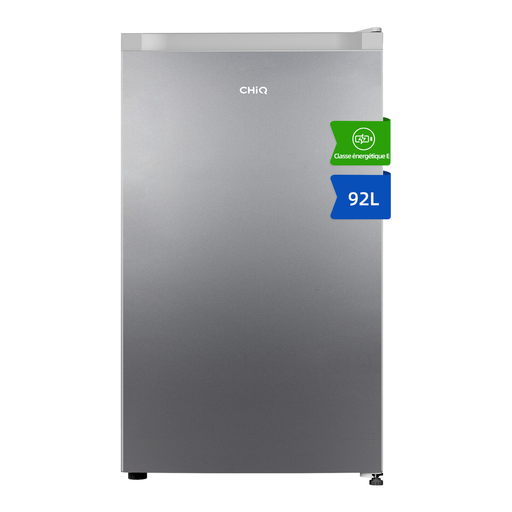 Image unavailable
CHiQ JR92DSE, compact fridge, 92 L, with freezer compartment
This size is worth considering for a small amount of storage or as a secondary appliance, rather than assuming it will suit you as your main fridge. The product name lists a capacity of 92 L and an E rating. Check the kWh/year on the energy label and make sure you have enough space before choosing.
View on Joybuy
Frequently asked questions
How do you compare two fridges?
Start by comparing appliances of the same type and with a similar capacity. According to the European Commission, fridge and freezer labels include details such as the energy efficiency class, kWh/year, compartment capacities and noise levels. A different rating doesn’t remove the need to check whether the capacity suits your household.
Do a dishwasher’s kWh per 100 cycles represent a year’s use?
No. ADEME and the European Commission say that this figure relates to 100 cycles of the Eco programme. To estimate consumption based on how often you use your dishwasher, multiply it by your annual number of Eco cycles and divide by 100. Other programmes and your usual loads need to be considered separately.
Can you choose a hob based on an energy efficiency class comparable to an oven’s?
No. The European Commission says that mandatory energy labels apply to ovens and cooker hoods, but not hobs. For a hob, check the model’s features, your cooking habits and whether your cookware is compatible. Don’t assume it has an oven-style energy label rating.
Could a broken dishwasher or fridge qualify for the Repair Bonus?
In France, repairs may qualify for the Repair Bonus subject to certain conditions. The ministries responsible for the environment and ecosystem say, among other things, that the appliance must no longer be covered by a warranty, the fault must be eligible and you must use an approved repairer. Check these points during the diagnosis before relying on the scheme.


