What can influence your decision
First, check whether the appliance could keep serving you after maintenance or repair. If you’re considering a replacement, compare appliances of the same type and with a suitable capacity, then relate the label figures to how you use it.
| Criteria |
What to check |
Consumers this may apply to |
| Fridge-freezer energy use |
Compare the annual kWh consumption of fridge-freezers with similar capacities and compartment layouts. |
If my fridge-freezer runs all the time, I want to know whether its capacity still meets my needs before replacing it. Around 29% of consumers this may apply to could make this continuous energy use a priority. |
| Electricity and water used per cycle |
Check the kWh per 100 cycles and litres per cycle, then compare them with how often you use the appliance and which programmes you choose. |
If I often do laundry or wash dishes, I want to work out what those cycles add up to over the year. For around 29% of consumers this may apply to, these running costs could be their main consideration. |
| Capacity and usage |
Check the capacity and dimensions, and, depending on the appliance, the Eco programme duration or noise level. |
I don’t want to run extra cycles because an appliance is too small, or choose a capacity I won’t use. Getting the size right could be the main consideration for around 21% of consumers this may apply to. |
| Repair before buying |
Ask for a diagnosis and quote; check the appliance’s condition and the terms of any repair support scheme. |
If an appliance breaks down, I’d rather find out whether it can be repaired before deciding to replace it. Around 21% of consumers this may apply to could make this their priority. |
Brands to consider, model by model
These brands offer appliances in the categories covered here. Compare the details of the specific model rather than assuming its energy use or lifespan based on the brand name alone.
Bosch
In France, Bosch offers built-in, freestanding, compact and under-counter dishwashers, as well as washing machines.
- Bosch’s washing machine range includes models with capacities from 7 to 10 kg.
- Check the capacity, energy label and repair information for your chosen model; these features are not the same across the whole range.
Miele
Miele offers, among other appliances, front-loading washing machines and integrated dishwashers.
- Miele’s product page for the WWA120 WCS Active washing machine lists an 8 kg capacity, while the page for the G 7678 SCVi XXL AutoDos Excellence dishwasher lists an energy rating of A.
- These details apply to these specific models. Check the format, capacity and energy label for any other model you’re considering.
Beko
Beko offers washing machines, dishwashers and refrigeration appliances, with information about their energy labels.
- The range includes options to meet different laundry, dishwashing and food-storage needs.
- When comparing Beko models, use the figures and design details for each appliance rather than assuming a feature applies to the whole brand.
Appliances to explore on Joybuy
These models are options to consider if you’re specifically replacing a washing machine or fridge-freezer. Before choosing, compare their design and capacity with your current appliance, then check the energy label for the version you’re interested in.
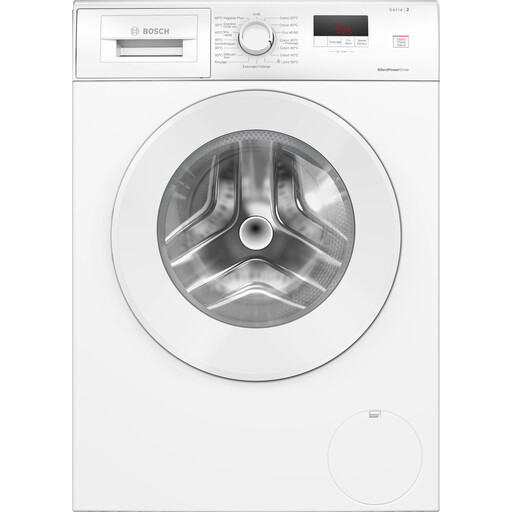 Image unavailable
Bosch WGE02407FR, 7 kg front-loading washing machine
Worth considering if you’re replacing a front-loading washing machine and a 7 kg capacity suits your usual loads.
The product listing states 1,400 rpm and an energy rating of A. To estimate the cost of your cycles, check the consumption figures and reference programme on the label for the exact model.
View on Joybuy
 Image unavailable
Bosch KGN33NLEB, 282 L fridge-freezer
Consider this model if a total capacity of 282 L suits your household and you’re looking for a fridge-freezer with the freezer at the bottom.
The product listing states an energy rating of E. Check the label to compare annual kWh consumption, compartment capacities and noise levels with similar models.
View on Joybuy
 Image unavailable
Haier HTW5618ENMG, 360 L three-door fridge-freezer
Check that the three-door design and total capacity of 360 L suit the space you have and how much storage you need.
The product listing mentions an energy rating of E, Total No Frost, Wi-Fi and My Zone. Before comparing running costs, check the annual kWh consumption and capacity of each compartment on the label for the exact model.
View on Joybuy
 Image unavailable
Candy TCA464TM4-S ProWash 500, 6 kg washing machine
Its top-loading design is worth considering if it suits your available space and a 6 kg capacity is enough for your usual loads.
The product listing states 1,400 rpm, an energy rating of B, 17 programmes and Wi-Fi. To compare energy use, check the figures and reference programme shown on the label.
View on Joybuy
 Image unavailable
Sonlu CC-520WE, 444 L fridge-freezer
With a total capacity of 444 L, check both the space available and how much food you actually store.
The product listing states an energy rating of E and frost-free operation. Before comparing it with your current appliance, check the annual kWh consumption and the separate compartment capacities in the documentation for the exact model.
View on Joybuy
Frequently asked questions
How can I estimate the annual running cost of a washing machine or dishwasher?
Multiply the kWh figure shown per 100 cycles by the number of comparable cycles you run each year, divide by 100, then apply the cost per kWh shown on your bill. For water, multiply the litres per cycle by the same number of cycles, divide by 1,000 to get m³, then apply your local water and drainage charges. ADEME and the European Commission explain that these figures are based on the washing machine’s Eco 40-60 programme or the dishwasher’s Eco programme. If you use other programmes, the calculation will only be an estimate of your usage.
Why compare annual kWh for a fridge-freezer but kWh per 100 cycles for a washing machine?
The units reflect different patterns of use: a fridge-freezer runs continuously, while a washing machine’s energy use depends on how many cycles you run. The European Commission states annual energy consumption for refrigeration appliances and consumption per 100 cycles for washing machines. Compare each appliance using the unit provided for its category.
Will a larger capacity always mean fewer cycles?
No. A larger capacity is only useful if your usual loads genuinely need the extra space or you can fill the appliance at a frequency that works for you. Before choosing a larger washing machine, consider how much laundry builds up between washes. For a dishwasher, compare the place settings with the dishes you use each day. ADEME says a 7 kg washing machine is enough for most people, but this won’t be right for every household.
What should I check before deciding whether to repair a washing machine?
Start by asking for a diagnosis and quote, then take the appliance’s overall condition and energy use into account before choosing between repair and replacement. In France, ADEME states that a durability index has applied to washing machines put on sale since April 2025. This can help you assess the repairability and reliability of the model in question.
Could a repair qualify for the Repair Bonus?
Yes, if the appliance and fault are eligible and the appliance is no longer under warranty. According to ecosystem, the support is deducted from the bill under the scheme. Check the terms and quote with a QualiRépar-approved repairer before factoring it into your decision.


