What should you check before buying?
Start by checking where it will go and how it will drain. Then consider whether connecting it to the tap would be useful and what capacity you need for your usual load of washing-up.
Compact model with a water tank
Worth considering: if you can fill the appliance and position its drain hose near a sink or suitable container, without needing a fixed water supply.
Bear in mind: you’ll need to fill it manually and its capacity will be limited; a water tank doesn’t remove the need for drainage.
Compact model connected to the tap
Worth considering: if the model, tap and drainage allow for a compatible connection. HAVA says the R09 can be supplied either by its water tank or by a hose connected to the tap.
Bear in mind: you’ll need to check the connector and, depending on your tap fittings, you may need an adaptor.
Standard-sized model
Worth considering: if a compact model doesn’t meet your needs and the water supply, drainage and electrical supply can all be installed as required.
Bear in mind: without dedicated connections, you can’t assume this type will fit into your kitchen as it is.
| What to check |
What to look for |
Who is this for? |
| Space and drainage |
Measure the available space, then check the manual for the permitted hose length and route to the sink or container. |
If the kitchen is cramped and has no dedicated waste connection, my main priority is avoiding an appliance that can’t drain waste water properly; around 42% of consumers rank this compatibility check first. |
| Manual filling |
If you’re considering a tap connection, check the model’s connector, your tap and any accessories you may need. |
For frequent use, I’d rather avoid filling the tank if my tap allows a suitable connection; this is the top priority for around 33% of consumers. |
| Capacity and usage |
Compare the place settings with the crockery you actually use. For water, energy and noise, compare figures for the same cycle and model variant. |
If plates and saucepans pile up between washes, my first priority is avoiding the need to run extra cycles; around 25% of consumers prioritise this capacity and the conditions of use. |
A compact dishwasher with a water tank on Joybuy
If you’re renting a kitchen without a dedicated water supply, this compact model with a water tank could let you drain into a container using the hose, provided it suits your available space.
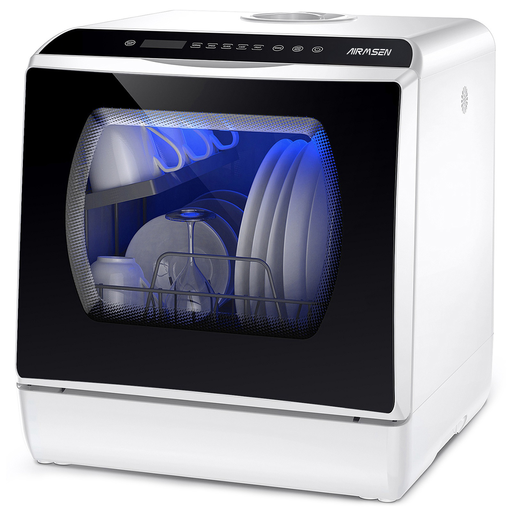 Image unavailable
AIRMSEN worktop dishwasher, 5 L tank, 5+1 cycles
Worth considering if you want to avoid a fixed water supply and can direct the drain hose into a suitable container.
The product name lists an integrated 5 L water tank and 5+1 wash cycles. Before ordering, check the manual for the hose length and route, and make sure the electrical supply is compatible with your installation.
View on Joybuy
Frequently asked questions
Can a dishwasher with a water tank work without drainage?
A water tank replaces the fixed water supply, not the waste water outlet. HAVA describes the R01 as draining through a hose into a sink or a container such as a bucket; check the permitted destination and hose route in the manual for the appliance you choose.
Can I connect a compact dishwasher to any tap?
No: the connection must be compatible with both the tap and the exact model. HAVA lists a GHT 3/4-inch connector for the R01 and says an adaptor may be needed; don’t assume this applies to another appliance.
What should I do if installation requires a lasting alteration to my rental?
Ask your landlord for written permission before making any alteration to the rented property or its fittings, as ANIL advises. This requirement doesn’t, by itself, determine who would pay for any work.
How can I compare models’ energy use and noise?
Compare figures calculated on the same basis for the variants you’re considering. ADEME says water consumption is shown in litres per reference cycle; also check the kWh per 100 cycles and noise information on each energy label.
What should I check about the electrical supply before buying?
Check the voltage, plug, cable and installation instructions on the rating plate and in the manual for your chosen model, then compare them with the socket available in your kitchen. The electrical specifications of another dishwasher won’t tell you whether this one is suitable.


