
Livraison le jour même ou le lendemain

Qualité garantie

Débloquez vos offres de bienvenue: Livraison GRATUITE | Jusqu'à -80 % | 30 jours d'essai gratuits à JoyPlus
Téléchargez l'application
Buying a remote control car for children seems simple enough… until you start comparing features, the recommended age, battery life and how tough the vehicle really is. Some models promise spectacular stunts, but become difficult to steer on a carpet or quickly lose their appeal when the battery starts to run low.
To avoid any nasty surprises, it’s worth focusing on three points that marketing tends to push into the background: the design of the wheels, the sturdiness of the bodywork and the conditions in which it’s allowed to be used. Here are the criteria to consider before choosing a 4x4 RC car, a stunt model or an amphibious vehicle.
An RC car capable of 360° drifting or a model you can control with gestures naturally catches the eye. But these features don’t perform the same way on every surface. Omnidirectional wheels are great fun on a hard, clear floor, but far less comfortable on a thick carpet or rough ground.
Each feature should therefore match a specific use:
An amphibious RC car can move across water, but that doesn’t mean it’s suitable for all aquatic environments. Before ordering, check whether the product page allows use in shallow water, in a swimming pool or only on damp ground.
After a session in water, a few precautions are needed:
An all-terrain car for children may be described as rechargeable without its battery life or charging time being clearly stated. Check that the box actually contains the cable, battery and remote control. For gesture-controlled models, also make sure the watch or sensor is included.
How often you need to recharge depends on how intense the stunts are, the terrain and the condition of the battery. For a gift, a ready-to-use model with all the essential accessories saves you from having to buy extras straight away.
A four-wheel drive transmission, or 4WD, powers all four wheels to distribute power more effectively. It makes starting off easier, helps tackle small obstacles and handles uneven surfaces. That doesn’t make the vehicle indestructible, though: steps that are too high, repeated impacts against walls and muddy terrain can damage the gears.
Mecanum wheels allow lateral and diagonal movement. Propeller tyres can, depending on the vehicle’s design, provide propulsion on water. In both cases, this technology should be matched to where you plan to play: the living room, garden, beach or shallow paddling pool.
A body made from ABS, with rounded edges and designed to withstand impacts, will generally cope better with everyday bumps. Still, check the instructions for the recommended age, precautions and usage limits.
For a purchase in the UK, also check for the CE marking, instructions in English and the contact details of the person responsible for placing it on the market. The CE marking doesn’t guarantee the product will never break: it indicates that the manufacturer declares it meets the applicable European requirements.
A 2.4 GHz controller generally allows several vehicles to operate without having to manually select a channel, depending on the product’s design. That’s a real plus for playing together. However, it’s still best to check the stated range and keep a clear space between the child and the vehicle.
Here is our selection for different usage profiles.
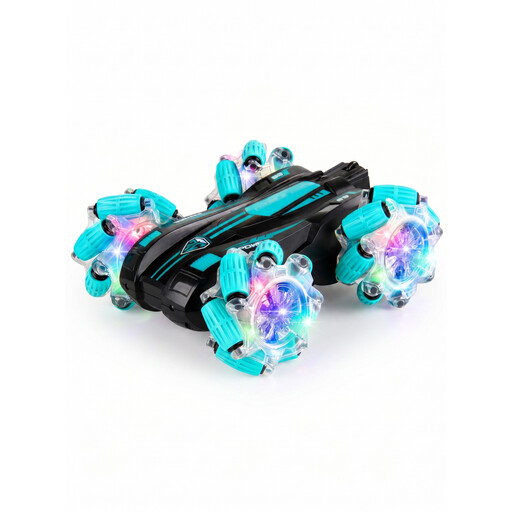
Why this choice suits this profile: its manual controls and demonstration mode allow you to get to grips with driving gradually, both indoors and outdoors.
Driving on both sides means you don’t have to flip the vehicle back over after a roll, while the Mecanum wheels are designed for lateral movement.
4WD transmission, stated 9 cm wheels, 360° rotation, LED lighting and rechargeable battery according to the product page.
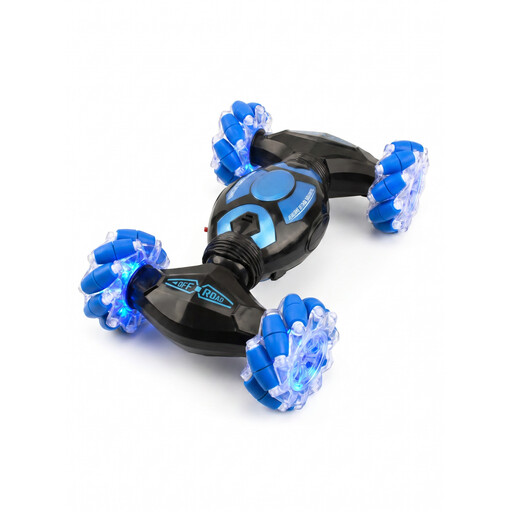
Why this choice suits this profile: its two control modes and articulated structure appeal to users who want to vary their stunts and progress in their driving skills.
The traditional remote offers precise control, while the gesture watch provides another way to steer the vehicle.
Mecanum wheels, driving on both sides, lateral movement, ability to tackle small obstacles and stated 2.4 GHz compatibility.
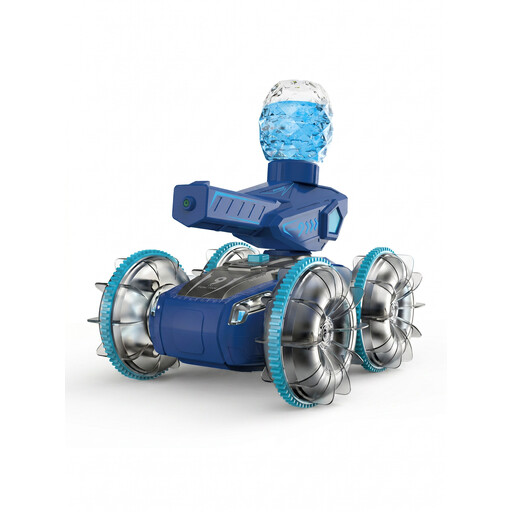
Why this choice suits this profile: this amphibious remote-controlled tank is suited to supervised play on the lawn, sand and in shallow water, with a water jet function.
The product page mentions a sealed, waterproof structure, while distinguishing between aquatic and land use. You must still respect the maximum depth and the instructions in the manual.
Dual control, 360° rotation, LED lighting, propeller wheels, water jet and 2.4 GHz multiplayer operation according to the description.
We’ve put together a complete selection, updated in real time, of products that meet these demanding criteria and European safety regulations.
To extend the life of a remote-controlled toy for boys or girls, a few simple habits make all the difference:
Start by checking the recommended age on the packaging and in the manual. For a young child, choose simple controls, a body with rounded edges and no small parts that could easily come off. Acrobatic features can be fun, but adult supervision is still essential.
That depends entirely on the specific instructions for the model. A mention of a waterproof structure or navigation in shallow water does not mean it is allowed in deep pools or rough water. Supervision must be constant and the vehicle must be dried according to the manual after use.
The running cost mainly depends on how often you recharge and whether the battery eventually needs replacing. A rechargeable model saves you from buying disposable batteries regularly, but you need to consider the charging time, the stated battery life and the availability of a compatible replacement battery.