
Livraison le jour même ou le lendemain

Qualité garantie

Débloquez vos offres de bienvenue: Livraison GRATUITE | Jusqu'à -80 % | 30 jours d'essai gratuits à JoyPlus
Téléchargez l'application
Is your original iPhone or iPad cable on its last legs?? Tired of the infamous "This accessory may not be supported" message and charging that stops without warning?? You're not alone. Upgrading to a reinforced USB-C to Lightning cable is the logical solution, but navigating the jungle of often-unfulfilled marketing promises can be tricky.
Before you dive in, here are the common pitfalls that leave many users regretting their purchase?:
To avoid getting duped, focus on these three key points that separate a reliable cable from a marketing gimmick.
MFi certification is a label issued by Apple that guarantees an accessory has been designed specifically for its devices and meets its performance and safety standards. An MFi-certified Lightning cable includes an authentication chip that communicates with your iPhone or iPad. It's your best insurance against compatibility issues, overheating, and long-term damage. Immediately dismiss any cable that doesn't explicitly mention this certification.
A braided Lightning cable is a good start, but true durability comes down to another detail. Look closely at the strain relief—the small plastic or rubber piece that protects the base of the connector. It must be long and flexible enough to absorb the stress from daily twists and bends. The sheath materials also matter?: ballistic nylon or aramid fibres (like Kevlar) offer far superior abrasion and tensile strength compared to basic plastic.
To take advantage of fast charging on an iPhone 8 or newer, all your equipment must be compatible with the USB Power Delivery (PD) standard. This means your USB-C to Lightning cable must support this protocol, as must your power adapter. Even with a high-powered charger, a standard cable will throttle the charging speed. A 1m USB-C Lightning cable often represents the ideal compromise between everyday convenience and performance.
Rather than an endless list, we've selected products for specific user profiles. The goal?: to help you find the cable that truly fits your needs.
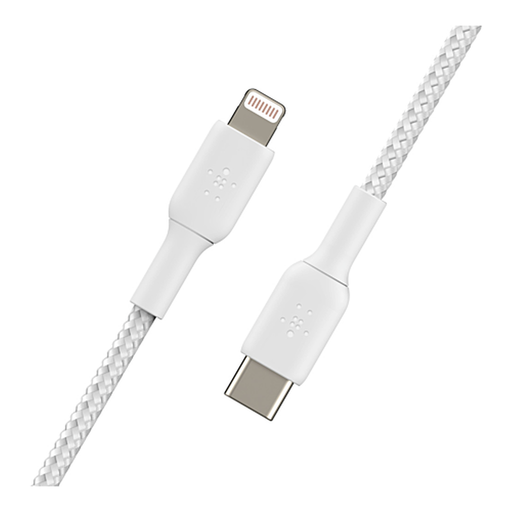
Why we chose it : For those who make no compromises on safety and compatibility. Belkin's reputation and official certifications offer peace of mind for protecting an expensive device.
This Belkin iPhone cable is dual-certified (MFi and USB-IF), eliminating any risk associated with non-compliant accessories. It's engineered for foolproof reliability within the Apple ecosystem.
Dual certification (Apple MFi, USB-IF). Braided nylon sheath manufacturer-tested to withstand over 10,000 bends.
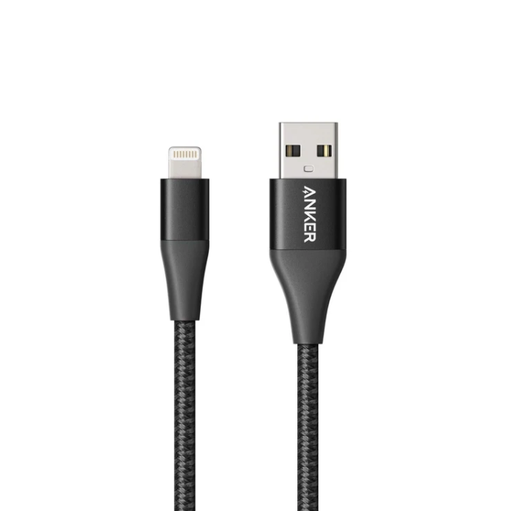
Why we chose it : Ideal for those who constantly put their cable through its paces: tossed in a bag, plugged in the car, carried to the office... Its design is entirely focused on longevity against the rigours of daily life.
It avoids the "false durability" trap with an internal and external construction built to last, featuring a double-braided nylon sheath and reinforced components from end to end.
Extreme durability claimed by the manufacturer (tested for 30,000 bends). Laser-welded connectors and a robust stainless steel design.
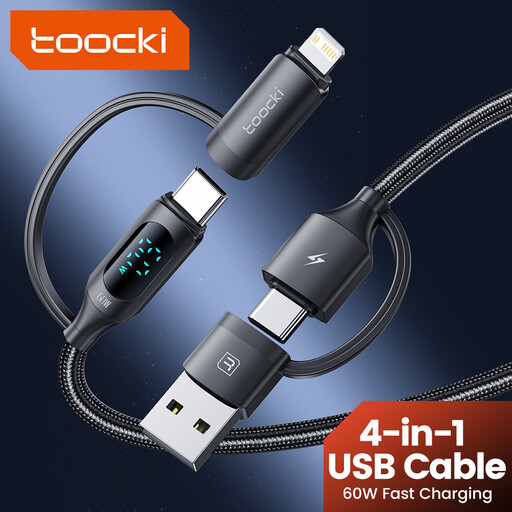
Why we chose it : Perfect for those who juggle multiple devices (iPhone, Android tablet, headphones...) and want to travel light with a single cable to charge everything.
No more multiplying fragile cables! This model offers a single, versatile solution. Its sturdy braided sheath provides far better resistance than a collection of basic cables.
Maximum versatility with 4 connector combinations (USB-C to Lightning, USB-C to USB-C, etc.). The ideal travel companion to reduce clutter.
Explore our full selection of products that meet our selection criteria and current safety standards.
Absolutely, and for several reasons. A non-certified cable can stop working at any time after an iOS update. More seriously, it can deliver unstable power that risks damaging your device's battery in the long run or, in extreme cases, causing short circuits. MFi certification is a quality assurance that fully justifies a slightly higher investment to ensure the safety of your valuable device.
Yes, but with one crucial condition: it must be paired with a USB-C wall charger that is Power Delivery (PD) compatible. A standard USB-A port is limited to 5W or 12W of power. The combination of a USB-C to Lightning cable and a USB-C PD charger (18W or more) enables fast charging on compatible iPhones, allowing you to regain about 50% battery in just 30 minutes.
It all depends on the manufacturing quality and how you use it. A well-made reinforced cable from a reputable brand, with a nylon sheath and solid connector protection, can last for several years, even with heavy use. Conversely, even braided, entry-level models often fail at the connectors in less than a year. The key is to choose a model where the reinforcement at the base of the connector is visibly robust.