Start by working out whether you need more room for fresh food, meals to freeze, or both: a larger total capacity won’t necessarily solve the right problem. If your current fridge has enough room for fresh food but its freezer is regularly full, a separate freezer could meet your needs, provided you have space for a second appliance and can keep it running continuously. If both compartments are short on space, compare their usable capacities in the fridge-freezers you’re considering before replacing your appliance.
Who is this choice for?
Households that prepare several meals in advance
If you regularly freeze portions, first check how much space is available in your freezer and how easy it is to access your food. A separate appliance is worth considering if your fridge already meets your needs.
Households that shop less often
You need enough room for fresh and frozen food between shops. Compare the usable capacity in litres of each compartment: a large total capacity doesn’t guarantee the balance you need.
Households with limited space or energy-use concerns
In a compact kitchen or an existing housing unit, measure the space before choosing a capacity. As the appliance will run continuously, ADEME also recommends considering energy consumption and avoiding buying more capacity than you need.
How do the options compare?
Keep and reorganise your current appliance
When to consider it: if you only run short of space occasionally and better organisation would let you store your usual shopping.
Drawback: it won’t add capacity if your freezer is regularly full.
Fridge with a small freezer compartment
When to consider it: if you only freeze a few portions or items at a time.
Drawback: space for frozen food can quickly run out if you regularly prepare meals in advance.
Fridge-freezer
When to consider it: if you need more room for both fresh and frozen food but don’t have space for a second appliance.
Drawback: a high total capacity doesn’t tell you how many litres are actually allocated to each compartment.
Separate freezer
When to consider it: if you’re running out of room for prepared meals or frozen food, while your current fridge has enough space for fresh food.
Drawback: you’ll need a suitable space and an additional appliance that runs continuously.
| What to consider |
What to check before buying |
What matters to shoppers |
| Capacity split |
Compare the usable capacity in litres of the fridge and freezer separately with what you store between shops. |
I want enough room for fresh food without reducing my frozen-food storage; around 29% of shoppers would make this balance their priority. |
| Freezing space |
Check the freezer’s usable capacity and how easy it is to access the storage areas; check the features listed for the specific model. |
My prepared portions regularly fill the freezer: around 29% of shoppers would make increasing this capacity their main need. |
| Installation |
Measure the appliance, the space where it will go and the doorways it needs to pass through; check the manual for ventilation and, for a built-in model, the housing unit and fittings. |
I need to replace an appliance without making my kitchen bigger; for around 21% of shoppers, fitting the available space would come before capacity. |
| Ongoing energy use |
Compare the kWh/year and energy rating on the energy label of appliances that suit your needs, without choosing more capacity than you require. |
I want to store my shopping without running an oversized appliance; around 21% of shoppers would prioritise this aspect of ongoing use. |
Mistakes to avoid
-
Choosing based on total capacity alone
Two high-capacity appliances can offer very different amounts of space for fresh and frozen food. A freezer that’s too small will still be a problem for prepared meals, even in a large fridge-freezer.
Work out separately what you need to store in each compartment, then check the usable capacity of each one.
-
Adding a freezer to solve a temporary lack of space
A second appliance won’t necessarily solve a short-term storage problem. ADEME points out that refrigeration appliances run continuously.
Before adding one, check whether your current freezer is regularly full of portions or shopping you want to keep.
An additional freezer takes up space and uses electricity continuously.
-
Forgetting about installation and set-up
The right capacity isn’t enough if the appliance won’t fit through the access points, its doors can’t open properly or you can’t allow for the clearances specified by the manufacturer.
Measure everything before ordering and follow the manual for your chosen model, including its guidance on ventilation, transport and set-up.
-
Assuming NoFrost means lower energy consumption
Manufacturers describe NoFrost as a feature that manages ice build-up; the name doesn’t tell you the usable capacity or energy consumption of an appliance.
If this feature interests you, compare it separately from the capacity of each compartment, kWh/year and dimensions.
Brands to know
Bosch
Bosch offers freestanding and built-in fridge-freezers, as well as XXL formats across selected models.
- Bosch lists Total NoFrost and a VitaFresh XXL 0 °C zone among the features of its KGN492IAF model.
- These features aren’t available across the whole range: check the product details, dimensions and manual for the model you’re considering.
Liebherr
The range includes both fridge-freezers and separate freezers.
- Liebherr offers NoFrost freezers and selected fridge-freezers with an A energy rating.
- Check the energy consumption, capacity and installation requirements for the model you choose rather than assuming they apply to the whole brand.
Whirlpool
Whirlpool’s built-in fridge-freezers may suit households that need to fit an appliance into a fitted kitchen.
- Whirlpool states that the WHK25323B5E1 divides its 300 L capacity between 224 L of fridge space and 76 L of freezer space.
- Check this model’s capacity split against the amount of food you want to freeze and the dimensions of your housing unit.
Beko
Beko offers freezers worth considering if extra space for frozen food is your priority.
- Beko describes its No Frost technology as a way to prevent ice from building up in the freezer.
- If the appliance will be kept in an unheated room, check the climate class and the ambient temperatures permitted for the specific model.
LG
LG offers large-capacity fridge-freezers designed to store fresh and frozen food in one appliance.
- LG lists the GBV22NCDPY as a 387 L fridge-freezer.
- Total capacity doesn’t replace the need to compare the compartments, dimensions and energy consumption of the model you choose.
Appliances to suit your storage needs
These appliances illustrate two options: a fridge-freezer when you need to store fresh and frozen food together, or a separate freezer when you mainly need more space for frozen portions. Compare their capacity split and format before deciding whether to replace your current appliance or add to it.
 Image unavailable
Haier HTW5618ENMG, 3-door fridge-freezer, 360 L
Worth considering if you want a single appliance for your shopping and meals to freeze; compare the space allocated to each compartment.
Advertised total capacity of 360 L, Total No Frost and E energy rating.
Check the available space and the ventilation and set-up instructions in the manual.
View on Joybuy
 Image unavailable
Candy CFQQ5T817EPS, 4-door fridge-freezer, 467 L
Worth considering if you need space for both fresh and frozen food, provided the format suits your kitchen.
Advertised total capacity of 467 L, Total No Frost and E energy rating.
Check the dimensions, door clearance and specified gaps before ordering.
View on Joybuy
 Image unavailable
AEG NSC6M18FES, built-in fridge-freezer, 249 L
Worth considering for a fitted kitchen if you want to combine refrigeration and freezing in a built-in appliance.
Advertised total capacity of 249 L, TwinTech No Frost and E energy rating.
Check the capacity of each compartment on the energy label, and consult the manual for details of the housing unit, fittings and ventilation.
View on Joybuy
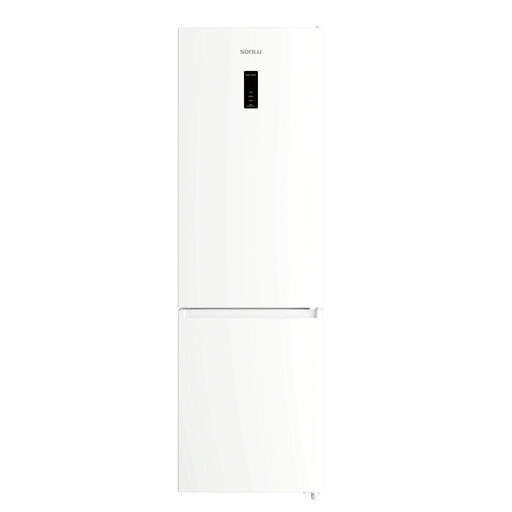 Image unavailable
Sonlu CD‑400RW, fridge-freezer, 355 L
Worth comparing if you need space in both compartments and have limited width available.
Advertised capacities of 252 L for the fridge and 103 L for the freezer; stated width of 60 cm and E energy rating.
Check the other dimensions, annual energy consumption and installation clearances.
View on Joybuy
 Image unavailable
Heinrich´s, No Frost freezer, 161 L
Worth considering if your fridge has enough room for fresh food but your current freezer doesn’t have enough space for prepared portions.
Advertised capacity of 161 L, No Frost technology and C energy rating.
This appliance won’t add space for fresh food. Check its dimensions, annual energy consumption and climate class for the room where you plan to keep it.
View on Joybuy
Frequently asked questions
Should I choose the largest total capacity available?
No: choose a capacity split that suits your fresh food and frozen meals. UFC-Que Choisir gives an average guideline of 100 to 150 L for one person, plus 50 L for each additional person; compare this with your habits and the capacity of each compartment.
What should I compare on the energy label?
Compare the energy rating and annual energy consumption of appliances with a capacity and intended use that suit you. ADEME says that the energy label for new fridges is available online and in shops; read it alongside the model’s product details, and don’t consider the rating separately from its capacity.
What should I check before delivery and set-up?
Measure the space, access points and clearance needed to open the doors, then follow the manual for ventilation and set-up. A Bosch manual advises waiting at least one hour after installing the appliance it covers in an upright position; this waiting time doesn’t automatically apply to other models.
Can I put a separate freezer in an unheated room?
Only if the room’s temperature falls within the conditions specified for the model you choose. Beko says some of its freezers are designed to operate at ambient temperatures as low as −15 °C, but this doesn’t apply to the whole range: check the climate class and manual for the appliance you’re considering.


