Who are these criteria useful for?

People who are watching their salt intake

If you regularly make soups, rice dishes, vegetables or sauces, you’ll want to know how much salt the cube adds. A product labelled ‘reduced salt’ and one labelled ‘salt-free’ won’t necessarily contain the same amount per serving.

People who are watching their fat intake

You want to compare the fat content of prepared stock without assuming that reducing the salt also reduces the fat. The amount you use and the basis for the nutritional values both matter when making this comparison.

People who check the ingredients

Before choosing vegetable, chicken or beef stock, check the ingredients, allergens and any ‘may contain’ statements for the exact product.

Which criteria should you compare?

‘Salt-free’, ‘reduced salt’ and ‘low fat’ refer to different things: none of these claims tells you about both nutrients on its own. First compare the nutritional values for an equivalent amount of prepared stock, then check the ingredients and format.

Criterion What to check Who is it for?
Salt The amount of salt per prepared serving and the dilution instructions; ‘reduced salt’ doesn’t mean ‘salt-free’. When I make stock regularly, I want to know how much salt the cube adds to my recipe. Around 42% of consumers would put reducing salt first.
Fat The fat content and, if needed, the saturated fat content, measured on the same prepared-serving basis. If I’m watching my fat intake, a claim about salt isn’t enough to guide my choice. Around 33% of consumers would put this criterion first.
Ingredients and allergens The ingredient list, highlighted allergens and any ‘may contain’ statements for the exact product. I need to be able to rule out a cube containing an ingredient that doesn’t suit my dietary requirements, even if its nutritional profile appeals to me. Around 17% of consumers would put this compatibility first.
Format and availability The number of cubes, the servings they make and whether the product is available from your shop or collection service. For the recipes I usually make, I’m looking for a suitable pack size and a product I can buy. Around 8% of consumers would put this practical choice first.

Common misconceptions to avoid

  • Assuming ‘reduced salt’ means ‘salt-free’

    According to Knorr France product information, its reduced-salt vegetable stock contains 1.4 g of salt per serving, compared with 0.02 g for its salt-free vegetable stock. So a reduction doesn’t mean there’s no declared salt.

    Check the amount of salt per serving and how many servings you’ll make, rather than relying only on the claim on the front of the pack.

  • Assuming the salt claim tells you about the fat content

    Knorr France product information gives the fat content as 0.8 g per serving for its reduced-salt vegetable stock and 1.3 g for its salt-free version. These figures relate to two specific products, not every recipe carrying these claims.

    If you’re comparing cubes as part of a low-fat diet, check the ‘fat’ and ‘salt’ values separately, using the same prepared-serving basis.

  • Comparing different nutritional reference amounts directly

    A value per 100 g of dry stock cube can’t be compared directly with a value per 100 ml of reconstituted stock. The amount of cube and volume of water change what counts as a prepared serving.

    Follow the dilution instructions and compare equivalent amounts of prepared stock.

  • Forgetting to check a recipe’s allergens

    Knorr reduced-salt vegetable stock lists celeriac, among other ingredients, and may contain traces of other allergens. You can’t tell what’s in it just from the ‘vegetable’ flavour.

    Check the ingredients and ‘may contain’ statements on every pack, even if you already know the brand.

Brands to consider

Knorr

The range includes reduced-salt vegetable stock and salt-free vegetable stock: two products to compare according to the nutrient you want to prioritise.

  • According to Knorr France, the reduced-salt product contains 25% less salt and has 1.4 g of salt and 0.8 g of fat per serving.
  • According to Knorr France, the salt-free product has 0.02 g of salt but 1.3 g of fat per serving. Less salt doesn’t necessarily mean less fat.

Maggi

The KUB OR Reduced Salt and KUB OR Low Fat products show how different nutritional claims relate to different things.

  • According to Carrefour France product information, KUB OR Reduced Salt contains 25% less salt than the average stock cube that isn’t reduced in salt; KUB OR Low Fat contains 30% less fat than the average stock cube that isn’t low fat.
  • These percentages refer to different nutrients and use different comparisons. The ‘low fat’ claim doesn’t, on its own, tell you how much salt the product contains.

Carrefour Original

Carrefour France lists a reduced-salt Carrefour Original chicken stock cube.

  • This product is another option to consider if you’re looking for chicken stock with a reduced-salt claim.
  • To compare it with vegetable stock or a low-fat cube, check the pack for the amounts of salt and fat, as well as the prepared serving size.

Jardin Bio Étic

Carrefour France lists a Jardin Bio Étic vegetable stock cube described as salt-free and gluten-free.

  • These two claims can help you identify a product to consider if salt and gluten are among your criteria.
  • The ingredients list includes celery. Check the full label and fat content before deciding whether this product suits your requirements.

Stock cubes available on Joybuy

These two products meet different needs: a vegetable stock cube with a reduced-salt claim and a chicken stock cube labelled ‘Fat-Free’. For each one, check the nutritional values and preparation instructions on the pack before comparing them.
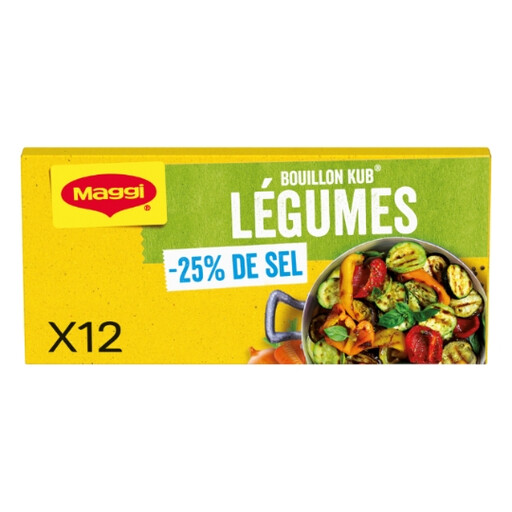
MAGGI KUB 25% Less Salt Vegetable stock cubes, 120 g pack

MAGGI KUB 25% Less Salt Vegetable, 120 g

Worth considering if you’re looking for a vegetable stock cube with a reduced-salt claim while also watching your fat intake.

The pack is listed as 120 g. Check the salt and fat content, dilution instructions and ingredients for the product you buy: ‘Less Salt’ doesn’t mean ‘salt-free’.

View on Joybuy
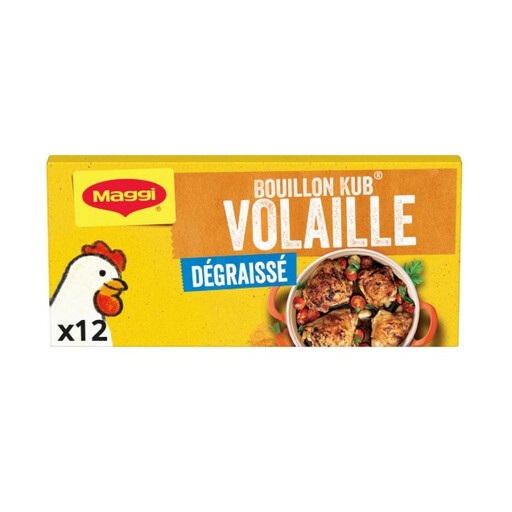
Maggi Chicken Bouillon Cubes Fat-Free, box of 12 cubes

Maggi Chicken Bouillon Cubes Fat-Free, 12 tablets

Worth considering if you’re looking for a chicken stock cube and want to prioritise fat content.

The pack is listed as containing 12 cubes. The ‘Fat-Free’ claim doesn’t mean it contains less salt: check both nutritional values and the preparation instructions on the pack.

View on Joybuy

Frequently asked questions

Is a ‘reduced-salt’ stock cube salt-free?

No. ‘Reduced’ refers to a comparison; it doesn’t mean there’s no salt. Knorr France states that its reduced-salt vegetable stock contains 1.4 g of salt per serving, while its salt-free version contains 0.02 g per serving. Check the serving size recommended for your recipe.

How can I make reduced-salt stock without automatically adding salt?

Follow the instructions for the product you’re using, then taste the dish before adding any salt. For Knorr reduced-salt vegetable stock, Carrefour France recommends dissolving one cube in 500 ml of simmering water to make stock; instructions may vary depending on how you’re using it.

Is a salt-free stock cube always suitable if I’m watching my fat intake?

No. You’ll also need to check the ‘fat’ value. Knorr France states that its salt-free vegetable stock contains 1.3 g of fat per serving. Compare this figure with other products using the same prepared-serving basis.

Which allergens should I check in a stock cube?

Check the ingredients and ‘may contain’ statements for the exact product. Knorr reduced-salt vegetable stock lists celeriac, among other ingredients, and may contain traces of gluten, milk, mustard, egg and soya. Other recipes may have different ingredient lists.