For a weekday breakfast, a single-serve dehydrated soup is a good option if you want something easy to store in the cupboard and quick to make with hot water. If you’re looking for a product labelled as reduced in salt, the examples here are liquid or chilled soups. Choosing one of these formats means checking how it should be stored, as well as how much salt is in the portion you’ll drink.
Who is each option suitable for?
Busy mornings with access to boiling water
A single-serve dehydrated soup could be right for you if you want to make a hot soup quickly and keep the sachets in the cupboard. Then check the salt content of the reconstituted cup, rather than the powder on its own.
People looking for a reduced-salt label
If the reduced-salt label matters more to you than choosing a dry format, a liquid or chilled soup could be an option. Check the salt content of the specific product and its storage instructions before switching formats.
People checking ingredients and allergens
The exact recipe matters: the dehydrated soups featured by Monoprix, Carrefour and E.Leclerc list ingredients such as milk, wheat or celery, depending on the product. Check the label whenever you switch brand or recipe.
What should you check?
Start by choosing a format: stick with an easy-to-store dry soup, or opt for a liquid or chilled soup if you’re looking for a reduced-salt label. Either way, compare ready-to-eat portions and check the label for the recipe you choose.
Dehydrated soup
Choose this if: you have access to hot water in the morning and want to keep portions in the cupboard.
Bear in mind: convenience alone tells you nothing about the recipe’s salt content or allergens.
Liquid or chilled soup
Consider this if: a reduced-salt label on a specific product matters more to you than choosing a dehydrated format.
Bear in mind: storage requirements, including how to store the soup after opening, vary by product.
| What to check |
Check this |
Who is this for? |
| Salt in your bowl |
Check the ‘salt’ entry per 100 ml of soup as prepared, then for the amount you’ll drink. If the product is labelled ‘reduced salt’, also check what it is being compared with. |
If my main aim is to limit the salt in my breakfast, I want to know how much is in my bowl, even when the packaging carries a reduced-salt label. Around 42% of consumers would put this first. |
| Quick preparation |
Check the amount of water, the stated preparation time and the number of portions, as well as whether you have a way to heat the water. |
When I’m heading out early, I want to make a hot portion without adding a lengthy step to my morning. Speed would come first for around 33% of consumers. |
| Dry format and ingredients |
Check the ingredients and allergens for the exact recipe, then check the nutritional information for the reconstituted soup if it is provided in that form. |
I prefer to keep sachets in the cupboard, but I also need to be able to rule out recipes with ingredients that don’t suit me. This would be a priority for around 25% of consumers. |
Mistakes to avoid
-
Assuming dehydrated soup is the same as reduced-salt liquid soup
A reduced-salt label on a carton or chilled soup does not apply to powdered soup sachets. Storage and instructions for after opening also differ.
First choose a format you can store, then check the label and salt content of each product you’re considering.
-
Comparing salt content without accounting for bowl size
Portions are not always the same size: the Royco Velouté 12 légumes cup featured by Monoprix is 200 ml, while Auchan’s listing for Liebig Pur Soup 12 légumes also gives a value for 250 ml.
Convert the figures to the same volume of ready-to-eat soup, then work out the amount in your portion.
-
Assuming every vegetable soup suits every dietary restriction
Ingredients vary from recipe to recipe; the soup listings reviewed here include ingredients such as milk, wheat or celery, depending on the product.
Read the ingredients and allergens on the exact packaging, even when you’re buying a different recipe from the same brand.
-
Forgetting how to store liquid soup
The Ferme d’Anchin 8 légumes soup featured by Carrefour needs to be kept chilled. For Liebig Pur Soup 12 légumes, Auchan says to refrigerate it and consume it within 48 hours of opening.
Check the instructions for the format you choose and buy an amount that suits the number of portions you plan to eat.
Brands to compare
These examples help you compare formats and read their labels. The details given apply to the named products, not to every soup from each brand.
Royco
The range includes instant soups in individual portions. Monoprix features a Velouté 12 légumes in four 20 cl cups.
- For this Velouté 12 légumes, the stated preparation method is to add 200 ml of boiling water and leave for 2 minutes.
- Monoprix states that each reconstituted 200 ml cup contains 1.4 g of salt. The separately featured tomato Provençale recipe lists ingredients including milk, wheat and celery.
Knorr
The 9 légumes dehydrated soup featured by Carrefour is prepared in a saucepan and makes three 250 ml bowls.
- Carrefour states that this product needs 750 ml of water and 3 minutes of cooking.
- Making it in a saucepan is not the same as preparing an instant cup. Check the allergens and salt content for the recipe you buy.
Regal Soupe
The brand’s products include a 64 g instant vegetable soup featured by E.Leclerc.
- The listing gives the salt content for the reconstituted soup: 0.7 g per 100 ml.
- The ingredients include wheat and celery. E.Leclerc states that this product is not sold on its website and advises checking local availability.
Liebig
The reduced-salt products featured by Auchan are liquid soups, not dehydrated soups.
- For Pur Soup 12 légumes ‘sel réduit’, Auchan states that it contains 0.51 g of salt per 100 ml and 1.3 g per 250 ml.
- After opening this product, Auchan advises keeping it in the fridge and consuming it within 48 hours.
Ferme d’Anchin
Carrefour features a chilled organic 8 légumes soup carrying a reduced-salt label.
- The Carrefour listing explains that the ‘30% less salt’ claim compares this product with the average for chilled soups.
- This comparison is not with dehydrated soups. The product needs to be kept chilled.
Dehydrated soups on Joybuy
These two soups are dry formats to prepare with hot water, making them suitable for a weekday morning. Compare the recipes and the salt content of each prepared portion if reducing salt is a deciding factor.
 Image unavailable
ROYCO Dehydrated Carrot and Mushroom Noodle Soup, 3 × 20 cl
The pack of three portions is handy if you want to make one cup at a time in the morning.
Check the packaging for the salt content of the reconstituted portion and the allergens in this recipe.
View on Joybuy
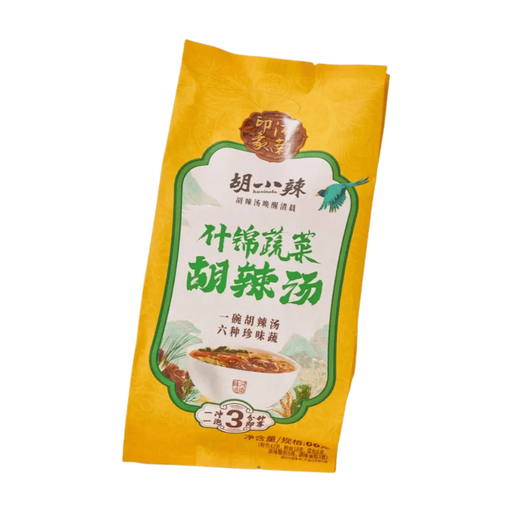 Image unavailable
Haoxiangni Spicy Vegetable Soup, 66 g
This 66 g dry format is for anyone looking for a spicy soup to prepare in the morning.
Before choosing this recipe, check the preparation instructions, allergens and salt content for the bowl you’ll be having.
View on Joybuy
Frequently asked questions
Is a dehydrated soup ‘reduced in salt’ if it doesn’t taste very salty?
No. Taste alone doesn’t tell you whether a product carries this label. Check the exact product and read the salt content in its nutritional information. The DGCCRF notes that comparative nutrition claims are based on a comparison with products in the same category.
How do I compare the salt in powdered soup with the salt in soup from a carton?
Compare the soups as prepared, using the same volume, then compare the amount you plan to drink. For these specific products, Monoprix states that a reconstituted 200 ml portion of Royco Velouté 12 légumes contains 1.4 g of salt, while Auchan states that 250 ml of Liebig Pur Soup 12 légumes contains 1.3 g. These portions are different sizes, so the figures should not be compared as they are.
How much water should I use for dehydrated soup?
Follow the instructions for the recipe you choose. For Royco Velouté 12 légumes, Monoprix specifies 200 ml of boiling water per cup and a 2-minute wait. Other soups may have different instructions.
How should I store liquid soup after opening?
Follow the instructions for the product you buy. For Liebig Pur Soup 12 légumes, Auchan advises keeping it in the fridge and consuming it within 48 hours of opening. This guidance does not apply to every liquid soup.


