Anyone comparing fat content
Whether you’re making soup, rice or a sauce, you’re looking for a stock described as reduced-fat or low in fat. The label on the product you choose is still the key to knowing how much you’ll add to your recipe.


If you’re looking to cut down on fat in a recipe, start by choosing a stock whose product description and nutritional values match the amount you’ll use, rather than choosing a container simply because it’s easy to measure. A liquid seasoning that you can add drop by drop isn’t automatically a substitute for a reduced-fat stock cube. Check the product type, salt and ingredients before switching formats.
Whether you’re making soup, rice or a sauce, you’re looking for a stock described as reduced-fat or low in fat. The label on the product you choose is still the key to knowing how much you’ll add to your recipe.
You want to compare the salt in the prepared stock, without assuming that reduced-fat stock is also reduced in salt. Manger Bouger lists stock among the condiments that contribute to salt intake.
You’d like to add small amounts without using a whole stock cube. In that case, it’s important to distinguish between how the product is dispensed, the type of seasoning and its nutritional information: a bottle alone doesn’t meet the reduced-fat criterion.
Start with the amount of stock your recipe needs, then compare the fat and salt content for that amount. If you’re thinking of replacing a cube with a liquid, check the format and ingredients too.
| Criterion | What to check | Who this matters to |
|---|---|---|
| Fat | The exact wording on the product, and the fat content per 100 g and per prepared serving, if stated. | If I’m making soup or vegetables, I want to know how much fat the amount of stock I use will add; around 42% of consumers make this a priority. |
| Salt and ingredients | The salt content per prepared serving, the ingredients list and any allergens stated for the product you’ve chosen. | Even with reduced-fat stock, I want to be able to adjust the salt in my dish and check the ingredients; this is a priority for around 33% of consumers. |
| Measuring and container | The product type, measuring instructions and, for a bottle, the dispensing mechanism and storage instructions after opening. | When I only need a few drops, I prefer to control what I pour without mistaking liquid seasoning for reduced-fat stock; around 25% of consumers prioritise ease of measuring. |
Auchan product listings for reduced-fat Maggi stock say these products contain 30% less fat than the average non-reduced-fat stock. This comparison doesn’t mean the product contains no fat.
Check the exact wording, then compare the nutritional values with the amount of stock your recipe calls for.
Knorr describes Viandox as a seasoning to be added drop by drop, not as the nutritional equivalent of a reduced-fat stock cube. Being easy to pour tells you nothing about its fat or salt content, or whether it contains allergens.
Before switching, compare the product descriptions, ingredients and nutritional information of both products.
Fat and salt content are two separate criteria. The amount of stock you add to the dish matters too.
Check the salt content for the amount you’re preparing, and taste the dish before adding any salt.
A liquid seasoning sold in a bottle won’t necessarily have the dispensing mechanism you’re looking for, and shouldn’t be treated as low-fat stock.
Check the exact container on the product listing and packaging, as well as the storage instructions after opening.
Auchan product listings include reduced-fat Maggi stock cubes, including beef and chicken varieties.
Knorr lists a low-fat Chicken Stock Cube separately from salt-focused varieties and its liquid seasoning, Viandox.
Carrefour France lists reduced-fat beef- and chicken-flavour stock, as well as reduced-salt chicken stock.
E.Leclerc lists Rustica reduced-fat chicken stock cubes, as well as reduced-fat veal stock.
These two cube products are useful for comparing formats measured by the cube. One highlights fat content, while the other focuses on salt. Check the labels against the criterion that matters for your recipe.
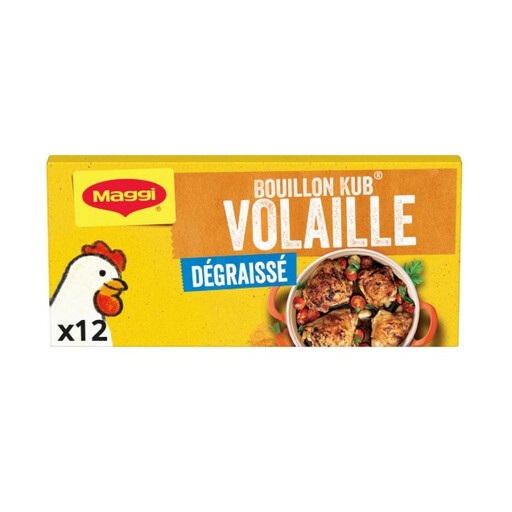 Image unavailable
For recipes where you’d rather measure stock by the cube than add it drop by drop. The box contains 12 cubes. Don’t assume that the Fat-Free label means the prepared serving contains no fat. Check the fat and salt content, and the ingredients, on the packaging.
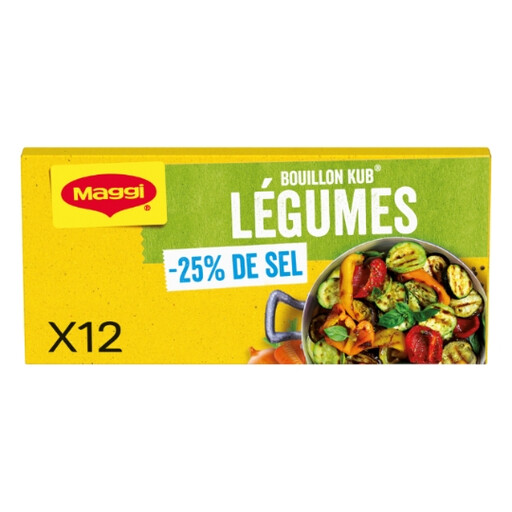 Image unavailable
For recipes where you want to compare the salt content of stock cubes. The pack weighs 120 g. Check the label to see what the 25 % Less Salt claim is compared with, and check the fat content for the amount you’re preparing. A claim about salt alone doesn’t tell you how much fat the product contains.
No. ‘Reduced-fat’ doesn’t necessarily mean ‘fat-free’. Auchan lists some Maggi products as containing 30% less fat than the average non-reduced-fat stock. Check the nutritional values for the specific product and the amount you’ll use.
Because salt is a separate consideration: reduced-fat stock isn’t automatically reduced in salt. Manger Bouger lists stock among the condiments that contribute to salt intake, so compare the amount for your prepared serving.
You can use it to season a recipe if it suits your needs, but don’t assume the two products have the same composition. Knorr recommends adding Viandox drop by drop. Before replacing the cube, compare its product description, ingredients and nutritional information with those of the liquid seasoning.
Check the product description, ingredients list, nutritional information and preparation instructions for the exact product. The DGCCRF explains this labelling information for prepacked foods. For your recipe, also check which quantity the fat and salt values refer to.