For a secondary school lunchbox, choose a savoury biscuit whose fat and salt content you can compare per 100 g with a similar product. The label ‘reduced fat’ isn’t enough to make a decision. Next, check the allergens, how much you’ll actually pack and, if the pupil has specific dietary needs, the arrangements agreed with the school. According to the French Directorate-General for Competition Policy, Consumer Affairs and Fraud Control (DGCCRF), Nutri-Score is voluntary in France. If it appears on the packaging, it complements the nutritional information.
Who is this guide for?
Parents comparing fat content
You’re looking for savoury biscuits for a lunchbox and want to check whether a product labelled ‘reduced fat’ contains less fat than a similar one. The DGCCRF says that nutritional values per 100 g make it possible to compare products on a like-for-like basis.
Families who need to check allergens
You need to read the ingredients of the product you choose and follow the guidance that applies to the pupil. The French Ministry of National Education says that an individual care plan (projet d’accueil individualisé, or PAI) can be put in place for a food allergy or a specific diet.
Anyone packing snacks to take to school
You’re looking for a pack that’s easy to pop into a lunchbox, without confusing the pack size with the amount the pupil will actually take with them.
What should you check?
First compare the values per 100 g for similar types of savoury biscuit, then check the allergens and the amount you plan to pack in the lunchbox.
| Criteria |
What to check |
Who is this for? |
| Fat |
Value per 100 g and comparison with a similar type of savoury biscuit. |
If I’m packing savoury biscuits for lunch, I want to know what ‘reduced fat’ means compared with a similar product. Around 33% of consumers would make reducing fat their priority. |
| Allergens and school requirements |
Ingredients and allergens in the specific product; any school guidance or applicable PAI. |
If a pupil needs to avoid an ingredient, the choice must first and foremost follow their dietary requirements and any arrangements agreed with the school. Around 25% of consumers would put this check first. |
| Salt and other values |
Fat and salt per 100 g; Nutri-Score, if shown. |
A claim about fat content doesn’t tell me how much salt the product contains. For around 25% of consumers, comparing these values together would be the main priority. |
| Pack size and portion |
Weight of the pack or bag and the amount actually put in the lunchbox. |
If I’m preparing the lunchbox in advance, I want to pack an appropriate amount without relying on the pack size alone. This would be the priority for around 17% of consumers. |
Mistakes to avoid
-
Assuming ‘reduced fat’ means a better choice in every way
A claim about fat content doesn’t, by itself, tell you about salt or allergens. The DGCCRF also points out that Nutri-Score is voluntary when displayed.
Compare fat and salt per 100 g across similar products, then read the ingredients of the one you choose.
-
Assuming all products do or don’t contain gluten
Ingredients vary from product to product. For example, Carrefour’s listing for Schär gluten-free crackers mentions soya, so avoiding gluten doesn’t address the question of other allergens.
Check the ingredients and allergens on the packaging of the product you buy, even if it says ‘gluten-free’.
-
Forgetting the requirements of the pupil and their school
For a food allergy or specific diet, the French Ministry of National Education says that a PAI can be used to arrange individual adaptations.
Before packing a biscuit that may be affected by these requirements, check the guidance with the family and school, as well as any applicable PAI.
Brands to compare
Carrefour Classic'
Carrefour France includes Carrefour Classic' reduced-fat sesame breadsticks in its savoury biscuit range.
- A product labelled ‘reduced fat’ can be a starting point for comparison with similar breadsticks.
- The range description doesn’t replace checking the nutritional values and allergens on the pack you choose.
Auchan
Auchan France’s savoury biscuit range includes a variety of formats and recipes to compare.
- Products can be compared by biscuit type and pack size.
- Check the fat, salt and allergens in each product before choosing it for a lunchbox.
Belin
Auchan France includes Belin Monaco crackers in its savoury biscuit range.
- A cracker from this range can be compared with another cracker on a per-100 g basis.
- Belin’s presence in the range doesn’t mean that all its products have the same ingredients.
Vico
Auchan France includes Vico paprika-flavoured lentil crisps in this range. They’re a savoury snack, not a cracker.
- This different category may be worth considering if you’re looking beyond savoury biscuits.
- Its presence in the range doesn’t show that it’s lower in fat or free from allergens.
A cracker option on Joybuy
This 30 g pack of crackers could work for a lunchbox. To see whether it suits your search for lower-fat savoury biscuits, compare its nutritional information with that of similar crackers.
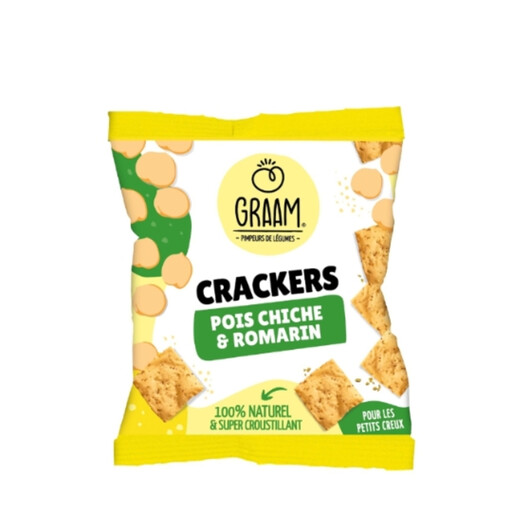 Image unavailable
Gram Chickpea Cracker, 30 g
The 30 g pack makes it easy to plan a specific amount for the lunchbox. Before choosing it to reduce fat, compare the values per 100 g with those of a similar cracker. Check the allergens on the packaging too.
View on Joybuy
Frequently asked questions
Is Nutri-Score compulsory on savoury biscuits in France?
No. The DGCCRF describes Nutri-Score as a voluntary system. For prepacked food, a nutrition declaration is generally compulsory and lets you check values such as fat and salt per 100 g.
How can I check whether a savoury biscuit is lower in fat?
Compare its fat value per 100 g with that of a similar type of savoury biscuit. Check the salt and ingredients too: a claim about fat doesn’t tell you everything about the product.
Do all savoury biscuits contain gluten?
No. Check the ingredients of each product individually. The DGCCRF says that allergenic ingredients must be highlighted; a gluten-free product may contain other allergens, as shown by the soya listed on Carrefour’s product page for Schär crackers.
Should I check with the school before packing these biscuits in a lunchbox?
Check the school’s guidance, especially if the pupil has a food allergy or specific dietary requirements. The French Ministry of National Education says that a PAI can be put in place to set out individual adaptations.
Are gluten-free crackers necessarily lower in fat?
No. The ‘gluten-free’ label addresses a different question from fat content. Compare the nutritional information per 100 g and check separately for any other allergens in the product you choose.


