Buying priorities
Fridges and freezers run continuously, according to ADEME. Start by selecting the useful format and capacity, then compare the information on the labels of genuinely comparable appliances.
| Priority |
What to check |
Your needs |
| Annual energy consumption |
Compare kWh/year between appliances of the same type, capacity and installation format. Use the A to G class as an additional reference. Do not directly convert an old A+++, A++ or A+ label to the new scale. |
I want to be able to compare the electricity used by an appliance that stays switched on all year round. The label’s QR code can help you find the exact model listing in EPREL when available. |
| Usable capacity |
Look at the litres for the fridge compartment and freezer compartment separately. Once you have selected a suitable capacity, compare the kWh/year of the usable formats. |
My appliance must hold the fresh food I need without buying an unnecessarily large total capacity. If frozen food is only an occasional requirement, a small compartment may be enough; otherwise, check the freezer capacity before choosing. |
| Installation and noise |
For built-in models, check the niche dimensions and installation requirements. Compare the noise level in dB(A), the noise class and the installation type between equivalent models. |
I want a model that is compatible with my kitchen and quiet enough for use near a living area. Dimensions and ventilation clearances matter just as much as the stated capacity. |
Joybuy products for this comparison
Joybuy options covering standalone fridges and fridge-freezers, so you can compare capacity, installation and stated annual energy consumption according to your kitchen.
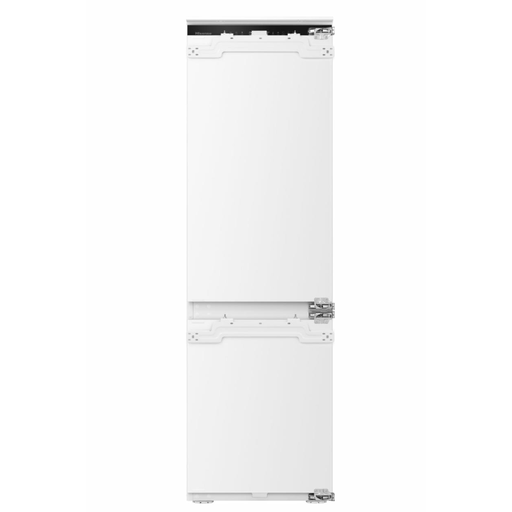 Image unavailable
Hisense RB3B250SAWC 252 L built-in fridge-freezer
Worth considering for a fitted kitchen requiring separate fresh-food and freezer compartments.
Stated figures: 176 L fridge capacity, 76 L freezer capacity, 150 kWh/year, class C and 34 dB(A). No Frost model with reversible door.
Check the niche dimensions and ventilation requirements before buying. Compare the 150 kWh/year with built-in fridge-freezers of a similar capacity.
Joybuy
 Image unavailable
Haier HTW5618ENMG 360 L 3-door fridge-freezer
This freestanding fridge-freezer is aimed at households needing substantial fresh-food and freezer capacity.
Stated figures: 235 L fridge capacity, 125 L freezer capacity, 271 kWh/year, class E and 35 dB(A). Dimensions: 185 × 59,5 × 66,7 cm.
Its 360 L capacity should match a genuine need. Check the installation space, ventilation and the clearance required to bring it into position.
Joybuy
 Image unavailable
CHiQ JR263LGE 262 L black fridge-freezer
A 54 cm-wide format to consider for a narrow kitchen requiring both refrigeration and freezing.
Stated figures: 187 L fridge capacity, 75 L freezer capacity, 215 kWh/year, class E and 39 dB(A). Dimensions: 1760 × 540 × 550 mm.
The Low Frost system still requires periodic manual defrosting. The stated N-ST climate class is suitable for an ambient temperature between 16 °C and 38 °C.
Joybuy
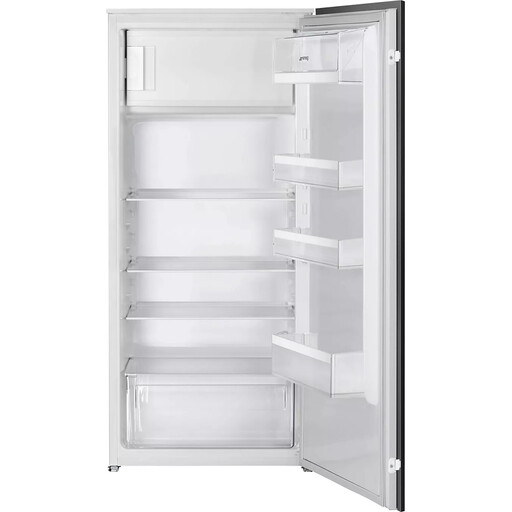 Image unavailable
SMEG S4C122E 188 L built-in fridge-freezer
This model is primarily suited to a built-in kitchen where the main requirement is refrigeration.
Stated figures: 174 L fridge capacity, 14 L freezer capacity, 146 kWh/year, class E and 35 dB. Stated niche: 56 × 122,5 × 55 cm.
The 14 L freezer compartment is limited and requires manual defrosting. Also check the sliding-door system and whether a furniture door is included.
Joybuy
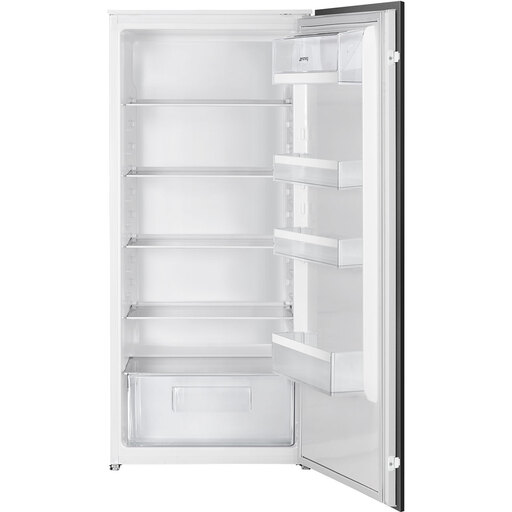 Image unavailable
SMEG S4L120E 1-door built-in fridge
Only consider this model if you need refrigeration without a freezer compartment in the same appliance.
Stated figures: 101 kWh/year, class E, 34 dB and automatic defrosting. The stated capacity differs between the available information: 188 L in the title and 208 L in the description.
Confirm the exact net capacity, niche dimensions and door-fixing system before buying.
Joybuy
Frequently asked questions
Which energy label information should you compare for a fridge or freezer?
For comparable refrigeration appliances, note the annual consumption in kWh, the net capacities of the fridge and freezer compartments, the noise level, the noise class and the A to G energy class. Capacity and kWh/year should be considered together: a better class letter does not replace comparison with an appliance of a comparable capacity and format.
Can you directly compare an old A+++ class with a new A class?
No. Bosch and Whirlpool explain that the old A+, A++ and A+++ classes were replaced by the A to G scale in 2021, with revised methods and criteria; a direct conversion is not reliable. Prioritise the kWh/year figures and net capacities on current labels.
Is a fridge-freezer always more energy-efficient than two separate appliances?
No. The choice depends on the capacity genuinely required in each compartment. A fridge-freezer is suitable when you need refrigeration and freezing at the same time in one appliance; if you are considering two appliances, add their annual energy consumption together and check that their additional capacity meets a lasting need.
Does the energy label apply to fridges and freezers sold in France?
Yes. Delegated Regulation (EU) 2019/2016 sets labelling requirements for mains-powered refrigeration appliances with a capacity greater than 10 L and less than or equal to 1,500 L, subject to the exclusions set out in the legislation. The relevant domestic refrigeration appliances sold in France must display an energy label.
Should you use a durability or repairability index to choose between fridges?
Do not assume so. ADEME states that the mandatory durability index applies to televisions from January 2025 and washing machines from April 2025. For a refrigeration appliance, check the available documentation, spare parts, warranty terms and any repair prices published by the manufacturer on a case-by-case basis.


