
Livraison le jour même ou le lendemain

Qualité garantie

Débloquez vos offres de bienvenue: Livraison GRATUITE | Jusqu'à -80 % | 30 jours d'essai gratuits à JoyPlus
Téléchargez l'application
Does your car's halogen lighting feel lacklustre and a bit dated?? Dreaming of adding a modern touch of colour to your interior, without triggering a cascade of dashboard errors?? Switching to a red W5W LED bulb is the easiest and most effective way to modernise your vehicle.
But here's the catch: the market is a jungle of part numbers where it's easy to get lost. Between compatibility, brightness, and error-cancelling systems, making a choice can quickly become a headache.
Our mission?? To help you see things more clearly. This guide breaks down the essential criteria for finding the perfect bulb and presents our selection of the most reliable and high-performing models available today.
Before you buy, here are a few technical points to check for a hassle-free installation and maximum lifespan.
The great advantage of the W5W bulb is its standardisation. You'll find it under different names that all refer to the same base?: T10, 194, 168, or 2825. These bulbs are designed to be '?plug and play?', meaning they directly replace your original bulbs without any modifications.
They are commonly used for?:
A simple tip?: before any purchase, check your vehicle's manual to confirm that the W5W/T10 base is the correct one.
Modern vehicles (generally post-2005) feature an electronic system called Canbus (Controller Area Network). This system constantly monitors the proper functioning of components, including the bulbs. Since an LED bulb consumes far less power than a halogen one, the on-board computer (OBC) may mistake it for a burnt-out bulb and display an error message.
To bypass this issue, it's crucial to choose an error-free W5W bulb. These models, known as Canbus T10 LEDs, include a built-in resistor that mimics the power consumption of a standard bulb. The diagnostic system won't detect any issues, guaranteeing you a headache-free installation.
An LED's brightness is measured in lumens (lm). It's simple?: the higher the number, the brighter the light. Obviously, a red LED courtesy light for the interior doesn't have the same requirements as a third brake light.
Crucial Point on Regulations?: In many regions, the law is strict. For example, in France, using red for licence plate lighting is prohibited; it must be white. The same applies to front position lights (sidelights), which must be white or amber. The use of red bulbs is therefore restricted to rear position lights, the third brake light, and interior lighting. When in doubt, always check your local regulations before modifying your vehicle's exterior lighting.
To guide you, we've scoured the market and selected three models that excel in compatibility, reliability, and performance.
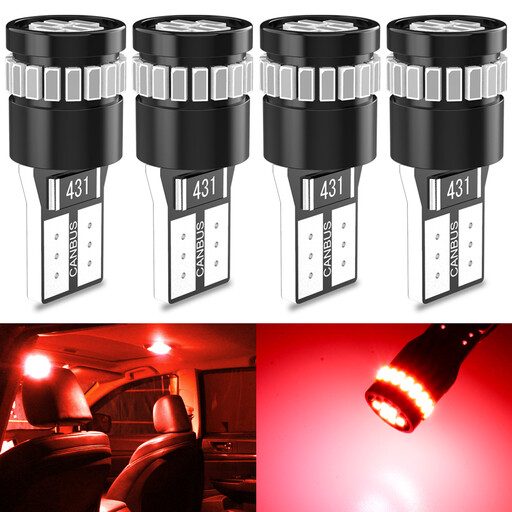
What sets it apart?: This model is the ideal entry point into the world of LED lighting. It offers a stunning balance of brightness, compatibility, and ease of installation, all in an ultra-compact design.
Key features?:
Who is it for?? For the driver looking for a simple and reliable solution to swap out old halogen bulbs for a bright red LED light, whether for the interior or rear lights.
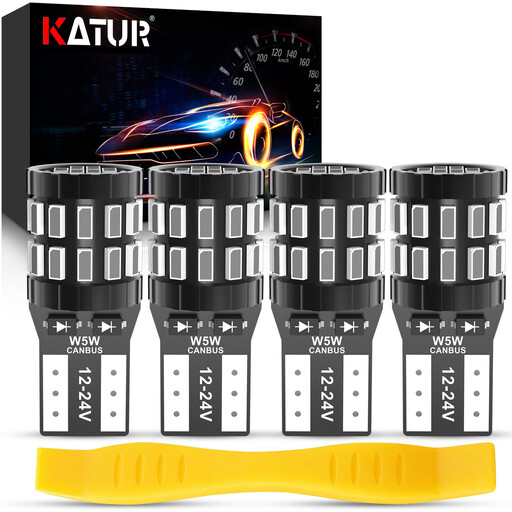
What sets it apart?: With its 30 LED chips and impressive light output, this model is built for those who refuse to compromise on intensity. Its compatibility with a 12V to 24V voltage range also makes it highly versatile.
Key features?:
Who is it for?? For the car customisation enthusiast or the demanding user seeking the highest possible lumen output, especially for a high-impact third brake light or intense interior lighting.
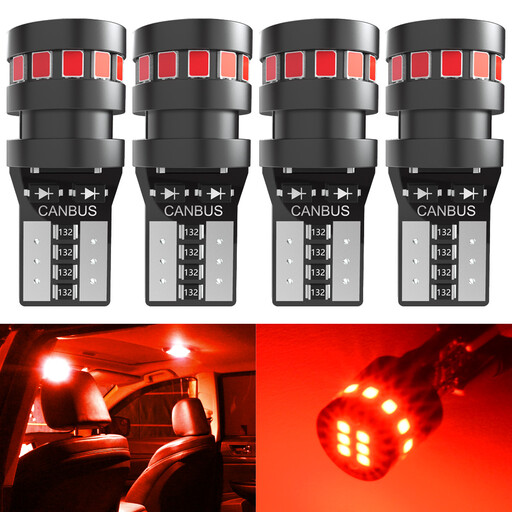
What sets it apart?: Here, the focus is on durability and stability. Its full aluminium body ensures exemplary heat dissipation, while its intelligent integrated circuit protects against short circuits and promises record-breaking longevity.
Key features?:
Who is it for?? For the pragmatic user who prioritises reliability and longevity above all, without sacrificing the quality of a red light that is far superior to halogen.
If our selection doesn't tick all your boxes or if you want to explore other types of lighting for your vehicle, feel free to browse our complete category. There you'll find a much wider choice of models, power levels, and colours for all your customisation projects.
Absolutely. These are interchangeable standards for the same type of glass wedge base. A red T10 LED bulb will therefore fit perfectly into a W5W, 168, or 194 socket, and vice-versa.
This common phenomenon is due to residual current flowing through the electrical circuit of some vehicles. The on-board computer sends a micro-pulse to check that the bulb isn't burnt out. A halogen bulb is not sensitive enough to react. An LED, however, may flicker or glow faintly. Opting for a quality Canbus T10 LED bulb resolves this issue in almost all cases.
It all depends on their location and your local laws. For interior lighting (LED dome light, glove box, trunk), all colours are generally permitted. For the exterior, however, traffic laws are very strict: