
Livraison le jour même ou le lendemain

Qualité garantie

Débloquez vos offres de bienvenue: Livraison GRATUITE | Jusqu'à -80 % | 30 jours d'essai gratuits à JoyPlus
Téléchargez l'application
Choosing a red 3D filament? At first glance, nothing could be simpler. However, the nature of the material is just as crucial as the colour. Between a red PLA filament for a decorative object, a red PETG for a mechanical part, or a Red Silk PLA for an ultra-glossy finish, the possibilities are vast. Each project has its own requirements for strength, flexibility, and aesthetics.
As a product expert at Joybuy, I'm here to break down the specifics of each red filament for you. The goal: to help you find the one that perfectly matches your projects and your 3D printer.
Before diving into our selection, let's review the essential criteria that will guide your choice.
The choice of polymer is the number one criterion.
We have selected three products that each excel in their respective fields: speed, aesthetics, and durability.
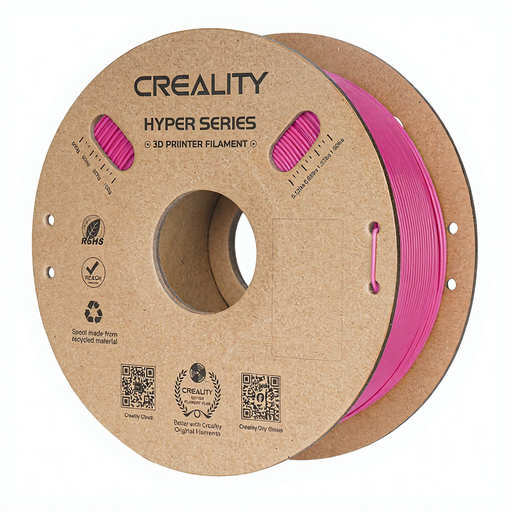
Why It Stands Out This Creality filament is specially formulated for very high-speed printing, up to 600 mm/s. Its high fluidity and accelerated cooling allow it to maintain excellent surface quality even at full speed, drastically reducing print times.
Advantages
Who Is It For? For owners of fast 3D printers (Creality K1, Bambu Lab, and similar models) who want to maximise their productivity, whether for prototyping or small-batch production.
See Creality Hyper PLA on Joybuy
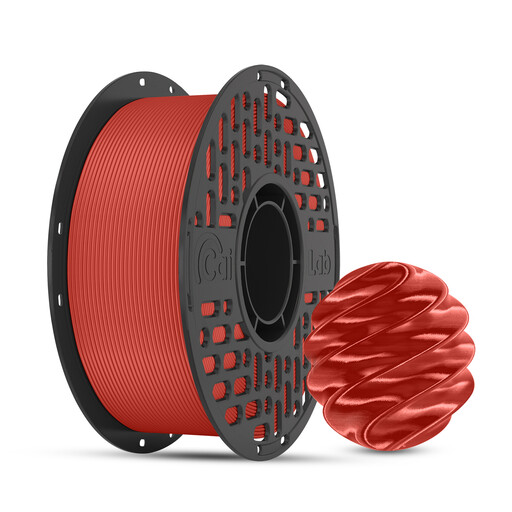
Why It Stands Out The Red Silk PLA from CaiLab is distinguished by its exceptionally glossy and satin-like finish. It catches the light in a unique way, giving printed objects a premium appearance and a silky feel, all with no post-processing required.
Advantages
Who Is It For? For creators, artists, and makers who prioritise aesthetics above all else. Ideal for vases, statuettes, jewellery, or any project where visual impact is the top priority.
Discover CaiLab Silk PLA on Joybuy

Why It Stands Out This red PETG filament from CaiLab is the practical choice for functional parts. It combines high impact resistance, good flexibility, and better temperature resistance than PLA. Its major advantage: it is much easier to print than ABS, as it is far less prone to warping.
Advantages
Who Is It For? For engineers, hobbyists, and anyone who needs to print strong, durable parts for real-world applications.
Check out CaiLab PETG on Joybuy
Our selection focuses on three key uses, but the world of red filament is much broader. If you're looking for a specific shade, another material, or simply more choice, feel free to explore our full catalogue.
Explore our full range of red 3D filament
1. What is the main difference between red PLA and red PETG? The main difference lies in their mechanical and thermal properties. Red PLA filament is more rigid but also more brittle; it deforms at relatively low temperatures (around 60°C). Red PETG filament, on the other hand, is more flexible, much more impact-resistant, and can withstand higher temperatures (up to 80°C), making it the natural choice for functional parts.
2. Is high-speed filament compatible with a standard 3D printer? Yes, absolutely. A high-speed filament is compatible with any 3D printer that accepts 1.75 mm filament. You simply won't reach the peak speeds for which it is optimised, but it will work perfectly at standard speeds. Its high fluidity can sometimes even improve extrusion quality.