
Livraison le jour même ou le lendemain

Qualité garantie

Débloquez vos offres de bienvenue: Livraison GRATUITE | Jusqu'à -80 % | 30 jours d'essai gratuits à JoyPlus
Téléchargez l'application
Choosing your table linen is no longer just a matter of taste. With an ever-expanding selection, opting for a recycled tablecloth seems like the perfect choice for more responsible consumption. But be warned: not all tablecloths labelled "eco-friendly" are created equal. Behind some marketing promises lie products with poor durability, and disappointment often follows.
To ensure you invest in a piece that will grace your table for years to come, let's review the most common pitfalls.
To make an informed choice, here are the technical specifications that will truly separate a good investment from a disappointment.
The composition is the first indicator of the quality and longevity of your eco-friendly table linen. The winning formula often found is a blend of 80% recycled cotton and 20% polyester.
This combination is no accident. Recycled cotton, derived from textile production scraps, provides the softness, matte appearance, and pleasant feel of natural fibres. Polyester, on the other hand, plays a key technical role:
This blend allows for the creation of sustainable table decor without sacrificing everyday practicality.
In a market saturated with "green" claims, independent labels are a genuine guarantee. The STANDARD 100 by OEKO-TEX certification is one of the most reliable and recognised.
An Oeko-Tex tablecloth guarantees that every component, from the thread to the finished fabric, has been tested and declared free of harmful substances. Note that this is not an ecological label for the production process, but rather an assurance that the final product is safe for skin contact. This is a reassuring criterion, especially for an everyday item that comes into contact with food and the whole family.
Manufacturing details are often the best indicator of a product's overall quality.
To illustrate how these criteria apply in practice, here are two models that meet different needs while checking all the boxes for quality and durability.
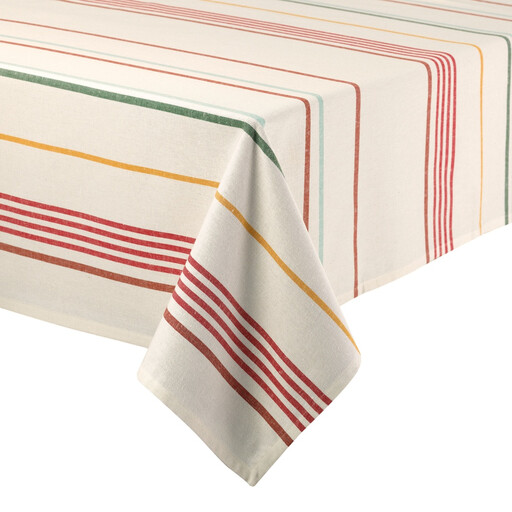
Key features: Perfect for everyday tables as well as large, convivial meals, its multicoloured stripes add a dose of cheerfulness. Its composition makes it easy to live with and care for, even with children at the table.
Its 80% recycled cotton / 20% polyester composition is clearly stated, ensuring excellent stability during washing. The colours come from a "yarn-dyed" weave, which guarantees they won't fade, unlike a low-quality print.
The combination of vibrant, long-lasting colours and hassle-free maintenance. It is also available in a large size (170x300 cm) for extra-large gatherings.
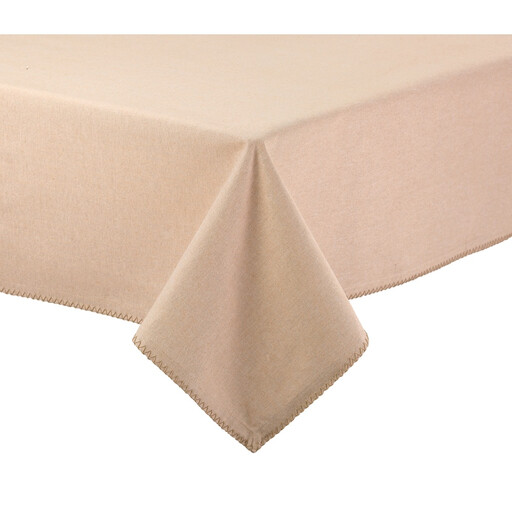
Key features: Ideal for those who prefer a refined and timeless aesthetic. Its natural shade and neat finishes complement both an everyday table and festive decorations.
It features a truly effective stain-resistant treatment for daily use, avoiding the pitfall of protections that fade too quickly. Its Oeko-Tex certification and recycled cotton composition check the boxes for transparency and safety.
The perfect marriage of elegance, with its "saddle stitch" finish, and the practicality of its stain-resistant treatment. The Oeko-Tex certification adds essential peace of mind.
As you can see, the presence of polyester in these tablecloths is the key to their durability and ease of care. If you're interested in the benefits of this material for other uses, take a look at our selection of clothing.
We have put together a complete selection of products that meet these quality criteria and current regulations.
To preserve the fibres and treatments, washing at a low temperature (30°C or 40°C) with a mild detergent is ideal. Above all, avoid fabric softener, which can impair the effectiveness of the stain-resistant treatment. Opt for air-drying and iron on the reverse side at a medium temperature.
It all depends on the quality of the treatment. A good coating creates a water-repellent effect that gives you time to blot up liquids (water, wine, coffee, etc.) with a damp sponge before they set in. It's a valuable everyday helper, but be aware that it doesn't make the tablecloth invincible, especially against grease stains or colourful sauces that are left to sit.
The golden rule is to ensure a balanced overhang on each side. Measure the length and width of your tabletop, then add between 40 and 60 cm (16 to 24 inches) to each dimension (which means a 20 to 30 cm or 8 to 12 inch overhang on each side). For example, for a table that is 90 cm wide by 180 cm long, a tablecloth of about 150 cm by 240 cm will provide the perfect drape.