
Livraison le jour même ou le lendemain

Qualité garantie

Débloquez vos offres de bienvenue: Livraison GRATUITE | Jusqu'à -80 % | 30 jours d'essai gratuits à JoyPlus
Téléchargez l'application
A recirculation cooker hood with a charcoal filter is particularly well suited to kitchens where installing an external extraction duct is impossible or too inconvenient. In recirculation mode, air laden with smoke and cooking odours passes through an activated charcoal filter before being returned to the room.
This system makes fitting out a kitchen in a flat much simpler, but it doesn't mean you can skip checking a few essential points. Here are the criteria to consider before buying a cooker hood or a replacement filter.
Expressed in m³/h, the airflow rate indicates the volume of air the hood moves. However, it alone isn't enough to judge how comfortable it will be to use. Noise level, the shape of the hood, the length of the ducting and the condition of the filters all affect performance.
A hood advertised at 650 m³/h may operate at several speeds. So take the time to look at the data for each speed setting, rather than relying solely on the maximum airflow rate.
Activated charcoal gradually becomes saturated. An unsuitable filter can be difficult to install and may reduce airflow. Before ordering a charcoal filter for a Ciarra hood, check the exact model reference of your appliance, as well as the shape and dimensions of the filter.
The Ciarra CBCF002X2 filter, for example, measures 11 × 11 × 4 cm. It is suitable for models including the CBCS6201, CBCB6201, CBCS6906D, CBCB6906D, CBCB9201-B and CBCB6201-B. The Ciarra CBCF003 filter, on the other hand, is round in shape and has a diameter of 175 mm.
A hood fitted with an activated charcoal filter will usually also have a metal or aluminium grease filter. This must be cleaned regularly, often every two to four weeks depending on usage. When it becomes clogged, the airflow drops and deposits can build up inside the appliance.
A recirculation hood doesn't need a duct through the wall. It passes air through a charcoal filter to treat odours, then returns it to the kitchen. This setup is ideal for homes without an external vent.
A hood with external extraction expels smoke and moisture directly outside, provided the installation is compatible. Some models offer both modes, giving you more flexibility during a renovation or a house move.
The width of the hood should match or exceed that of your hob, where the layout allows.
Before ordering, measure the available width, the depth of the cabinet and the height between the hob and the hood.
To compare two models, note at least the following:
A quiet cooker hood isn't defined by a universal threshold that applies in every situation. Instead, compare the stated values under similar conditions. The Comfee TSHM77SS-60, for example, has a noise level of 59 dB and a maximum airflow of 650 m³/h, while some simpler models rely on mechanical controls and more modest power.
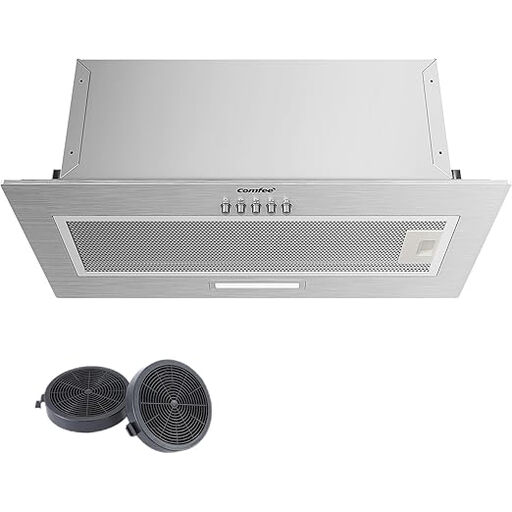
Why this choice suits this profile: This 60 cm hood offers three speeds, a stated airflow of 400 m³/h and both extraction and recirculation modes. It's ideal for a standard kitchen that benefits from simple mechanical controls.
The two ventilation modes prevent you from choosing an appliance that's incompatible with your home's layout. The aluminium grease filter is removable, making maintenance easy.
60 cm width, three power levels and charcoal filter included according to the product listing.
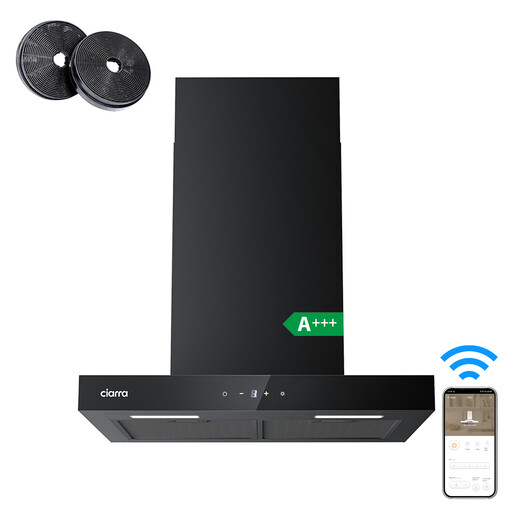
Why this choice suits this profile: This wall-mounted model combines recirculation and extraction, touch controls with Wi-Fi, a boost function and a stated airflow of up to 650 m³/h.
The listing states the CBCF003 filter type and that two charcoal filters are included, making it easy to check before buying for recirculation mode.
A+++ energy rating, stated maximum noise level of 59 dB and stated annual energy consumption of 12 kWh.
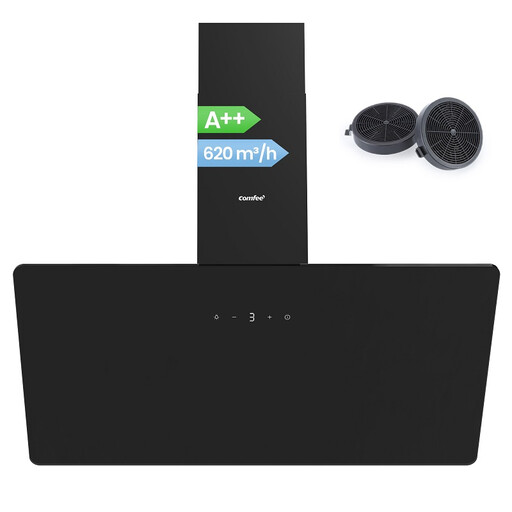
Why this choice suits this profile: With its 90 cm width, four speeds and stated airflow of 620 m³/h, it's ideal for frequent cooking and large hobs.
The choice between recirculation and extraction lets you adapt the installation to your home. The adjustable speeds mean you don't have to run the hood at full power all the time.
90 cm width, four speeds, stated airflow of 620 m³/h and stated noise level of 59 dB.
How often you need to replace the filter depends on how much you cook, the types of food you prepare and how often you use recirculation mode. For Ciarra filters, the product listings generally recommend replacement every two to four months, depending on usage.
Always check the reference given in the manual or printed on the filter already installed. A replacement filter for a cooker hood shouldn't be chosen by appearance alone.
We've put together a comprehensive, real-time updated list of products that fully meet these strict selection criteria and European safety regulations.
For several Ciarra models, the recommendations suggest replacing it every two to four months. However, heavy use, cooking fatty foods or persistent odours may mean you need to change it sooner.
In recirculation mode, it mainly treats odours and some particles using the charcoal filter. It doesn't expel moisture to the outside like a hood connected to a duct. To reduce condensation, remember to air the room after cooking.
Yes, some models are designed to work in recirculation mode. However, you need to check that a compatible filter is available, that there's enough space in the cabinet and that the installation instructions are followed. The electrical connection and fixing must also comply with the guidance in the manual.