If you can’t use an external extractor duct, choose a cooker hood specifically designed for recirculation and check which charcoal filter is compatible with the model. In an open-plan kitchen, compare the noise levels and extraction rates for recirculation, where these are specified, and choose a size that leaves enough room for installation and maintenance. The hood filters the air and returns it to the room; it does not replace your home’s ventilation system.
Who is this option for?
Open-plan kitchen owners who want to tackle cooking smells
If cooking smells drift into your living space and there’s no usable external outlet, recirculation filters the air before returning it to the room. As Qualitel explains, this means accepting that air is returned to the kitchen and keeping on top of filter maintenance.
Households mindful of noise and space
When your kitchen shares space with your dining or living area, noise levels matter just as much as the hood’s visible size. Compare the figures given for recirculation and make sure you can reach the filters once the hood is installed.
Home cooks prepared to maintain their filters
If you’re happy to follow the model’s maintenance instructions, compare compatible filter references before choosing. Depending on the model, Elica offers disposable or washable filters; these accessories are not interchangeable across all its cooker hoods.
What should you check before buying?
For an open-plan kitchen without a usable extractor duct, start by checking that the hood is compatible with recirculation. Then consider how it will suit your room, kitchen units and the maintenance you can keep up with.
| What matters |
What to check |
Who it matters to |
| Cooking smells in the living space |
Confirm that the hood has a recirculation mode and check the charcoal filter reference. If an extraction rate is listed, make sure it applies to this mode: UFC-Que Choisir measures recirculation and extraction separately. |
When my kitchen opens onto my living space, I want to limit the spread of smells without relying on an external outlet; around 33% of consumers put this need first. |
| Noise while cooking |
Compare the stated noise levels for recirculation at comparable speeds and using the same acoustic measurement. A figure for just one speed won’t tell you how the hood performs across its full range. |
If meals or conversations happen near the hob, I want a cooker hood that’s quiet enough for everyday use; around 27% of consumers prioritise low noise. |
| Space and installation |
Measure the available space and check the dimensions and installation clearances specified in the manual for the exact model. |
With a wall unit above the hob or an already-fitted kitchen, I need to be able to install the hood and reach its filters without altering existing ductwork; around 20% of consumers prioritise this kind of fit. |
| Filter maintenance |
Note the reference for the compatible filter, its cleaning or replacement instructions, and whether you can reach it after installation. |
If I prefer to plan maintenance from the outset, how often the filters need attention and how easy they are to access will influence my choice; around 20% of consumers put this need first. |
Mistakes to avoid
-
Thinking the cooker hood replaces your home’s ventilation
A recirculating cooker hood filters cooking air and then returns it to the room; it does not renew the air in your home. The French order of 24 March 1982, published on Légifrance, prohibits connecting a cooker hood fitted with a fan to a shared air outlet system.
Keep your existing ventilation system separate and choose a cooker hood designed for recirculation, with compatible filters.
-
Comparing extraction figures only
Air passing through a charcoal filter changes the conditions in which the hood operates. UFC-Que Choisir measures cooker hood extraction rates separately for ducted extraction and recirculation, so a figure given for the former won’t tell you how it performs in the latter mode.
For your needs, look for noise and extraction figures specified for recirculation. If they’re not on the product page, ask for them for the model you’re considering.
-
Forgetting to check you can reach the filters
Charcoal filters need to be maintained according to their specific reference. Electrolux also says that grease build-up on the filter can reduce extraction performance.
Before installation, check the filter reference and the manual’s instructions, and make sure you’ll be able to remove the filters once the hood is in place.
Disposable filters need replacing regularly; washable filters take time to clean and must be maintained according to their instructions.
-
Assuming recirculation resolves every issue with gas
A recirculating cooker hood doesn’t vent cooking air outside. So, compatibility with this mode alone isn’t enough to assess the setup in a kitchen with a gas hob.
If you cook with gas, check the hood’s instructions and your home’s ventilation before deciding on this installation.
Brands to consider
The details below apply to the models and filters mentioned, not to every product in these brands’ ranges.
Electrolux
Worth considering if you’re looking for a filter unit built into your kitchen furniture.
- Electrolux says the LFG916K filter unit can be used in recirculation mode with an optional standard or long-life charcoal filter.
- For this model, check the reference of the filter you choose and its installation requirements before finalising the housing.
Bosch
An option to explore if you need an under-cabinet model to fit beneath a wall unit.
- Bosch describes the DHU626ML as a 60 cm under-cabinet cooker hood that can be used in recirculation or extraction mode.
- Bosch advises checking charcoal filter compatibility using the exact reference number of the appliance.
Elica
A brand to compare if charcoal filter maintenance is an important part of your decision.
- Elica recommends replacing the disposable CFC0038000 filter every 3 to 4 months. The CFC0166361 filter is washable, with replacement recommended every 2 years.
- These details relate to two different references, so check which one is compatible with the cooker hood you’re considering.
Wall-mounted cooker hoods available on Joybuy
These two 90 cm wall-mounted cooker hoods are listed as having a recirculation mode. If this size suits your open-plan kitchen, check the charcoal filter required, the installation space and the figures for recirculation for each model before choosing.
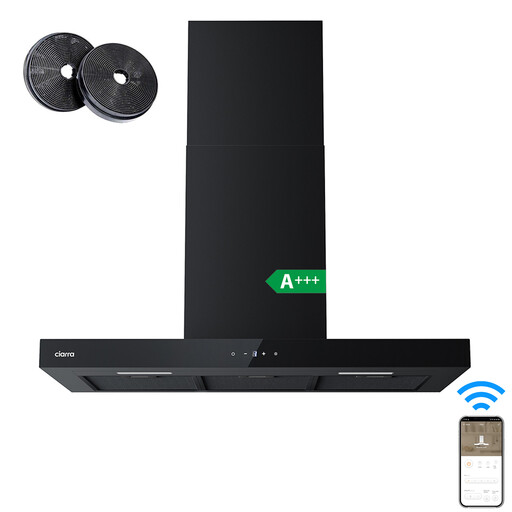 Image unavailable
Ciarra, 90 cm recirculating wall-mounted cooker hood
Worth considering if you have a suitable wall and enough space for a 90 cm cooker hood. The product name specifies touch controls, Wi-Fi connectivity and four speeds with a booster function.
The CBCF003 charcoal filter is listed for recirculation; check its maintenance instructions. The maximum extraction rate of 650 m³/h and noise level of 59 dB aren’t specified as figures for recirculation mode. If they’ll affect your decision, ask for the figures for this mode.
View on Joybuy
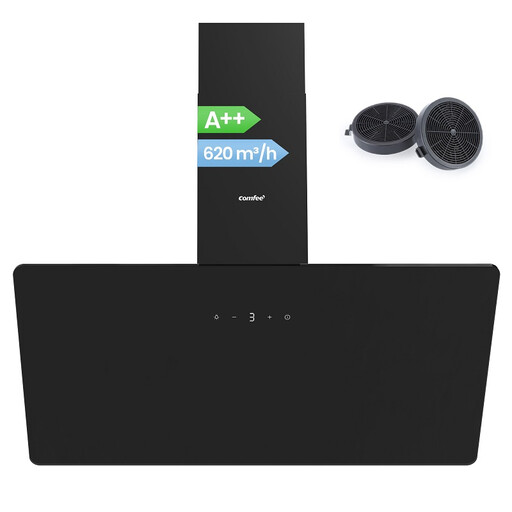 Image unavailable
Comfee' CH90J64ET4A2B2-EU, 90 cm angled cooker hood
Worth a look if you’re after a 90 cm angled cooker hood for wall-mounted installation. The product name specifies four speeds, touch controls and a five-layer aluminium grease filter.
Recirculation mode is listed, but check the reference and whether the compatible charcoal filter is included before buying. The stated extraction rate of 620 m³/h and noise level of 59 dB aren’t specified as figures for recirculation. Also ask for the installation dimensions to make sure it will fit your space.
View on Joybuy
Frequently asked questions
Can you connect a cooker hood with a motor to a building’s shared air outlet?
No. The French order of 24 March 1982, published on Légifrance, prohibits connecting an individual mechanical device, such as a fan-assisted cooker hood, to a shared air outlet system. The option covered here is to use the hood in recirculation mode without altering the existing ductwork.
Does a recirculating cooker hood replace your home’s ventilation?
No. As Qualitel explains, a recirculating cooker hood filters cooking air and returns it to the room; it doesn’t renew the air in your home, which is the job of your ventilation system. Keep the two systems separate.
What should you check if you have a gas hob?
Check your home’s ventilation and the cooker hood’s installation instructions before choosing recirculation. This mode returns filtered air to the kitchen rather than venting it outside, so the words “recirculation compatible” alone aren’t enough to assess your setup.
Is the energy label enough to compare two recirculating cooker hoods?
No. ADEME says that cooker hood energy labels are available online and in shops; the EPREL product information sheet may also give annual energy consumption and several efficiency ratings. For a kitchen without an external extractor duct, check separately whether the extraction and noise figures you’re comparing apply to recirculation mode.


