If you don’t have an external duct, choose a cooker hood specifically designed for recirculation and check which compatible odour filter it needs before comparing the stated extraction rates. An integrated hood is suitable for a compatible wall unit, while a decorative hood avoids this constraint. A hob with an integrated extractor also means checking the base unit, drawers and plinth. To assess noise and filtration, prioritise figures measured in recirculation mode.
Who is this option for?
You don’t have an external air outlet
Your cooker hood will need to work in recirculation mode. Compare odour reduction, noise and filter maintenance in this mode rather than in extraction mode. UFC-Que Choisir points out that the installation mode affects these factors.
You’re fitting out an existing wall unit
For a built-in cooker hood, measure the cabinet and check the clearance from the hob, as well as the space needed to remove the filters.
You’re redesigning the whole cooking area
If you’re also replacing the hob and base unit, you could consider a hob with an integrated extractor. For recirculation, make sure the installation is compatible with the space beneath the worktop, the drawers and the plinth.
What should you check before buying?
Start with the space available, then check the filtration, noise and maintenance for the recirculation set-up you’ll be using.
| Factor | What to check | What you need |
|---|
| Installation |
Check that the exact model supports recirculation. For a standard or decorative cooker hood, check the position and installation clearances; for a built-in hood, check the dimensions of the wall unit; for a hob with an integrated extractor, check the base unit, drawers and plinth. |
I want to choose a solution that fits my kitchen without assuming I can connect an external duct. |
| Odours |
Find out which odour filter is compatible, whether it’s included and how it needs to be maintained. If available, check the odour-reduction results in recirculation mode: UFC-Que Choisir measures this separately from airflow. |
Cooking smells bother me, so the stated extraction rate alone isn’t enough to tell me how well they’ll be reduced. |
| Grease |
Check the type of grease filter, how easy it is to access for cleaning and, where available, the grease-capture results measured in recirculation mode. UFC-Que Choisir assesses grease absorption separately from odour reduction. |
I want to be able to remove and clean the grease filter easily. |
| Noise |
Compare the stated noise levels in the same mode and at a similar speed. UFC-Que Choisir notes that the installation mode affects noise. |
In an open-plan kitchen or a small home, I want to know how noisy the cooker hood will be in the mode I’ll use. |
| Maintenance |
Check the reference numbers for replacement filters and follow their care instructions. Replacement intervals vary by filter, so you can’t work them out from the cooker hood brand alone. |
I’d rather know what needs replacing and how to maintain the appliance before choosing it. |
What mistakes should you avoid?
-
Comparing figures measured only in extraction mode
These figures don’t necessarily reflect noise levels or filtration when the cooker hood returns air to the kitchen. UFC-Que Choisir tests the two modes separately.
Look for figures measured in recirculation mode and compare noise levels at equivalent speeds.
-
Buying without checking which odour filter you need
The cooker hood needs a filter that’s compatible with its model reference, and maintaining it is part of using the appliance in recirculation mode.
Note down the filter code for your chosen model, check whether it’s included and read the instructions for replacing or cleaning it.
-
Relying on the stated width alone
A built-in hood may need precise cut-outs and clearances, while a hob with an integrated extractor also takes up space beneath the worktop.
Measure the cabinet and compare your measurements with the model’s installation diagram, remembering to allow access to the filters.
-
Choosing a decorative cooker hood based on looks alone
The shape of a cooker hood doesn’t tell you how well it captures grease or reduces odours, or how noisy it will be in recirculation mode.
Check these factors for the exact model, along with access to the filters and installation clearances.
Which brands should you compare?
Manufacturer product pages can help you check installation requirements and filters, but make sure you compare specific models rather than brands as a whole.
Electrolux
For details of the requirements for a built-in hood in recirculation mode, Electrolux’s French product page for the LFG615X provides figures for this mode.
- Electrolux states that the LFG615X comes with a standard charcoal filter, with a long-life filter available as an optional extra.
- Its stated noise levels in recirculation mode range from 60 to 71 dB, depending on the speed, so check the figure that applies to how you’ll use it.
Siemens
The LB55566 built-in hood is an example of a model that can operate in recirculation or extraction mode.
- Siemens lists the LB55566 as 53 cm wide; compare its installation dimensions with those of your cabinet.
- Before choosing, check the recirculation set-up, the filter required and the model’s noise figures.
Elica
Elica’s NikolaTesla Fit is an option for projects that combine a new hob with an integrated extractor.
- Elica says the NikolaTesla Fit is suitable for 60 cm cabinets and lists its height as 19.4 cm.
- The kit and plinth layout depend on the recirculation set-up, so check the instructions for the model you’re considering and the space available beneath the hob.
A decorative cooker hood to consider on Joybuy
This option is a T-shaped wall-mounted cooker hood listed as suitable for recirculation. It’s designed for an installation where the hood is visible above the hob.
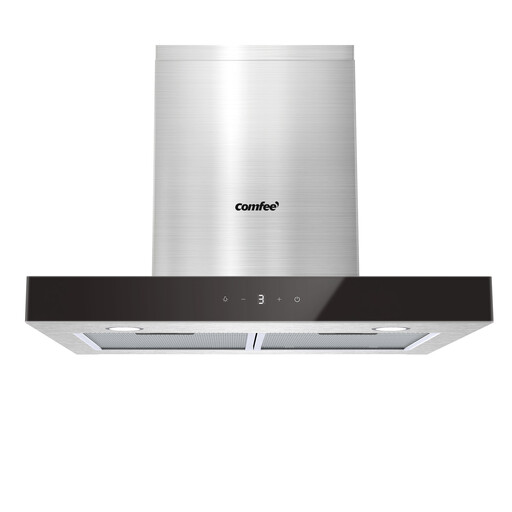 Image unavailable
Comfee TSHM77SS-60 T-shaped cooker hood, 60 cm
This cooker hood is listed as suitable for both recirculation and extraction. It has a five-layer aluminium grease filter, described as reusable and dishwasher-safe.
The stated extraction rate is 650 m³/h. To assess how it performs without a duct, check the figure and noise level in recirculation mode at the speed you’re likely to use. Also check which odour filter is compatible, whether it’s included and the installation clearances.
View on Joybuy
Frequently asked questions
How can I tell whether a built-in hood will fit in my cabinet?
Compare the cabinet’s internal dimensions with the installation diagram for the exact model. Also check the cut-outs, minimum distance from the hob, space needed to remove the filters and the set-up required for recirculation.
When should I replace a charcoal filter?
Follow the guidance for the filter compatible with your cooker hood: the replacement interval depends on the filter reference and how you use it. As examples for these specific products, Electrolux recommends replacing its OdourClean Standard filter every 4 to 6 months and its long-life OdourClean Plus filter every 2 to 3 years, while Bosch recommends replacing some standard filters every 6 to 12 months.
Does a high extraction rate guarantee good odour reduction?
No. In recirculation mode, the odour filter and the cooker hood as a whole also matter. UFC-Que Choisir measures airflow, grease absorption and odour reduction separately, so check the results for the model you’re considering in this mode.
Does a recirculating cooker hood replace your home’s ventilation?
No. It filters cooking air and returns it to the kitchen without creating an external air outlet. Keep your home’s ventilation separate from your cooker hood.


