People renovating without a usable duct
If you don’t have an external outlet or want to avoid altering a wall, first check that the cooker hood can operate in recirculation mode and find out which accessories are required for its model number.


If you don’t have a usable external duct and can’t confirm that one can be installed, choose a cooker hood specifically designed for recirculation, with a kit and filter compatible with its model number. Filtered air is returned to the kitchen, so check the dimensions, the route for the air to flow back into the room and access to the filters before ordering. Extracting air outside is only an option if the duct and any necessary permissions are possible for your home.
If you don’t have an external outlet or want to avoid altering a wall, first check that the cooker hood can operate in recirculation mode and find out which accessories are required for its model number.
If you’re fitting the appliance into a wall unit or alcove, the installation dimensions and the space needed to access the filters matter just as much as the hood’s visible size.
If recirculation is your installation option, check which compatible odour filter you’ll need and what maintenance it requires before choosing a model.
For a renovation without an external vent, first confirm that the hood can operate in recirculation mode. Then check that it suits your kitchen layout and the maintenance you’ll be able to keep up with.
| Criterion | What to check | Who it’s for |
|---|---|---|
| Recirculation without a duct | Recirculation mode is permitted in the manual; compatible kit and filter model numbers. | Without an external outlet, I need to be able to install a cooker hood that returns filtered air to the kitchen. Around 33 % of consumers would make this feasibility their top priority. |
| Fit | Dimensions of the hood and unit; clearances and access to filters as specified in the manual. | In a compact kitchen, I want the hood to fit the space without making maintenance difficult. Fit would come first for around 27 % of consumers. |
| Odours and noise | Suitable odour filter; stated noise levels for comparable models. | If I cook often, lingering odours and the noise from the hood affect my day-to-day choice. Around 20 % of consumers would prioritise this comfort. |
| Filter maintenance | Model number, number of filters required and replacement or regeneration instructions. | I want to be able to find the right filter and maintain it over time. This would be a priority for around 20 % of consumers. |
The appliance’s design doesn’t guarantee it can be converted. Bosch says its kits aren’t universal, while Elica states that not all of its cooker hoods can be converted.
Note down the exact model number of the hood, then check the manual for the model numbers of the required kit and odour filter.
You may need to buy a compatible kit and filter as well as the hood.
Drilling through a wall can affect the façade or communal areas. Article 25 of the 1965 law, published by Légifrance, governs permission for work that affects communal areas or the exterior appearance of a building in a shared-ownership property.
Before planning any work, check the status of the wall, the leasehold or freehold regulations and, if you’re renting, get written permission from your landlord. Also contact your local council to check which rules apply to your project.
Maintenance instructions vary by model. Electrolux recommends replacing its ECFB01ST filter every 4 to 6 months, while Elica recommends replacing its regenerable CFC0166361 filter every two years. These recommendations don’t apply to all their filters.
Find out which filter your chosen hood uses and follow its specific replacement or regeneration instructions.
Replacing or regenerating the filter adds a regular maintenance task.
In recirculation mode, filtered air is returned to the kitchen rather than vented outside. The odour filter and the route taken by the returning air are therefore part of your decision.
Compare the stated figures for similar models and check each manual for the required filter and installation conditions.
Bosch offers cooker hoods and recirculation accessories, including kits designed for specific configurations.
Elica offers wall-mounted and built-in cooker hoods, as well as filters designed for recirculation mode.
Electrolux offers OdourClean carbon filters in various models for recirculation installations.
Siemens offers recirculation kits and filters, including products in its CleanAir and Long Life ranges.
These wall-mounted models are worth considering if you’re looking for a cooker hood that can operate in recirculation mode in a kitchen without an external outlet. Check their width, installation requirements and filter needs against your kitchen setup.
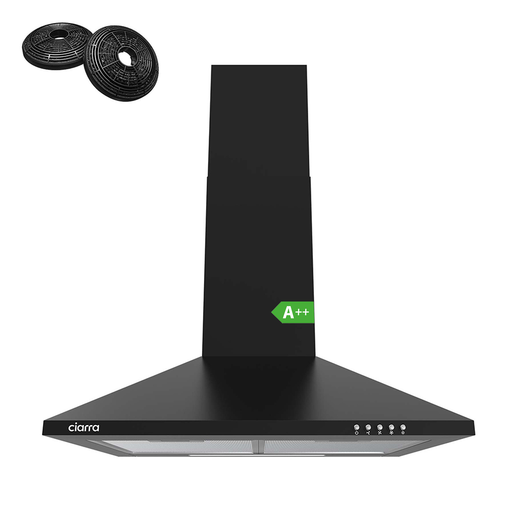 Image unavailable
If you’re planning a wall-mounted installation without a duct, check the recirculation setup specified for this hood. It has a stated width of 60 cm and button controls. Check whether the CBCF002X2 filter is included, then compare the installation dimensions and clearances with your kitchen.
Image unavailable
Worth considering for a wall-mounted installation with recirculation mode. The product title lists an extraction rate of 580 m³/h, three speeds and touch controls. Check the installation dimensions and filter maintenance instructions for the CBCF055 filter compatible with this hood.
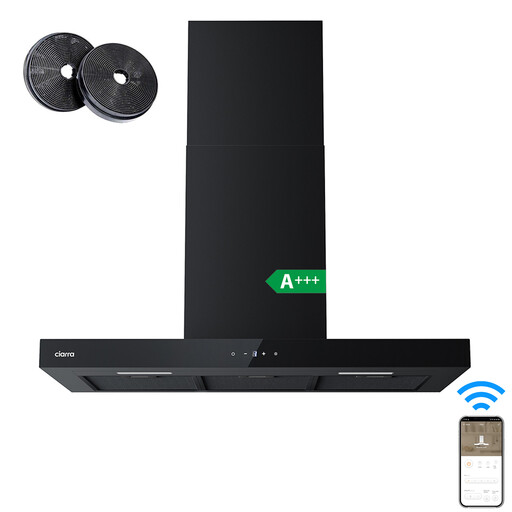 Image unavailable
Consider this model if your wall space can accommodate a 90 cm cooker hood. The product title lists an extraction rate of 650 m³/h, four speeds with a booster function and app-controlled touch controls. Check that its width suits your available space and find out how to maintain the CBCF003 filter.
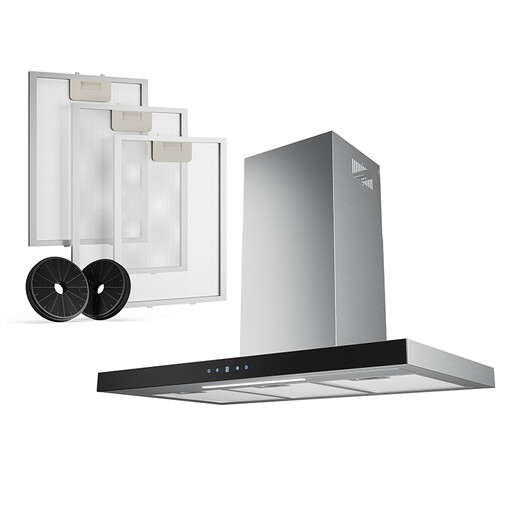 Image unavailable
For a 90 cm wall-mounted installation without an external outlet, this model is listed as suitable for recirculation and includes a carbon filter. Its product title lists an extraction rate of 564 m³/h. Check the detailed dimensions, then note down the filter model number for future maintenance.
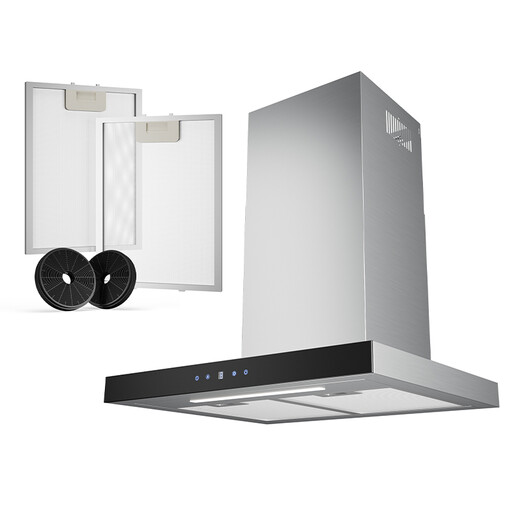 Image unavailable
For a 60 cm wall-mounted installation without an external outlet, this model is listed as suitable for recirculation and includes a carbon filter. Its product title lists an extraction rate of 611 m³/h. Check the installation clearances and the filter model number to use when replacing it.
Yes, provided the model you choose is designed for this type of operation and has the required accessories. The air passes through an odour filter before being returned to the kitchen. Elica says that not all of its cooker hoods can be converted, so check the manual for your model.
Before drilling or making any alterations to a rented property, get written permission from your landlord. ANIL highlights this requirement for alterations to rented premises and equipment. Also check any other restrictions that apply to the wall and the proposed outlet.
If the work affects communal areas or the exterior appearance of the building, authorisation from the general meeting is governed by Article 25 of the 1965 law, published by Légifrance. Check the proposed work and the shared-ownership regulations before choosing an extraction hood.
Contact your local council before starting work to find out which planning requirements apply to your project. The Town Planning Code, published by Légifrance, distinguishes in particular between work that changes the exterior appearance of an existing building. The requirements depend on the work you’re planning.
Follow the instructions for the filter model compatible with your cooker hood: how often and how to maintain it varies by filter. Electrolux recommends replacing its ECFB01ST every 4 to 6 months and its OdourClean Plus MCFE11PL every two to three years. Elica recommends replacing its regenerable CFC0166361 filter every two years.