
Livraison le jour même ou le lendemain

Qualité garantie

Débloquez vos offres de bienvenue: Livraison GRATUITE | Jusqu'à -80 % | 30 jours d'essai gratuits à JoyPlus
Téléchargez l'application
A rechargeable portable fan can be extremely practical on public transport, at work, when travelling or at an outdoor event. However, not all models are created equal and, more importantly, they are not suited to the same uses. An ultra-compact device may lack battery life, while a fan with a large battery can quickly become awkward to hold.
To avoid a disappointing purchase, it is worth looking beyond the number of speed settings and claims of “power”. Here are the key points to check, the pitfalls to avoid and a selection designed for different needs.
Maximum battery life is generally measured using the lowest fan setting. As soon as the speed increases, power consumption rises significantly. A model marketed as a long-lasting battery fan may therefore run for much less time during intensive use.
Always check the battery-life range and the testing conditions stated on the product page. A 5 000 mAh battery, for example, offers more capacity than a 1 800 or 2 000 mAh model. However, it may also make the device heavier and increase charging time.
A motor with a high revolutions-per-minute rating does not, by itself, guarantee greater comfort. Noise levels, the shape of the air outlet and the ability to direct the airflow also matter. In a shared office or on a train, a quiet fan with several settings will often be more pleasant than a very powerful but noisy model.
A pocket fan should genuinely fit into a bag or pocket without the risk of being switched on accidentally. On a bladed model, the grille must provide adequate protection, particularly if the fan is used around children or near hair. A bladeless fan, such as some neck fan models, reduces direct contact with the blades but does not remove the usual precautions associated with a lithium-ion battery.
For occasional use, a 1 800 to 2 500 mAh battery may be enough. For a day of travelling, a concert or a hike, a capacity of 4 250 to 5 000 mAh offers a more comfortable reserve.
A USB-C fan is particularly convenient, as its cable can often also be used with a smartphone or power bank. However, take the time to check the charging time and whether the device can be used while plugged in. This feature is not standard and should be explicitly mentioned in the product description.
A rechargeable handheld fan weighing 130 to 180 g is easy to carry. A heavier model may contain a larger battery, but could become tiring to hold for several hours. For a handbag, cabin luggage or a jacket pocket, prioritise the dimensions when the device is folded.
Foldable designs can also work as a portable desk fan, provided that their base is stable and the airflow angle can be adjusted.
Three fan settings are usually enough for straightforward use in a car or when placed on a table. Five speeds or more allow you to adjust the airflow, from a quiet environment to a very hot outdoor area. When the product page states a wind speed, treat it as a technical specification rather than a guarantee of identical comfort for everyone.
In a car, distinguish between a USB car fan, powered via a USB port or power bank, and a model designed for a 12 V or 24 V socket. The power source determines whether it is compatible with your vehicle.
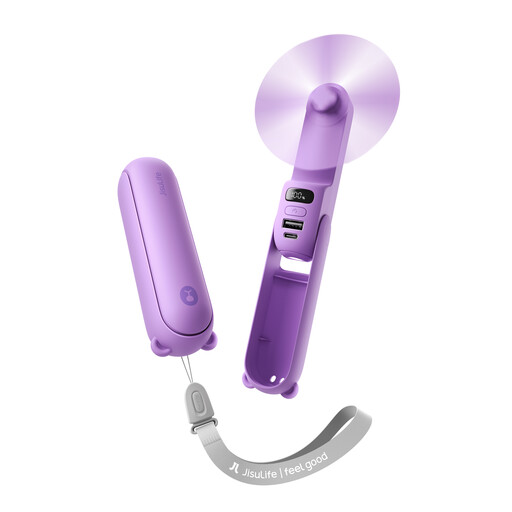
Why this choice suits this profile : Its foldable design and advertised weight of around 130 g make it easy to take with you every day, on trips or for a short outing. According to the product page, it can also be used as a lamp and a backup power bank.
The display shows the fan setting and remaining battery, helping to avoid unpleasant surprises. The description also mentions automatic shut-off if an obstacle is detected.
2 500 mAh battery, advertised charging time of 1 to 2 hours, three speeds and foldable design.
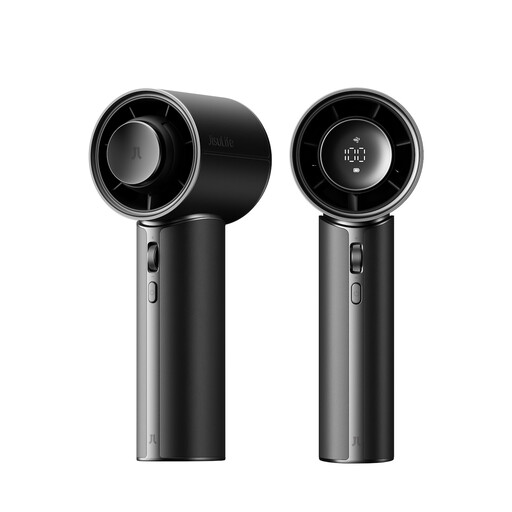
Why this choice suits this profile : This model focuses on its PU faux-leather finish, digital display and 1 to 100-level adjustment, according to its description. It is aimed at those who want a compact device with exceptionally precise control.
The highly precise adjustment lets you reduce the airflow in quiet environments. The safety lock also helps prevent the fan from switching on accidentally in a bag.
4 250 mAh battery, advertised battery life of 3 to 30 hours depending on the setting, case and retractable lanyard included.
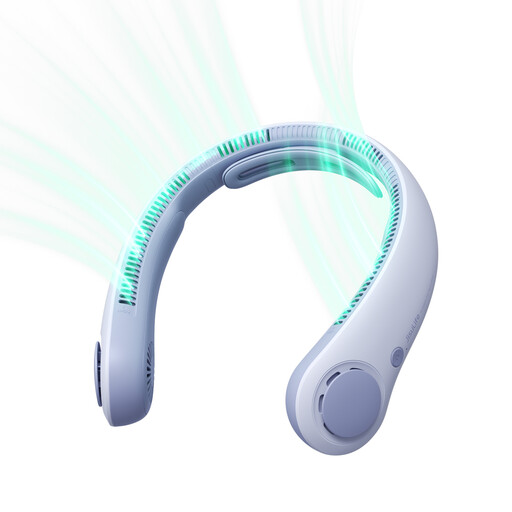
Why this choice suits this profile : The neckband design keeps your hands free while out for a walk, cycling or attending an outdoor event. The product page lists five speeds, a 5 000 mAh battery and a weight of around 282 g.
The absence of visible blades reduces the risk of hair getting caught. However, pay close attention to the battery-life information, which ranges from 2.5 to 16.5 hours depending on the setting.
Hands-free design, advertised USB-C charging time of 3 to 4 hours and five fan settings.
We have put together a complete, real-time selection of products that meet these demanding criteria and European safety standards.
Charging time depends on the battery capacity and the charger used. Compact 2 500 mAh models often have a charging time of around 1 to 2 hours, while a 5 000 mAh device generally takes 3 to 5 hours. Check the specifications for your chosen model and never charge a damaged or deformed battery.
Its power consumption is generally low compared with a device designed to cool an entire room. However, it varies according to the motor power and the fan setting selected. To extend the time between charges, use the setting you need rather than running the fan continuously at maximum speed. A display showing the battery level can also make everyday use easier to manage.
A foldable mini portable fan slips easily into a bag or cabin luggage. A pocket fan is suitable for short journeys, while a neck fan keeps your hands free during a walk or concert. For a car, check whether USB, 12 V or 24 V is compatible with both the fan and the vehicle.