
当日/次日达

品质保障

开启新人专享福利: 全场免邮 | 低至 2 折 | 免费试用 30 天 JoyPlus 会员
下载 Joybuy
A rechargeable portable fan can make all the difference on the underground, in a queue, at a concert or in the office during a heatwave. However, you need to choose a model suited to the way you plan to use it. A battery advertised as offering “ long-lasting” power, an ultra-powerful motor or a tiny design can also hide a few compromises.
Before buying a mini portable fan, check the following in particular:
Here are the main criteria to consider when looking for a pocket fan that is genuinely suited to your daily routine.
A technical specification may promise up to 22 or 30 hours of use. In most cases, this figure applies to the lowest power setting, measured under very specific conditions. As soon as you increase the airflow, the battery naturally runs down more quickly.
When comparing two devices, look at the battery-life range, the battery capacity in mAh and the time required to recharge it. A 5 000 mAh battery will generally provide more reserve power than a 1 800 mAh model, but it will also make the device heavier and may increase charging time.
A powerful fan can be very useful at a concert or outdoors. However, its highest setting is likely to be noisier and drain the battery more quickly. Conversely, a model limited to two or three speeds may lack the fine control needed in a quiet environment.
Multiple settings allow you to adapt the airflow to the situation: a gentle breeze in the office, medium airflow on public transport and higher power during outdoor activities.
A handheld fan should remain comfortable to hold after several minutes. If it is too heavy, it will eventually strain your wrist; without a wrist strap, it can become awkward to carry in a queue or while out for a walk.
For travelling, also check whether it has a lock, a case or a stand. Foldable models and those fitted with a strap are easier to slip into a bag. A bladeless neck fan, meanwhile, allows you to keep your hands free.
Prioritise devices whose specifications clearly state:
USB-C charging is particularly convenient if you already use this cable for your phone, tablet or power bank. However, it does not necessarily mean that charging will be fast: only the charging time stated by the manufacturer can confirm this.
For intensive use, a 4 250 to 5 000 mAh battery can be a good compromise, provided you are happy with a weight of between 180 and 282 g, depending on the model. Devices weighing between 130 and 180 g will be easier to slip into a pocket.
Three levels may be enough for occasional use. Five settings offer more gradual adjustment, while a control ranging from 1 to 100 lets you fine-tune the airflow very precisely. This last option is useful when moving from a discreet breeze to stronger ventilation without sudden changes.
An LED screen or digital display generally shows the selected speed and battery level. This is useful for avoiding the unpleasant surprise of finding the device flat just as you are about to leave.
The term quiet fan should be treated with caution when no noise level in decibels is provided. Perceived noise depends on the speed, distance and surroundings. In the office, library or on the train, look above all for a first setting designed to produce a gentle breeze.
The grille should prevent access to the blades as far as possible. Bladeless models reduce the risk of hair getting caught and may be easier to clean, but you must still follow the manufacturer’s instructions. A lithium-ion battery must never be dismantled or exposed to intense heat.
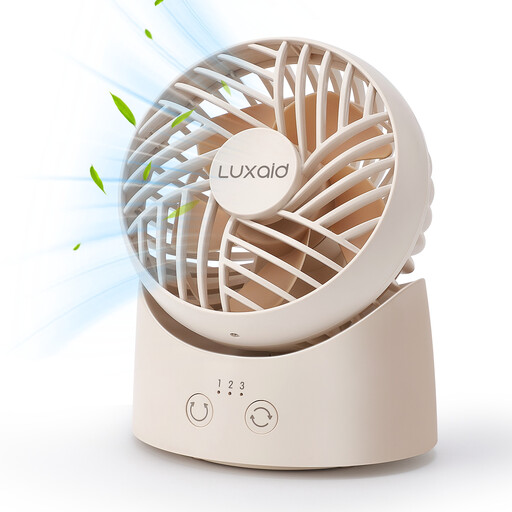
Why this model suits this profile : Its desktop design is ideal for first-time use at home or at work. It offers three speeds and advertised Type-C charging.
The specifications state an actual capacity of 1 800 mAh, despite different information appearing on the packaging. This makes the stated figures easier to compare.
Advertised battery life of up to 8 hours, three speeds and 60° oscillation.
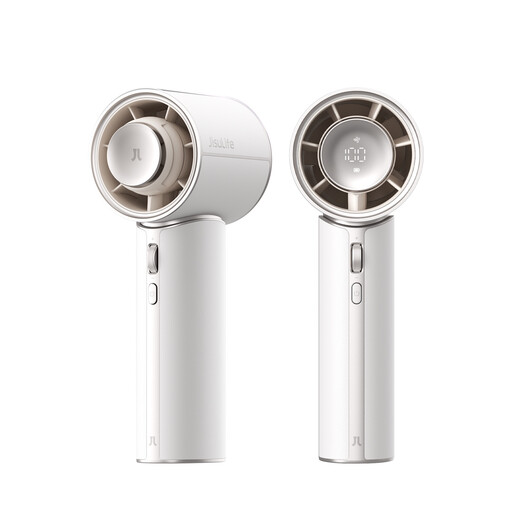
Why this model suits this profile : Its faux-leather finish, digital display and 100 adjustment levels are designed for users who care about the details and want complete control over the power.
Battery life is given as a range of 3 to 30 hours, depending on the speed, rather than as a single particularly flattering figure.
4 250 mAh battery, speed display, case, retractable wrist strap and fragrance capsule with five refills.
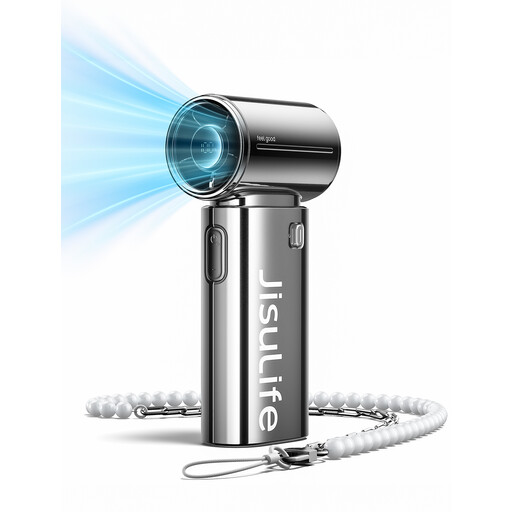
Why this model suits this profile : This pocket fan is designed for long journeys, concerts and outings where concentrated airflow and a good energy reserve are essential.
The specifications distinguish between five speeds and state a battery life of 3 to 22 hours. A useful reminder: maximum power puts greater demands on the battery.
5 000 mAh battery, LED display, motor rated at up to 27 000 rpm, airflow of up to 10 m/s and a weight of 180 g.
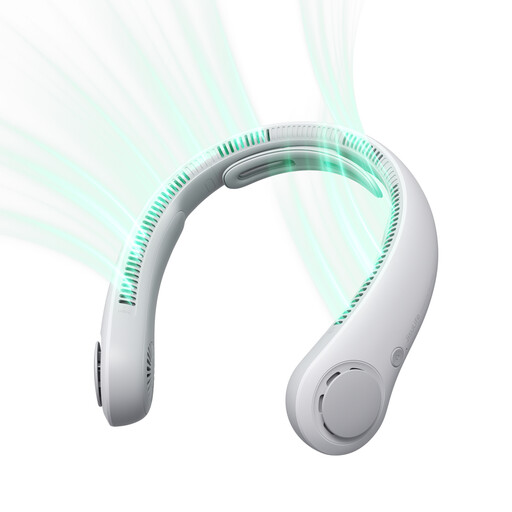
Why this model suits this profile : This neck fan is ideal for cyclists, walkers, festival-goers and professionals who want to keep their hands free.
Advertised battery life ranges from 2.5 to 16.5 hours, and the weight is stated as approximately 282 g. This is valuable information when assessing comfort before ordering.
Bladeless design, five speeds, 5 000 mAh battery and USB-C charging advertised at 3 to 4 hours.
We have put together a complete, real-time updated selection of products that meet these demanding criteria as well as European safety requirements.
To maintain the performance of your rechargeable handheld fan:
It depends on the battery capacity and charging circuit. The models featured state approximately 1 to 2 hours for a 2 500 mAh battery, 2 to 3 hours for 4 250 mAh and 3 to 4 hours for 5 000 mAh. Always check the instructions and use a suitable charger.
You need to distinguish between minimum and maximum battery life. A device may last only a few hours at full power but run for much longer on its lowest setting. For a day out and about, compare the battery capacity, number of speeds and whether it can be recharged via USB-C during a break.
Not necessarily. The absence of visible blades mainly concerns the design of the device and its safety in use. The motor and airflow can still generate noise. In the office or on public transport, look for a stated noise-level measurement and choose the gentlest settings.