
当日/次日达

品质保障

开启新人专享福利: 全场免邮 | 低至 2 折 | 免费试用 30 天 JoyPlus 会员
下载 Joybuy
A rechargeable portable desk fan can move from your office to your bedroom, then slip into a bag for a picnic or camping trip. Yet product listings often focus on the number of speed settings or the battery’s stated capacity, without explaining the features that really make a difference in everyday use.
Before placing your order, check the actual runtime, charging method and overall stability. These criteria will help you avoid ending up, after just a few weeks, with a fan that is inconvenient to use or underpowered as soon as temperatures rise.
A battery advertised at 2,000 mAh guarantees neither a precise operating time nor a consistent airflow. Runtime varies depending on the selected speed, oscillation and any integrated lighting.
Take the time to compare the information shown on the packaging with the details in the product listing. The Luxaid Mini Desk Fan, for example, lists an actual capacity of 1,800 mAh, while the packaging states 2,000 mAh. It is an important difference to bear in mind before confirming your order.
A USB Type-C fan can be recharged using a compatible adapter, power bank or certain computer ports. However, the presence of a USB-C port does not mean that a mains charger is included.
For portable use, check compatibility with the equipment you already own, as well as the stated charging time. At home or in the office, a sufficiently long cable may also prove more convenient than a battery offering extended runtime.
A wide oscillation range distributes air across a larger area, but it also requires more clearance around the fan. For someone seated in front of a screen, a compact fixed fan may sometimes be the better choice.
Conversely, 60° or 160° oscillation can be particularly useful in a bedroom, a small room or a shared space. Also consider the fan’s height, the stability of its base and the available tilt angle.
For occasional office use, a 1,800 to 2,000 mAh battery may provide several hours of operation, depending on the selected airflow level. If you need the fan to last all day or plan to use it away from a power outlet, a higher capacity offers more flexibility—usually at the cost of greater weight and bulk.
Do not focus solely on the number of speed settings. Three levels may be perfectly adequate for basic use, while ten settings allow you to fine-tune the airflow more precisely. As for claims of continuous operation, they should be treated with caution if the corresponding speed is not specified.
The term quiet fan is primarily a comfort claim rather than a universal measurement. Noise levels depend on the selected speed, your distance from the fan and the surface on which it is placed.
In a bedroom, look for a model with a gentle setting, a timer or automatic shut-off. At a desk, a stable base and precise airflow direction may be more useful than maximum power.
A device equipped with a lithium battery must be used in accordance with its instructions. Do not disassemble it, expose it to fire or operate it in a damp environment. Even when a bladeless design reduces the risk of hair getting caught, children should not operate this type of device unsupervised.
Before buying, review the safety instructions, manufacturer details, applicable markings and warranty terms. For maintenance, use a dry or slightly damp cloth, and never immerse the fan in water.
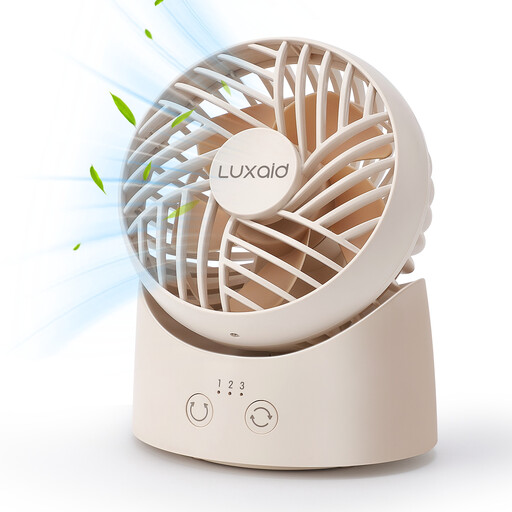
Why it suits this profile: its compact design fits easily on a desk, bedside table or small work surface. It can also be carried effortlessly in a bag.
The listing states the actual 1,800 mAh capacity instead of simply repeating the 2,000 mAh figure printed on the packaging.
Three speeds, 60° oscillation, USB-C charging and up to 8 hours of stated runtime, depending on the conditions of use.
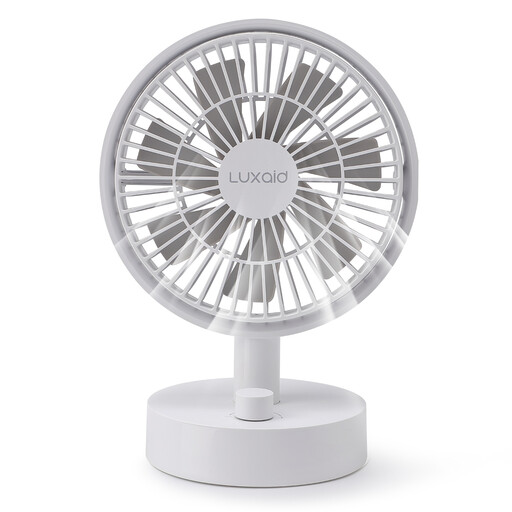
Why it suits this profile: anyone who likes to fine-tune airflow at their desk or in the bedroom will appreciate the range of available settings.
The listing specifies USB-C charging and 160° oscillation—two useful details for checking installation requirements and coverage.
Ten speeds, a 2,000 mAh battery, 160° oscillation and stated low-noise operation.
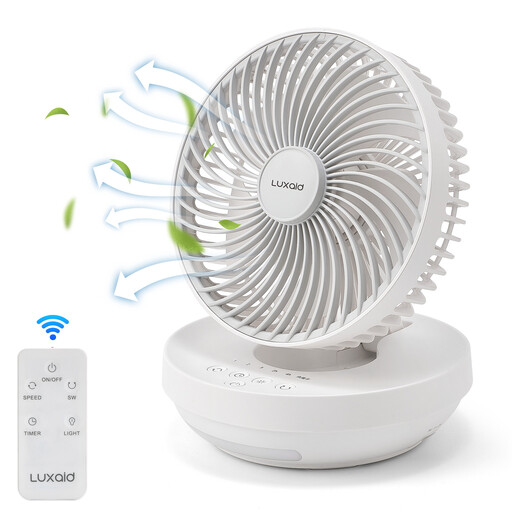
Why it suits this profile: its foldable design and multiple control options work equally well in a bedroom, living room, office or temporary accommodation.
The listing specifies an actual battery capacity of 4,000 mAh, despite the 2,000 mAh figure printed on the packaging.
Remote control, 4-hour timer, night light, USB-C charging, three speeds and the option to mount it on a wall.
A folding camping table can accompany a cordless portable fan on a picnic or during an outdoor break. The Woltu Portable Camping Table weighs 2.5 kg, folds into a carry bag and measures 63 × 43 × 56 cm when assembled. Its metal frame, Oxford-fabric tabletop, two cup holders and stated maximum load of 30 kg cover the essentials for practical use.
Its non-slip feet are designed for a range of surfaces, from grass and sand to gravel. However, respect the maximum load and keep the table away from flames, water and sharp objects. Find all the details on the Woltu portable picnic table.
It depends on the battery capacity, cable, adapter and charging circuitry. Consult the instructions for your chosen model and use a compatible adapter. A power bank can be useful when travelling, provided you follow the manufacturer’s recommendations.
Consumption depends mainly on the fan’s power rating and how often it is recharged. A small battery-powered model generally uses little electricity per cycle, but the exact cost varies according to your energy provider’s rate. To estimate it, multiply the energy used during a recharge by the price per kilowatt-hour specified in your contract.
Yes, provided you place it on a stable surface and use it in a dry environment. Do not leave it in the rain or expose it to condensation, do not block its openings and recharge the battery in accordance with the instructions. When camping, a stable folding table can also keep the fan at the right height while freeing up floor space.